Back to selection
FULL FRAME FILM FESTIVAL |
By Ryan Koo
Now in its 13th year, the documentary-only Full Frame Film Festival (April 8-11) takes place in my hometown of Durham, North Carolina. The city of Durham is historically a tobacco town, moving slowly but steadily towards an uncertain future: while its tobacco warehouses are being converted to swank lofts, downtown office space is readily available with a seemingly high vacancy rate. The festival is very much a cultural cornerstone for the city, and as a result Full Frame means a lot to Durham.
As of late, however, Durham also means a lot to Full Frame: while in previous years the festival’s most visible sponsors were non-locals like the New York Times, HBO, and A&E (from which the festival still enjoys some support), the main sponsors today are local institutions like Duke University and the City of Durham itself. As a result, the festival has slimmed down from its 2005 incarnation, when Martin Scorcese came to town and the festival packed twenty more films into venues spread around downtown. Despite less sponsors, less films, and less screening venues, however, 2010 ticket sales were reportedly just as brisk, and most of the films I attended played to packed houses.
Having all 100 of the festival’s selections within walking distance makes it a more intimate affair, one where you’re likely to spot festival linchpins D.A. Pennebaker and Chris Hegedus eating lunch, watching movies, and standing in line with the rest of the patrons. The main screening venue, the Carolina Theater — the last of Durham’s original theaters, built in 1926 — also fronts a sizable courtyard perfect for milling about, provided the weather is nice (which it was this year), and as such Durham’s festival feels much more centralized and relaxed than many. And of course there is the much-vaunted southern setting and hospitality, which make Full Frame an important festival not just because it’s documentary-only, but also because it takes place in a city that, not unlike independent film, is figuring out its future on the fly.
Documentaries have what PBS’s Yance Ford referred to on a funding panel as a “demographic problem,” which is to say that documentaries typically play to an older, whiter audience than other genres of film. The question for a southern-situated doc fest, then, is whether it plays to this same limited audience, or whether it can find a way to reach out into the local populace (Durham is made up equally of blacks and whites) to become less of an exclusive event for out-of-towners. Sundance this is not; I heard mentioned at one point that 50% of the Full Frame audience comes from within the Carolinas. Perhaps with demographic issues in mind, this year the festival introduced for the first time free public screenings; however, pass holders had very little incentive to attend a free screening when as many as six other films were playing at the same time. Suffice to say I didn’t catch any of the free shows, which is probably true of most out-of-towners (I now live in New York); the free screenings will hopefully be a larger part of the festival going forward. Also of note is the sizable Fellows program, which ensures there are an extra hundred young people running around, which helps integrate regional college students and does much to lower the average age of the attendees. Full Frame is now an unmitigated success from an organizational and programming standpoint, but with its leaner foundation and unique positioning it has an opportunity to do for theatrically-screened documentaries what many insular festivals cannot.

Speaking about the festival’s 1998 founding, Pennebaker recounted getting involved on the condition Full Frame show exclusively documentaries — a demand he described as being thought of as “absurd” and “a bad idea” at the time. Thirteen years later, he pauses and asks rhetorically, “How many documentaries were submitted this year? Twelve hundred? It’s not a bad idea.” Fittingly, then, the opening night selection was Pennebaker and Hegedus’s latest doc Kings of Pastry, which follows Chicago-based chef Jacquy Pfeiffer and his team to the Meilleurs Ouvriers de France, a sort of dessert Olympics. Pennebaker and Hegedus could easily turn the doc into a fawning example of food porn, but instead they employ a MiniDV aesthetic flattering to neither person nor pastry; the result is fitting, given the Direct Cinema tradition of observing drama instead of manufacturing it. Because of its lack of flashy cuts, voiceovers, and advertising breaks, Kings of Pastry manages to refresh the same subject matter seen on so many reality TV food shows. The doc also manages to address universal themes of craft, wherein the culinary creations are a stand-in for any artistic endeavor; you feel it in your gut when a cook makes a misstep and their ornate construction shatters to pieces on the kitchen floor. I care very little about luxurious foodstuffs, but there is one such moment in Kings of Pastry that’s nothing short of heartbreaking, and that is the mark of a good documentary: it made me care deeply for a subject about which I wouldn’t otherwise think twice.
While last year’s festival featured a thematic program focused on sports, Full Frame 2010 brought the reality of the current economic crisis to the fore with a thematic program focused on “Films on Work & Labor.” Despite the dreary thematic subject, however, only one doc I saw actually felt like a labor to watch — The Player, a fascinating look inside the minds of Dutch gamblers and swindlers, except for the “fascinating” part. And while the official thematic program may have been focused on labor, a host of documentaries in competition (totaling 57 films, with 29 world or U.S. premieres) dealt poignantly with the age-old question of mortality.
The obvious headliner to this theme was And Everything is Going Fine, Steven Soderbergh’s eulogy for the late monologist Spalding Gray (Soderbergh’s third film featuring Gray). In an era of Hollywood biopics, Soderbergh has made a different kind of career retrospective: the film offers no interviews with friends, no anecdotes from surviving family members, and no posthumous praise from fans: it’s Gray’s autobiography, told entirely in his own words. AEIGF manages to balances the funny with the morose, offering a fitting coda to Gray’s life — one that also happens to be a great introduction for Gray neophytes. At the conclusion of the well-received screening, editor Susan Littenberg observed of the Carolina audience, “New York audiences are much more reserved; they don’t laugh as much.”
Another film that managed to elicit widespread laughter while dealing with the same topic of mortality was The Invention of Dr. Nakamats, a profile of octogenarian Japanese inventor Yoshiro Nakamatsu. The doctor’s quirky self-aggrandizement is treated humorously by both filmmaker and subject, resulting in a comedic profile that also manages to avoid being Orientalizing. Dr. Nakamats believes he will live to the age of 144 using self-developed techniques, one of which includes photographing and cataloging every meal he eats (a feat he’s managed for 34 years), and through him the film brings a refreshing levity to the topic of our inevitable demise.
The second part of a double feature with Dr. NakaMats, Swedish doc Life Extended posits, “we don’t have an understanding of how to cope with death — only how to put it out of our minds.” The film includes interviews with several leading scientists and theorists, among them singularity theorist Ray Kurzweil, but it also focuses on how we pace our lives, interviewing a practitioner of a calorie-restriction diet one moment and a world-class sprinter the next. Perhaps out of my own interest in self-preservation, I found the film fascinating, even if some of the metaphorical visuals — sustained slow-motion shots of motion and decay — seemed to wear on fellow audience members.
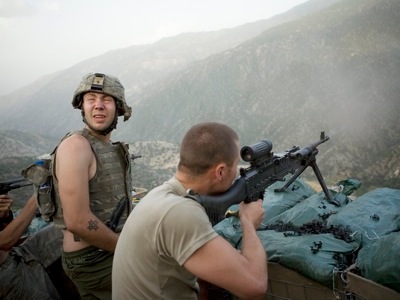
While Life Extended portrays death as Father Time, Sebastian Junger and Tim Hetherington‘s Sundance-winning Restrepo characterizes the other side of the equation: death as a visitor who might call at any time, at the behest of a very real enemy. Restrepo follows U.S. soldiers deployed in Afghanistan’s Korengal valley, and reveals unflinchingly that the characters and vernacular of the conflict in the Middle East aren’t any different from what you might witness in a local paintball fight — except in this battle, the combatants are in way over their heads, with a lack of clear goals and deadly consequences on both sides. When one of the squad members is harrowingly killed in action, the U.S. Captain vows that the squad will “find the motherfuckers that did this and make them pay.” Translate that to Pashto and you can bet the exact same speech is being made on the other side.
Crossing the border to Iran, The Poot is a narration and dialogue-free look at the elaborate process of handcrafting a Persian rug. With a Zen-like focus on craft, the film rarely allows glimpses of faces, instead staying locked on the labor itself. In an era of fast-cut reality TV and beta-launched web sites, The Poot focuses on timeless craft and permanence, and as such should really be seen in a theater or, at the very least, as far as possible from the intrusion of instant messages.
The Poot won the jury award for Best Short, and in my mind the doc was one of the more understandable selections of the festival. I saw several of the winners after the awards had been announced, and perhaps my expectations were raised because of this, but I nevertheless found some of my main detractions were in fact aimed at the award winners.
John-Keith Wasson’s Surviving Hitler: A Love Story (Inspiration Award) is the story of Jutta, a 5’10” blonde-haired, blue-eyed picture of Hitler’s ideal Aryan female. The only problem is, Jutta is half-Jewish, and her boyfriend is not; as such the film chronicles a couple torn asunder by Hitler’s WWII. Jutta’s account is almost too good: on one hand because she’s 90 and makes for a more lively and coherent interview than many people 20 years her junior, but on the other because it sometimes sounds like she’s reading from a script at Wasson’s behest. Regardless, the film offers a revealing and often touching first-person account of some of the events surrounding Operation Valkyrie (sans Tom Cruise this time), and is ultimately uplifting despite my nitpicks.
Katrine Philip’s Book of Miri (President’s Award) follows Korean-born, Sweden-residing librarian Miri, who takes pictures of herself in all manner of outfits in order to post them to her blog and interact with commenters. Book of Miri operates under the assumption that the viewer will find something interesting about Miri’s issues; I didn’t.
Peter Bull’s Dirty Business: “Clean Coal” and the Battle for Our Energy Future (Honorable Mention) is at its most effective when highlighting the disastrous effects of coal-mining techniques such as mountaintop removal, and the film makes it abundantly clear that no matter what emissions come out of the smoke stacks, there is no such thing as “clean coal.” But the film suffers from a periodic loss of the main narrative thread, which I felt diminished its otherwise strong message.
One honor I didn’t have any issues with was the selection of Summer Pasture (Honorable Mention), a gorgeous doc filmed in the Szechuan province of China (or Tibet, depending on who you ask). Summer Pasture follows a Tibetan couple as they raise an infant daughter under harsh nomadic living conditions. The film effectively explores the conflict of rural self-subsistent living versus urban wage labor, and it captures the dramatic valleys of the Kham region in gorgeous widescreen frames, giving the film the flavor of a Tibetan Western.
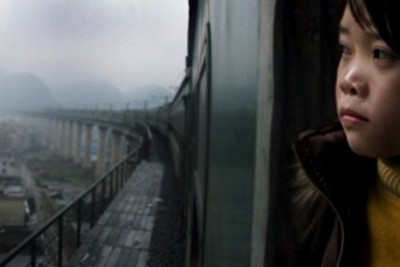
Exploring similar urban-versus-rural themes in China was Lixin Fan’s Last Train Home, which documents one Chinese family’s struggle with working far from home. One of the most valuable aspects of the film is the simple fact that it gives a human face to sweatshop laborers: while it’s one thing to know facts and statistics, to see two generations of a family sewing their lives away is heartbreaking. Unfortunately Fan seems to have too much material to work with, as the doc suffers from a sort of shapelessness, and some family scenes seem almost staged, with frequent tripod shots of expository dialogue. However, this style makes the film an unexpected antidote to MTV’s recent staged-doc style (The Hills, The City), making Last Train Home into a sort of The Real Sweat Shop.
Many of these films screened in the Carolina Theater’s main venue, Fletcher Hall, which at a thousand seats is one of Full Frame’s greatest assets. The screen gives documentaries a grand center stage they rarely receive elsewhere, complete with balcony seating and gorgeous HD projection. For Robert Patton-Spruill’s film Do it Again — about Boston Globe reporter Geoff Edgers’ attempt to reunite The Kinks — Full Frame not only sold out the theater, they also concluded the show by retracting the screen for Kinks cover band The Kinksmen to play a rousing if slapdash set.
In Do it Again, Edgers is not only attempting to reunite the Kinks, he also tries to convince every musician he interviews along the way (up to and including Sting) to perform a Kinks song with him. Patton-Spruill wisely pays Edgers’ own motivations close attention, as Edgers can be seen as a rock version of Humbert Humbert: Edgers’ motivations are Lolita-esque, in the sense that a pursuit interrupted during one’s formative years can leave a permanent trail of longing. For Edgers, his moment of coitus interruptus (rockus interruptus?) occurred as his high school band was about to perform on graduation day: a fire alarm was pulled and his climactic concert cancelled. By trying to unite The Kinks, Edgers is also trying to reclaim his childhood dream of being a rock star, and one perhaps-inevitable message of the film is: you can’t go back, and you can’t “Do it Again.”
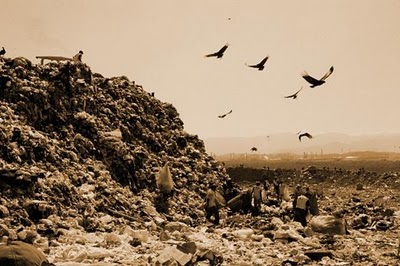
The Full Frame Audience award went to Lucy Walker’s Waste Land (pictured above), which follows Brazilian-born, Brooklyn-residing artist Vik Muniz as he returns to his motherland to call attention to Rio’s recycling problems. Rio lacks a recycling plant or any sort of collection strategy, instead employing the Soylent Green recycling plan: it’s people. People, that is, who clamber over mountains of garbage at a massive landfill, picking out cans and bottles by hand and selling them in bulk to collectors, who in turn haul it off and presumably actually recycle the stuff. The film employs a stunning mix of 35mm film and hi-def video, and Muniz is a compelling central character, but I found the film to be at its best when it leaves him in the background and follows the compelling lives of the garbage pickers. Audiences don’t seem to share my protestations — the film has collected audience awards at Sundance and Berlin as well — but I found the doc to be confused about what it wants to be: a profile of Brazilian artist Vik Muniz, or a film focused on the garbage pickers of Rio and the larger issue of recycling? To me, the garbage is the art, which is not to say the art is garbage (though Vik does, in fact, make his portraits out of garbage).
In Waste Land, Muniz notes early on, “the realm of the fine arts is a very exclusive and very restrictive place to be.” This sentiment was shared by the late architect Louis Sullivan, profiled in the doc Louis Sullivan: The Struggle for American Architecture. An overlooked Chicagoan credited as inventing the skyscraper and mentoring Frank Lloyd Wright, Sullivan’s promising early career stalled when his desire to create a specifically American style of architecture proved to be unpopular compared to the classicism and European revivalist designs of his peers. First-time director Mark Richard Smith employs dollies and cranes to impressive effect, giving the structures the visual respect they deserve, but the film’s fawning voiceover, combined with a sumptuous but overwrought score, makes the piece as a whole too adulatory to fully engage with.
Sullivan attempted the impossible with his Grand Opera House, setting out to build “an opera house for the working man.” In a way, his challenge was the same as Full Frame’s: in the words of one of the film’s interviewees, Sullivan’s desire was to create a venue that’s “not just a place for people with money to enjoy high culture.” Looking over the sun-drenched courtyard of a former tobacco town — now filled with a filmgoing Carolinian audience — one gets the sense that in a world of red-carpeted film festivals, Full Frame is fighting the same fight.
—
Ryan Koo was selected as one of Filmmaker’s 25 New Faces for his Webby Award-winning series The West Side. He blogs everyday at nofilmschool.com and can be found on Twitter at @ryanbkoo.