 
|

|

|


|
 |
 |
The Cannes Film Festival
The Festival International du Film at Cannes is easily the largest and most important film festival in the world. It maintains its position by serving two masters: on the artistic side, the Festival has positioned itself as the pinnacle of film culture, the party to which all filmmakers seek an invitation; and on the business side, it is recognized as the world's most important film market, playing host to a huge range of commercial concerns.
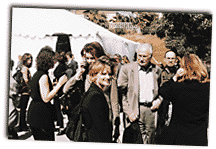 One of the legendary 19th century Riviera resort towns, Cannes transformed itself into the "city of festivals" after World War II. Activity centers on
the grandiose seaside fortress know as the "Palais des Festivals." It contains one massive theater, the Lumiere, one very large theater, the Debussy, and maybe two dozen small screening/meeting rooms. Stretching out to the East is the Croisette, the seaside promenade that takes visitors past some of the world's most glamorous hotels, notorious from films and literature - the Majestic, the Carlton, the Martinez - and their insanely overpriced beach
restaurants, the sites of Cannes' most exclusive and opulent parties. Megastars stay farther out at the Cap d'Antibes; mere civilians reside a few blocks
inland, off the Rue d'Antibes, the town's main drag.
One of the legendary 19th century Riviera resort towns, Cannes transformed itself into the "city of festivals" after World War II. Activity centers on
the grandiose seaside fortress know as the "Palais des Festivals." It contains one massive theater, the Lumiere, one very large theater, the Debussy, and maybe two dozen small screening/meeting rooms. Stretching out to the East is the Croisette, the seaside promenade that takes visitors past some of the world's most glamorous hotels, notorious from films and literature - the Majestic, the Carlton, the Martinez - and their insanely overpriced beach
restaurants, the sites of Cannes' most exclusive and opulent parties. Megastars stay farther out at the Cap d'Antibes; mere civilians reside a few blocks
inland, off the Rue d'Antibes, the town's main drag.
The commercial side of the Festival is administered by the "Marche International du Film," a registration service for buyers and sellers that rents out stands within the Palais and co-ordinates Market screenings in the small cinemas in the Palais and on the Rue d'Antibes. However, the business side of things has far outgrown the Marche bureaucracy: big companies take lavish offices in the beach hotels, wealthy national film agencies rent huge white tents around the Palais to promote their countries' films, production pitches issue from every terrace bar and cafe, and the ring of mobile phones is often deafening.
In years past, the screening portion of the Market has yielded some important discoveries. Some of these films are Cannes rejects, some are just finished, but most are genre-based and are screening for the legions of attending video buyers. 1996 saw far fewer Market "finds," a testament not only to the good job done by Festival programmers but also to the changing nature of international film promotion; with other festivals and well-endowed, aggressive U.S. boutique distributors combing the world, major new foreign-language talent rarely gets "discovered" in the Market any more. The hottest Market ticket this year, it turns out, was Italian horror master Dario Argento's The Stendahl Syndrome. A happy return to surreal form by one of Europe's great visual iconoclasts, it concerns a woman cop literally entering the paintings of the Uffizzi gallery while tracking down a brutal rapist.
World media tends to ignore this rapacious commercial activity - until journalists want party invitations, of course - concentrating instead on the Festival's official and unofficial sections, an unholy mess of competing agendas and egos that always, and this year in particular, manages to yield a sizeable crop of important new art films.
There are essentially four sections for new films. The first two, Competition and Un Certain Regard, are considered "Official Selections," and they come under the Palais-based Festival administration led by Gilles Jacob. The prestigious Quinzaine des Realisateurs (Directors' Fortnight), run by Pierre-Henri Deleau out of beautiful screening facilities in the Noga Hilton, sandwiched between the Grand and the Carlton Hotels on the Croisette, is extremely competitive with the "Official Section" and most emphatically not recognized by Jacob and his crew; no official Festival publication is permitted to utter its name. Finally, the small but plucky Semaine de la Critique (Critics' Week), run by Jean Roy, is half-recognized, appearing in Festival publications, but the participating films may not call themselves "Official Selections."
A Competition screening is the most glamorous premiere a film can receive. Throngs of tuxedos and ball gowns climb a steep, re-carpeted staircase to the dauntingly large premiere cinema. Exquisite projection on a massive screen, followed by the requisite massive party, seal the fate of the world's most promising candidates for art film beatification. Thumbs up normally ensures a global release and a place in the history books; thumbs down can often mean rank humiliation. Considering the pressures involved, very few first films are invited into the Competition; the section normally reads like a who's who of world art cinema and this year was no exception: Leconte, Leigh, von Trier, Frears, Altman, Bertolucci, Kaurismaki, Hou Hsiao-hsien, Chen Kaige. But such a list almost always means a certain amount of disappointment. And while this was certainly the case with a few titles - Altman's leaden jazz-age saga, Kansas City, and Chen Kaige's Temptress Moon, an unhappy marriage of hipster Hong Kong fluid camerawork and classical Chinese storytelling, were two - the level of the Competition was unusually high, exhibiting at least two, perhaps three, masterpieces.
Although he had to settle for the Grand Jury Prize, Lars von Trier's Breaking the Waves is the most astonishing art film to emerge from Europe in some time. Shot by legendary cinematographer Robby Mueller, the technically innovative film employs wide screen video technique to create an entirely new visual color palette. But this is no mere technical tour de force. Von Trier has used these extraordinary images and colors to frame a most affecting story of modern morality - an unorthodox young woman resists her Calvinist neighbors to care for her physically and mentally ill husband - which asks very big ethical questions about correct actions in unusual circumstances. It features breathtaking performances from its lead actors, especially Emily Watson as the young woman.
In a normal year, von Trier would have taken home the Palme and Watson the Best Actress prize. But, unfortunately for them, Mike Leigh also chose to make a career-defining film this year. Eschewing the political anger of his earlier Naked, Leigh's new film, Secrets and Lies, mines territory similar to von Trier's: the repercussions of very difficult moral choices. A beaten-down white working-class woman learns that a little girl she put up for adoption some years ago was, in fact, black; her brother, a successful commercial photographer, wants to put right his deeply troubled marriage. These and various subplots come together at a small, impossibly intense family gathering.
A plea for honesty and courage in everyday life, Secrets and Lies has the subtle flavor of a new post-Thatcher moral order. A thrillingly good storyteller, Leigh is ably assisted by his usually exquisite ensemble of actors: Brenda Blethy, as the sister, was awarded the jury's Best Actress nod.
The most controversial film of the Competition, greeted by an equal chorus of boos and bravos, was David Cronenberg's Crash, which follows a group of car-crash victims who are erotically charged by their body-disfiguring experiences. Featuring deadpan performances from an all-star cast and minimalist production design, the film is a bleak catalogue of wreckage and uninterrupted sex. The film was awarded an unheard-of prize for "audacity, daring and originality" by clearly uncomfortable jury chairman Francis Ford Coppola, who also referred to the film as "offensive" in his presentation speech.
Other Competition prizewinners included a joint Best Actor prize for Daniel Auteuil and Pascal Duquenne in The Eighth Day, the new film from Jaco Van Dormael (Toto le Heros), a sickly sweet bonding tale between a Downs Syndrome-afflicted young man and a maritally troubled French guy. Best Director went to Joel Coen for Fargo and Best Screenplay, perversely, to the narratively messy but fascinating tale of a self-invented Resistance hero (played by Mathieu Kassovitz of La Haine fame), Un Heros Tres Discrete. Playing out of Competition, the justified winner of the Technical prize was Microcosmos, a series of wordless stories featuring bugs shot with a new microcamera which gives tone and texture to even the smallest images; the restrained musical score and intuitive narrative sensibility made it one of the festival's most exciting discoveries.
Also Out of Competition was Danny Boyle's U.K. youth sensation, Trainspotting, a gleeful look at Edinburgh junkies living life to their fullest. For Boyle and producer Andrew MacDonald, this marks their second trip to Cannes. Cult hit Shallow Grave played in the Market two years ago. Says MacDonald, "It was a very different experience. Then, no one really wanted us to come; we took the bus." Why was this film, destined for a massive summer release through Miramax, not in Official Competition? "I think they were scared we would win," says MacDonald. "They don't like films like this - with lots of drugs and sex and kids - to win. But the placement of the film has done what we wanted in terms of massive worldwide publicity."
Un Certain Regard - for the films that Jacob selected but for some reason did not place in the Competition - is by definition a mixed bag. And, from Peter Greenaway's disappointing exercise in writing on flesh, The Pillow Book, to Lucile Hadzihalilovic's exquisite microbudget incest story, La Bouche de Jean-Pierre, 1996 was no exception. Notable films also included Sarunas Bartas' silent Siberian saga, Few of Us, destined as an oddity for most festivals, and Shirley Barrett's Love Seranade, winner of the Camera d'Or (best first film); the latter, a paper-thin (and familiar) tale of two kooky Aussie sisters falling for the same sleazy d.j., seemed an odd choice considering the strength of the first films in other Festival sections.
More careful choices were visible in the lineup of the Quinzaine. Hits included Brit gay teen love story Beautiful Thing, a big audience favorite; Judit Elek's emotionally rich documentary on Elie Wiesel; Michael Winterbot-tom's visually expansive and affecting Hardy adaptation, Jude; Takeshi Kitano's playful lost youth opus, Kids Return; and Peter Gothar's playful pastiche set in the new St. Petersburg, Vaska. Best of all, though, was Sergei Bod-rov's new film, The Prisoners of the Moun-tain. Set in the picturesque Georgian mountains, it features moving performances and very brisk pacing for Russian cinema. The story of two soldiers captured by Georgian rebels, their escape attempts and relationship with the people of the village will make American filmmakers question why no post-Vietnam war film has half the emotional resonance of Bodrov's beautiful film.
The Quinzaine has long been a happy home for American indies and this year included new films from John Sayles and Steve Buscemi. According to Olivier Jahan, one of the section's programmers, the section regularly takes three of four American films a year, mostly garnered from a New York screening trip one month after Sundance. But is there a "Quinzaine film?" "It's very personal, very subjective for us," says Jahan. "Sometimes I will love a film that Pierre-Henri [Deleau] will loathe, sometimes a filmmaker of style which we once supported will look tired to us, or a filmmaker whose work we don't like will suddenly make a terrific film. If pushed, I would say we seek films with emotion, work that is more interior, like Safe and Heavy which we showed, more character-driven [films], maybe more than visually [stylish films] but maybe not!"
The smallest and most intimate of the sections, the Semaine de la Critique (Critics Week) has yielded some big movies in recent years: both Ole Bornedal's Nightwatch (currently in remake production by Miramax) and Hal Salwen's Denise Calls Up were discovered there. Things were quieter this year, with Jean-Pierre Ameris' Les Aveux de L'Innocent, a tough tale of a country bumpkin confessing to a crime he never committed, the big standout. The U.S. was represented by Barry J. Hershey's The Empty Mirror and Greg Mottola's Daytrippers. Mottola was enthusiastic about the section: "They work hard for you but it's really laid back - much more causal than the other sections. They also screen the films many more times than the other sections so, especially making your first film, it's easier to lure people into the cinema."
In general, Cannes felt cinematically richer this year and, even amongst the flying deal memos, one had the sense that movies might serve a higher purpose. This inkling made Mike Leigh's Palme D'Or acceptance speech all the more genuine: "All of us went through hell making this film... This is incredibly encouraging for those of us making films about people, human relationships, those things that really matter in life."
-
The Cannes Film Festival by Noah Cowan
Los Angeles Independent Film Festival by Andrew O. Thompson
The New York Underground Film Festival by Pamela Grossman
Festival of New Latin American Cinema by Andrea Elliot
Palm Beach International Film Festival by Peter Steinberg
back to top
home page | subscribe | merchandise | history | order form | advertise | contact
archives | links | search
© 2005 Filmmaker Magazine