 
|

|

|


|
 |
 |
Cannes International Film Festival
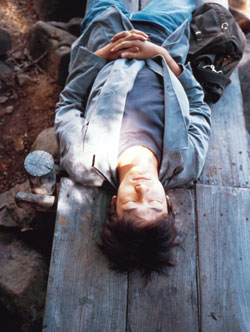 |
| Hirokazu Kore-Eda's Distance. |
Nowhere was this truer than in Competition, the festival’s main section, which has always elevated the auteur above all else. This year saw Cannes rehabilitating a couple of them, quite successfully, and also trying to create some new ones, which proved a total failure.
The old masters really came out in force. My favorite was the new film from Shohei Imamura, Warm Water under a Red Bridge, which harks back to his great masterpieces of the 1960s, such as Pigs and Battleships and The Pornographers. In Warm Water, the hero, an unemployed man, seeks a lost treasure in a provincial town only to discover a woman with, um, explosive sexual powers. Both political and perverse, Imamura, now well into his 70s, has lost none of his ability to provoke us. Only slightly younger, Jean-Luc Godard returned to Cannes with a somewhat accessible, dare we say romantic, new film, éloge de l’Amour. Featuring three couples of different ages, the film demonstrates a unique take on the four "key moments" of love.
Jacques Rivette has been in a less radical, more romantic frame of mind for a while now (Same Old Song, etc.), but audiences were charmed by Va savoir! ("Who Knows?"), his charming though overlong portrait of a theater actress living a Pirandello play. Although I remain unconvinced by his fixed cameras and in-your-face formalism, there was also much support for Manoel de Oliveira’s I’m Going Home, a portrait of the theater against a backdrop of personal loss featuring a knockout performance from Michel Piccoli.
Another master, mostly forgotten these days, turned in perhaps the most brilliant but also the most hated film of the festival. Ermanno Olmi won plenty of prizes around the world for earlier features such as The Tree of Wooden Clogs and Legend of the Holy Drinker. His newest film, The Profession of Arms, is a stunningly filmed look at an obscure bit of Italian history – the papal defense against Charles V’s fierce German armies – featuring a charismatic cast of Bulgarian actors. The film seeks to define the moment in which modernity began and a new class of weapons transformed Renais-sance Italy from bickering states into a bloody battleground. Machiavelli’s The Prince, had an equally profound effect on the craft of statehood, and it is used as a reference throughout the film. Olmi shows us the birth of the modern state in all its treacherous, bloody, ennui-laden horror. How sad that the assembled critics at Cannes feared to look in the mirror.
The American masters – at least as Cannes has defined them – turned in top-quality stuff as well. David Lynch (has he missed a Cannes?) added a surreal hour to his Mulholland Drive pilot. The result feels like a reworking of Twin Peaks territory but with a deliciously wry Los Angeles spin. Its goofy ending divided audiences, but this is Lynch in territory he has ploughed successfully before; the film has the feel of a director elegantly in control of his bizarre material. One can never underestimate the strict internal logic that Lynch’s better films ultimately follow, and Mulholland Drive is certainly one of those.
The Coen brothers (another example of a place reserved at Cannes) brought their take on film noir to the Croisette. The Man Who Wasn’t There features gorgeous black-and-white cinematography and a growling, intense performance from Billy Bob Thornton. It’s all dames and double-crosses but again shows the brothers’ mastery at reviving tired genres and the overwhelming sense of fun they have with cinema. But do either of these films matter in the end? Not really.
Ultimately the most praised film by an old master was not even new. Francis Ford Coppola premiered Apocalypse Now Redux in grand style, its new scenes universally worshipped and its continuing power acknowledged. Presented Out of Competition, it dwarfed the day’s official selections. I am not sure if he counts as a master yet, but Nanni Moretti won the Palme d’Or for his affecting The Son’s Room about a family’s loss of a son in a freak accident. Several serious film critics found the film to be false and manipulative in a disgusting sort of way. I see their point but think it’s overstated. Moretti’s sense of humor, though at times blackboard-scratch grating, allows him to take some emotional risks normally disallowed in contemporary melodrama. So as long as you buy into his brand of light-heartedness, Moretti provides a strangely liberating road map for confronting unexpected and inexplicable loss. And that deserves a Palme.
Death was also the subject of Tsai Ming-Liang’s very funny, charming What Time Is It There? A young man’s father dies, and his mother is obsessed with the father’s reincarnation. She drives her son crazy with new rules in the house to encourage dad’s return. Meanwhile a woman tries to buy the young man’s watch as she leaves for Paris. Tsai has a wry, minimalist style that is not everyone’s bag, but this is his best, and perhaps most accessible, film since Vive l’Amour.
The Cannes crowd has been pushing several filmmakers for a few years now, and this year saw the intellectual nudity of many of their favorites, especially set against all this strong work from the old guys. (And guys they were – one throwaway French entry and half of the Shrek team made up the female contingent in Competition this year. Remember festival president Gilles Jacob prattling on about the Year of the Woman two years ago? How sad that at his famed press conference at the Paris Opera, he did not muse this year about the Year of the Old White Man. A truly wasted opportunity.)
At the top of my list of art shmucks is Michael Haneke. I think we were all a little bit fooled by the earnest but coldly intense 1989 antiviolence film The Seventh Continent. Since then he has been making work that is expressly intended to shock us out of our lethargy of bourgeois existence. At best, the results have been boring, like last year’s Code Inconnu; at worst, condescending, offensive and pandering, like Funny Games, his pastoral slasher film. The new film, The Piano Teacher, manages to top even that art gore shlock; we merely yawn while Isabelle Huppert slashes at her naughty bits with a razor blade. Ostensibly the story of an isolated woman’s sexual misadventures, the film won both the acting prizes and the Grand Jury Prize in one of the most idiotic jury awards in recent memory. Liv Ullmann was the Jury President, replacing late dropout Jodie Foster. So was this award a complex joke about The Silence of the Lambs, or does Liv want to see Sweden spiced up again? The prizes were noted and ridiculed by all thinking journalists.
The French are desperate to find the Young Turks to take over from their old, distinguished filmmakers. But it’s tough. Every year another promising filmmaker or two makes a shocking piece of garbage, which is then duly put into Competition. (Arnaud Desplechin’s Esther Khan from last year and Jacques Maillot’s Our Happy Lives from the year before spring to mind.) This year’s biggest French faux pas was La Répétition from Catherine Corsini. (They love her in France – this is her fourth movie at Cannes, and they will keep putting them in until somebody cares.) La Répétition is the story of a dental hygienist who stalks her old college friend, an experimental theater actress. Turk number two, Cédric Khan, has actually made one very good film, Trop de Bonheur, but seems now to have lost his way. His latest, Roberto Succo, is the straightforward tale of an Italian serial killer, told without humor or dramatic intensity. The French loved its realism. Fine – they can have it.
The French have also become quite enthusiastic about Asia lately, and in this they are right. The most interesting stuff being made is coming from across the Pacific. But they went way over the top this year, with nine Japanese films alone in various sections. The two in Competition (other than the Imamura) should not have been there, but for different reasons.
Shinji Aoyama had a relatively undistinguished career full of arty genre movies until last year’s quite astonishing nearly-four-hour exploration of human frailty, Eureka. But he returned to form this year with a boring hustler hitman tale full of astonishingly pretentious Europeanisms. The film is called Desert Moon. (Wasn’t that an Eagles song?)
I am a big fan of Hirokazu Kore-Eda’s Distance. But following his pitch-perfect global hit After Life, which seemed to single-handedly resurrect the metaphysical art film, expectations were running way too high to put this very small, fragile film under the heat of Competition. Its story of five people on a pilgrimage to the site of a cult’s mass suicide is so ambiguous and unresolved that it allows small yields only after much work. But I can think of no filmmaker with the courage to try such an austere approach with such an open wound of a subject, especially in Japan. Rumor had it that it was elevated to compete at the last minute – how foolish.
Another good filmmaker making a difficult transition film was Mohsen Makhmalbaf. His Kandahar, about a woman’s attempt to travel through the Taliban’s Afghanistan, contains some of the most gorgeous shots I have ever seen: a planeload of artificial limbs floating down on little parachutes; a mosque full of fervent boys cacophonously praying yet not understanding a word they are saying. But Makhmalbaf tries too hard to make the film relevant for Americans, with an unlikely African-American doctor turning up halfway through, and the constant note-to-self tape recordings of the Canadian-Afghani woman protagonist adding an off-sounding English language component to the film.
The festival’s two smaller sections, Un Certain Regard (run by the Competition folks) and Directors Fortnight (run by competitors), seesaw from year to year in the quality of films they present. Neither section had a banner year, but both contained excellent work. Chiefly of interest in Un Certain Regard were Kiyoshi Kurosawa’s Pulse (also known as Kairo) and Lisandro Alonso’s La Libertad from Argentina.
Kurosawa has been making impressive work, with films such as Cure, Charisma and Séance, for some time now. He loves playing and twisting with genre to unsettling and innovative ends. Pulse is probably his most ambitious work yet, despite being set firmly within the teenage horror genre. In fact, the first half hour could be lifted straight from I Know What You Did Last Summer but with a kind of Internet-nerd spin. As the film progresses, however, Kurosawa’s obvious uses of genre convention matched up with baffling ambiguities and gradually lead to a Tokyo emptied of all people following the invasion of the city by ghosts of the dead via the Internet. Wow.
La Libertad confirms – along with La Ciénaga, the impressive debut of Lucrecia Martel in Berlin – that there is something very interesting going on in Argentina right now. Their tired old directors (Fernando Solanas, Eliseo Subeila) have been put out to pasture; a new, very young crowd is making rigorously formal, uncompromising cinema, and this is the boldest yet. It is a practically silent witness to a man’s life during a day in the jungle, as he chops down trees, shits, eats and all the rest. And it’s riveting.
Disappointing entries in Un Certain Regard sadly included new films from Todd Solondz (Storytelling) and Hal Hartley (No Such Thing), both of which felt like echoes of interesting earlier work. Solondz’s movie juxtaposes two Happiness-like tales, perverse and narratively complex, set in high school and college. Hartley’s film is a heavy-handed fable about a monster disgusted with human evolution who falls in love with an innocent young girl sent to rescue a film crew.
Some people have nice things to say about Abel Ferrara’s postcard to David Dinkins’s New York, R-Xmas. In this reviewer’s opinion, though, its drug-dealer-trying-to-make-good story is merely passable, making it a significant improvement over his past few films but still not that interesting.
The Directors Fortnight also had its share of American turkeys. Ethan Hawke’s rambling and pointless Chelsea Walls is dated and naive. Its portrait of the legendary New York hotel’s denizens was meant to be one of the Festival highlights. Arliss Howard’s Big Bad Love, despite the welcome return of his wife, Debra Winger, to the screen, is very much like a cable television movie about a drunk Southern writer. These two films occupied the Friday and Saturday night slots, so I assume that section programmer Marie-Pierre Macia was perhaps playing to the crowd a bit. The other films were nowhere near as bad.
The Fortnight’s opening film, in fact, was one of the best. Martha… Martha is the abject, painful story of a young woman who does everything she can to undermine her relationships with her husband, her daughter and her sister; the film allows that her behavior comes from a murky parental history but does not let her off the hook because of this. It is a tough, fascinating film from one of France’s most interesting filmmakers, Sandrine Veysset (Will It Snow for Christmas?).
Equally tough is Wang Chao’s simple, direct The Orphan of Anyang. It features a beautifully stretched time structure that captures the crushing boredom of a Chinese industrial town, making the characters – a hooker who has to give up her child, an unemployed man who needs to take the child in, and the small-time gangster who wants to claim it as his heir – and their aspirations all the more poignant.
Two other, much lighter films from Asia were also a pleasure. Ryosuke Hashiguchi’s Hush! was probably the audience favorite from any section. It is a rollicking but quietly intelligent comedy about two gay guys – one a closeted scientist, one a pet-store clerk – facing the possibility of having a child with a psychologically unbalanced woman. Hsiao Ya-Chuan’s Mirror Image sees a pawn shop clerk fall in with a mysterious woman who proves to be the finest saleswoman who ever lived – but only on the Taipei subway.
The Critics Week – the smallest and most ignored of the official Cannes sections – always pops out one fabulous movie a year, surrounded by forgettable, pretentious crap. This year’s winner was Bertrand Bonello’s The Pornographer, an achingly beautiful commentary on fatherhood and filmmaking. Jean-Pierre Léaud is the painfully mannered lead, his performance absolutely matching the film’s tone. The film falls precipitously between campy satire and intense melodrama. One wonders whether this, a first film, was not that Young Turk French film missing from the Competition. – Noah Cowan
-
Cannes International Film Festival by Noah Cowan
IFP/West Los Angeles Film Festival by Rolf Gibbs
South by Southwest Conference and Film Festival by Josh Zeman
San Francisco Documentary Film Festival by Justin Lowe
San Francisco International Film Festival by Chuck Stephens
back to top
home page | subscribe | merchandise | history | order form | advertise | contact
summer 2001: columns | features | short reports
archives | links | search
© 2005 Filmmaker Magazine