 Leading up to the Oscars on Feb. 22, we will be highlighting the nominated films that have appeared in the magazine or on the Website in the last year. James Ponsoldt interviewed
 Happy-Go-Lucky
writer-director Mike Leigh for our Web Exclusives section of the Website. Happy-Go-Lucky
is nominated for Best Original Screenplay (Mike Leigh).Picking a favorite Mike Leigh film can be a frustrating and exhilarating challenge. They’re all so uniformly excellent, so hilarious (
Life Is Sweet), moving (
Secrets & Lies), angry (
Naked), honest (
Meantime) and compassionate (
Vera Drake) that the body of work begins to take on a holistic value -- each movie a nuanced iteration of one director’s worldview. Overseeing improv sessions with a group of consistently top-notch actors, Leigh develops the raw material of his screenplays during a period of months. What has resulted is a series of films —- dating back over thirty years -— that define collaborative cinema, highlighting the talents and fears and hopes of the actors who helped generate the film’s scripts. Leigh is always at the helm, but he has the confidence, generosity, and intelligence to allow his actors —- and the characters they play -— the freedom to truly reveal themselves on screen. Though Leigh has a unique and much admired working process which leaves the fingerprints of each actor all over the screen, his films are as unmistakable and personal as those of Ingmar Bergman, Woody Allen, and Francois Truffaut.
Having played smaller parts in Leigh’s
All or Nothing and
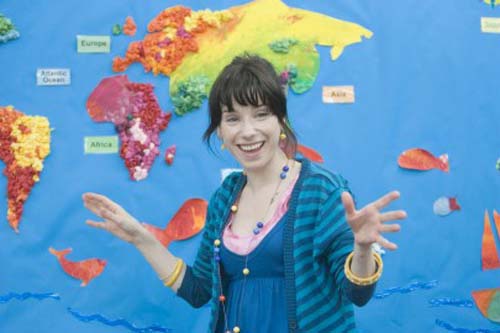
Vera Drake, actress Sally Hawkins now stars as the iconic, optimistic Poppy in
Happy-Go-Lucky. Since Hawkin’s performance won the Silver Bear for Best Actress at the 2008 Berlin Film Festival, Poppy has become something of a litmus test -- viewers seem to find her perpetual optimism inspiring, or they want to stuff a sock in her mouth. Most surprised by this response is Leigh himself, who, though often labeled a cynic, sees Poppy as well-balanced and perhaps even wise.
Happy-Go-Lucky is a disarming film, which evolves from a seemingly structureless character-study into a subtly taut story about friendship, teaching, patience, love, and joy. The film slowly accumulates gravity and dimension, and by the ending it becomes clear that Poppy’s unflinching hopefulness is an active choice and a product of internal strength, not naiveté. In this way, Poppy resembles another one of cinema’s great heroines: Cabiria.
Miramx Films opens
Happy-Go-Lucky this weekend.
Filmmaker: I wanted to ask you about Poppy from
Happy-Go-Lucky and Johnny from
Naked, how they might be seen as two sides of the same coin, as it were.
Leigh: Yes, I mean I think it’s an interesting discussion. But I think it’s dangerous to make too much of it because aside from everything else it’s not something I’ve thought consciously about at all until after I’ve made this film.
You could say that
Naked is the dark side, and more than any other of my films pretty much focuses on a single protagonist on a journey in a way. Although, it has to be said that dramatically and structurally,
Happy-Go-Lucky focuses exclusively on Poppy much more than
Naked does on Johnny because there’s quite a lot of parallel action in
Naked which doesn’t involve Johnny whereas there are only two tiny moments in
Happy-Go-Lucky where you see Zoe which are very minor. So you can talk about the differences but I think what’s interesting is what Poppy and Johnny have in common which is that they are both idealists. She is an optimistic idealist who is disposed to being positive and he is a frustrated idealist who is disappointed in the world. When we made the film someone described the film and Johnny as cynical, neither of which is true. He is lamenting. He laments the same things that Poppy would lament but he has actually become frustrated and embittered.
Filmmaker: Do you see there as being a certain rigidity to their optimism that sets them apart from the people in their lives?
Leigh: Certainly not. I think you certainly couldn’t say that about Poppy. Do you think you could say that about Poppy?
Filmmaker: No... but I think there’s a knee-jerk reaction people have when they first meet her.
Leigh: That’s a different matter. That may be true but that’s not what we’re talking about. That’s a whole different matter. Johnny, in a way, I don’t think rigidity is relevant to either of them, myself. I mean, when Johnny runs into Brad he’s up for a discussion. I really think too much can be made here. Some people have said that somehow Scott [from
Happy-Go-Lucky] is an extension of Johnny. I think Johnny understands all the things kicking around in his head while Scott understands none of them at all. He’s all over the place. And also, Johnny is nothing if not sexually active and confident. A person beginning by being potentially irritated by Poppy is fair enough. You know, you forgive them. It depends on your own disposition. You can forgive them for thinking “Can I spend two hours with this person?” But, you know, in time you have the opportunity to start to access what she’s about and you see that she’s focused and responsible and successful and intelligent and she’s got a great sense of humor. But when she meets Scott, instantly you see he’s a person with no sense of humor, and people with no sense of humor bring out the worst in us basically. That’s what that’s about.
Filmmaker: I said a “certain rigidity,” but perhaps what I meant was that there’s deep core of loneliness in her and she’s actively trying to keep her focus on staying positive.
Leigh: What is it that makes you think she has a core of loneliness?
Filmmaker: It’s a gut feeling... she constantly wants to do better. For the kids she teaches, for everyone.
Leigh: I think it’s certainly important that at a certain point she finds a guy. I think she doesn’t shy away from him. You’re the first person to identify a core of loneliness in her. Loneliness is not a word that’s come up. I think she’s certainly... she’s spiritually centered in some way. She’s able to enjoy her space and meditate in a sense. I don’t see any evidence myself for her being lonely. I think she enjoys people and company, being part of things. I think the other characters in the film absolutely are lonely, not she. But, having said that, I make films that are for you to interpret however you like. There are people, not you obviously, who have said that this is the most irritating character in a film ever and they cannot stand her and they want to kill her by the end. Now I find that so incomprehensible that I cannot begin to negotiate.
Filmmaker: When I say lonely I don’t mean to suggest, counter to what other people say, that she tries to act so happy that she’s obviously sad. I think any person who is grounded in some code of personal morality/ethics, who lives by that code and is something of a mega-ethicist, feels like they’re not ever doing enough. And there’s guilt and an isolation that comes with that guilt.
Leigh: Maybe you don’t mean lonely. Perhaps you mean spiritually centered.
Filmmaker: Perhaps. Just a hope, a desire that things could be slightly better in the world.
Leigh: Yes, but that’s a different thing. That is not being lonely. Poppy’s absolutely sensitive to the woes of the world and passionate about those things. But that has nothing to do with being lonely. It has to do with caring and being motivated by concern and sensitivity.
Filmmaker: What do you think it is that compels Poppy to not share with Zoe the fact that she met the homeless man and was engaging with him?
Leigh: Well, some things are private. Some things you just kind of... for me, my thing is that Zoe’s got the idea that she’s out there with everything and on display and she just has some coolness and that’s just that really. I think it’s important not to decode such things. It’s very important to avoid the tendency that we all have to decode such things in the sort of measured plot terms as laid down by Hollywood. It becomes “Why is she not telling? Why is it at that moment she doesn’t reveal what she’s been doing?” That’s all rubbish really because that’s not the kind of story it is. It’s not the type of thing where you think, “Now there’s a really significant reason for this which will become apparent later.” That is completely in the wrong language.
Filmmaker: There’s a quote from Nietzsche which I’m going to mangle slightly: “That for which we can find words is something already dead in our hearts. There is always a kind of contempt in the act of speaking.”
Leigh: Yeah! I think that’s possible.
Filmmaker: I’ve heard a lot of people talk about Poppy’s temperament. I haven’t heard that much about teaching and the different iterations of the role of teaching. And that’s actually for me what was most personally fascinating because it’s such a complex and integral part of society. I was wondering if you could just talk a little but about that.
Leigh: Well, obviously it looks at teaching, the film, and you’ve got a very good teacher in Poppy and obviously Heather, the headmistress, is also on the case. And Zoe in her own way is a good teacher and we assume that her boyfriend is a good teacher. And we’ve got a Flamenco teacher who is a very good teacher I reckon but unfortunately forgets one of the first rules of teaching, which is that you’ve got to leave your own baggage outside the classroom. And then you’ve got this guy who actually has a great deal to say about education and thinks he’s a really good teacher and is actually the worst kind of teacher there is and actually doesn’t know anything about it and is in fact infused with ignorance on the subject, as is Scott. I don’t make films that are in any way polemical, I mean, I reflect the nature of things and respond it. And hopefully you’ll come away with stuff to reflect on yourself, make of it what you will. And this is a reflection on education. It’s not a diatribe. There are no conclusions. An important scene in many contexts, including this one of education, is the scene in which she goes to see her pregnant sister. Values are right on the line. I think that’s important in the context of teaching.
Filmmaker: Do you think in some context filmmakers, or directors, could be seen as teachers?
Leigh: Oh yes, but you could say that about all art. Yes, of course. I don’t want to make that much of that, because that devalues the specific subjects of education in this particular film.
Filmmaker: Do you think the best teachers work in a Socratic method?
Leigh: In principal, yeah. In the last twenty years in the United Kingdom they’ve issued a national curriculum. I’m totally opposed to a national curriculum. I think it’s dreadful. But also, they’ve introduced all kinds of gradings and testings at various stages. All kind of stuff that imposes uniformity and standard criteria and content and teaching methods on all teachers. I think that’s completely opposed to what education should be about, which is people teaching their strengths and their passions.
Filmmaker: With a national curriculum, how do you think Poppy would go about that? Would she be crushed?
Leigh: Oh, she’d deal with it. She’d get on with it and deal with it. I thought about that for the film and whether I should deal with it and then I decided that’s not really relevant to what the film was about. No, no. These guys get on with it. That’s what you do because what’s important to you is the kids. People like the Poppies of this world, and there are millions of them everywhere. I mean the reason I call it an anti-miserablist film is because it is about the fact that, although we have a great deal to lament and be gloomy about in the 21st century people out there, all kinds of people, including people like you and me, are getting out there and doing stuff and being positive and optimistic. And teachers, not least! In the end, apart from anything else, the Poppies of this world just deal with it. It’s what they do.
Filmmaker: Poppy asks Scott whether he was bullied in school. We also see the troubled student in Poppy’s class who’s obviously dealing with quite a bit at home. Do you that think the damage that’s done to us in pre-adolescence is baggage that forms us for the rest of our lives?
Leigh: There is a connection there between the two, yes. Scott is somebody who you could tell from all the evidence that you pick up there that he’s had a bad relationship with his family, and it’s complicated with his mother, but you can bet your bottom dollar that at school he did not have the kind of treatment most kids get, and the caring. It was neglect. Yeah, obviously those characters resonate with each other.
Filmmaker: Will Scott find some peace in his life?
Leigh: What do you think?
Filmmaker: I hope so.
Leigh: No, that’s different.
Filmmaker: Well... no. I don’t know if he will, unfortunately.
Leigh: The guy is fucked up. Basically he’s doomed. Though it’s probably in the grander scheme of things not his fault, he is his own worst enemy. He’s isolated and it’s an exploration of a guy who’s so isolated. He creates his own reality. It happens to all fantasizers who’ve lost the capacity, or ability, or opportunity to really interact. As to the whole question of what happens afterwards, that is really where I hand it over to you. And if you say well you hope he’ll be alright, great, sure. But if you say you think he’ll be alright then I think you’re being deeply optimistic. But I don’t know what’s going to happen to anybody—including you and me.
Filmmaker: I read an article several years ago about scientists who were trying to determine whether we’re essentially hard-wired to be happy or sad much in the way with our genetic makeup whether we’re going to be obese or skinny, diabetic or not, straight or gay, etc. Do you, in your experiences, think that some people are fundamentally happy or sad?
Leigh: Well, I don’t know about hard-wired. We are, apart from our genetic makeup, affected by our environment and the way we relate to it. I mean, I know that my makeup -- which manifests itself in what’s in my films -- does come from some stuff in my relationship with my father and the way I was brought up. There’s a running theme through my films that manifests itself particularly when Poppy goes to see her sister. All my films in one way or another are about the kind of battle between freedom and anarchy and repressive conservative suburban material values. That runs through all of my films, well, obviously is a function of my own suburban experience.
Filmmaker: Scott says that he’s never given up on a student the moment when he’s about to give up on Poppy. But in the film, you really feel that it’s Poppy who refuses to give up on him and that when she does it seems heartbreaking.
Leigh: The other thing about it in the end is that she obviously knows what he’s going through. She sees what’s happening. The great thing I think for me was that we know by the time we get to the climax that Poppy knows how to deal with kids. And Scott is one big kid, so Poppy can deal with him.
Originally posted 10/10/08Labels: Web Exclusives
# posted by Jason Guerrasio @ 1/19/2009 03:43:00 PM
Comments (1)
I think the reason this movie works so well is because of the chemistry between Sally Hawkins and Eddie Marsan. I fully support the way that Mike Leigh makes his films. Maybe all films should be made like Mike Leigh's, if they are all going to result in such steller performances. Eddie Marsan is simply creepy and wonderful. His character could have only been conjured up by a brilliant actor such as Eddie.
#
posted by Leah-Vail @ 10/20/2008 7:41 PM






 See the VOD Calendar →