Pepi Ginsberg
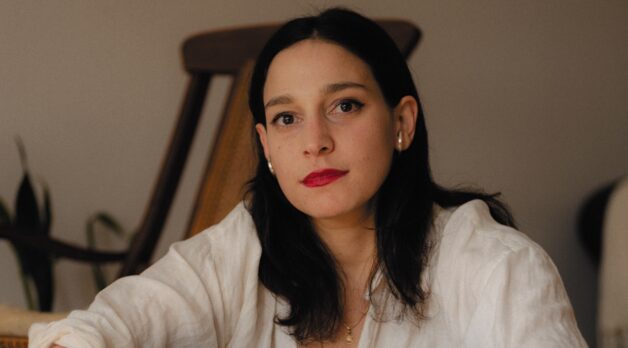 Pepi Ginsberg

Right next to the desk in Pepi Ginsberg’s Brooklyn home office, a six-foot stack of notebooks is piled high against one of the dark red walls. The larger ones are on the bottom, and the stack tapers to the smallest, perched precariously at the top. “I was a singer-songwriter for many years,” Ginbserg explains about the books, many of which she’d make while on tour buses. “I would keep notes about travel and lyrics along with drawings and other stuff in them. They’re special to me—they all have little designs on the covers, and they’re filled with photos and clippings. I have saved them all because they’re kind of the most meaningful thing to me from my past.”
That towering stack of creative material functions as something of a metaphor for Ginsberg’s career so far, which is characterized by constant forward motion and purposeful creative reinvention. After studying creative writing and visual studies at the University of Pennsylvania, she launched a music career, releasing solo albums under her name, Companion and N-A-R-C, scoring positive press in top music outlets. (KCRW dubbed one track as being like “a protean Kate Bush or a more idiosyncratic Grimes.”) But after a roommate died, Ginsberg began suffering stage fright and had a panic attack after a performance. She moved to New York’s Chinatown and started writing screenplays. “Something had change internally after my life was turned upside down, and a path in music no longer fit me,” she says. Night classes and “a succession of crappy industry jobs” followed until she enrolled in NYU’s Graduate Film Program, from which she graduated in 2022.
Stories with “hyper real emotions that are true, but where the circumstances feel elevated,” is how Ginsberg describes what attracts her. Her breakout short, 2022’s The Pass, is a perfect illustration. It’s about a young man taking a swim in a small beach town who’s confronted—while he’s in the water—by an ambiguously menacing stranger calling out to him from shore. As she previously told Filmmaker, “I’ve been bullied emotionally by people who hate themselves, I’ve let it hurt me, and I’ve also broken free of it…. This is where the heart of the story comes from.”
The Pass premiered in the 2022 Cannes Film Festival’s La Cinef program before becoming a Vimeo Staff Pick and New Yorker selection. It also attracted the interest of French production company Yukunkun Productions, which provided funding for Ginsberg’s newest short, the 2025 SXSW-premiering WassupKaylee. Inspired by influencer house videos Ginsberg watched during the pandemic, the short follows a 17-year-old influencer as she joins a TikTok content house and struggles to develop her own unique prank video voice. It’s simultaneously a tender coming-of-age story, tense near-tragedy and witty critique of viral video culture. Stylistically, it’s the opposite of The Pass’s quiet precision, embracing a more dynamic handheld camera, quicker cuts and lots of on-screen chat texts. “To be honest, that was not the original design of the film,” says Ginsberg about the aesthetic changeup. Citing Ruben Östlund’s Involuntary as an inspiration, she says the camera was “going to be locked off, and [the short would be] much more formal.” But a couple of things “contributed to the shooting style and design of the film that were out of my control, and ultimately, I think, benefited the film.” One was less time in the hero location, necessitating a reworking of the shotlist. But, also, with as many as six teenagers in the frame at once, Ginsberg realized she needed to follow rather than overly block their movements. “It also felt a little condescending,” says Ginsberg about her initial concept, “like viewing these characters from a distance, as if they were in a glass case. Suddenly, there’s judgment about them, and the whole point of my shorts is to give as much heart and humanity to my characters as possible. So, the formalism of [a more locked-off approach] didn’t feel right.”
After two acclaimed shorts, Ginsberg is moving on to features. Her current script is The Mirex, winner of the 2025 Melissa Mathison Award at the HamptonsFilm Screenwriting Lab, about a grief-stricken college student who finds further trauma in the world of a live-action role-playing game. The story was inspired by an encounter Ginsberg had with a young LARPer as well as a dream her two-year-old daughter relayed about living forever in a place called “The Mirex.” While Ginsberg seeks partners for the project as well as overall representation, she’s further developing the script, shooting music videos, like recent ones for John Cale, and also conceiving a microbudget picture she can just go out and make with longtime collaborators “in a DIY spirit, one that feels emotionally resonant but formally fresh.” —Scott Macaulay/Image: Molly Matalon