Authors — Nicholas Rombes
-
The Blue Velvet Project, #44

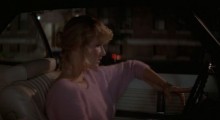
Second #2068, 34:28 “I hope you’re careful, Jeffrey,” Sandy whispers to herself, gazing up at Dorothy’s apartment, where Jeffrey has just not-heard her car horn warning because—and there is a strange, haunted reference to Psycho somewhere in this scene—he is in Dorothy’s bathroom and has just flushed the toilet. Laura Dern’s face is made-up in a way that hearkens back to her role in 1982’s Ladies and Gentlemen the Fabulous Stains, a film which teetered so delicately between the sweet danger of punk and the even sweeter danger of new wave pop that it practically imploded. Lines upon lines could […]
by Nicholas Rombes on Nov 18, 2011 -
The Blue Velvet Project, #43
Second #2021, 33:41 The tension in this sequence—as Jeffrey sneaks around alone in Dorothy’s apartment while half-listening for Sandy’s warning car horn—is sustained by carefully modulated shifts in what we as the audience know in comparison to what Jeffrey knows. While our knowledge of what is happening sometimes equals Jeffrey’s (those moments when we know nothing more or less than he does), at other times we are suddenly thrust ahead of his limited omniscience. In the previous scene, as Jeffrey explores the darkness of Dorothy’s apartment, we know what he knows, and nothing more. But once the film cuts to […]
by Nicholas Rombes on Nov 16, 2011 -
The Blue Velvet Project, #42

Second #1974, 32:54 What does it mean to speak of the cinematic image in the age of cinematic images? This frame, captured from the 2002 DVD edition of Blue Velvet, isn’t really even a frame; its relationship to the 35 mm source film is ambiguously fraught with the complications of digital coding. For one thing, if the film has been MPEG-2 compressed, what has been lost? The information in the frame leaks in and out, depending on our viewing medium of choice, so that we experience the digital image not so much through presence, but through absence. Spatial and temporal […]
by Nicholas Rombes on Nov 14, 2011 -
The Blue Velvet Project, #41
Second #1927, 32:07 Jeffrey and Sandy have agreed on four honks of the car horn: this will warn Jeffrey to leave Dorothy’s apartment. Sandy waits in the car outside, in the night, in her own cocoon of nervous electricity. This is when Blue Velvet begins to go very, very dark, as Jeffrey makes his way through the India Ink of the screen into ever deeper and deeper blackness in what are perhaps the most psychologically violent moments in the film. Where has Blue Velvet taken you? When he woke up he thought he’d dreamed about a movie he’d seen the […]
by Nicholas Rombes on Nov 11, 2011 -
The Blue Velvet Project, #40: A Plea For Less
Second #1880, 31:20 A PLEA FOR LESS [This version of the Blue Velvet Project is published on the occasion of Blue Velvet‘s release on Blu-ray with deleted scenes on November 8th.] There are probably many more good and sound reasons to make available Blue Velvet’s deleted scenes than not—I’ll concede that right from the beginning. For one thing, Lynch thankfully decided not to re-cut the film with the new scenes; this is not a “director’s cut.” Since Lynch was under contract to deliver a two-hour cut in 1986, it would make sense that the scenes (part of a longer, nearly […]
by Nicholas Rombes on Nov 9, 2011 -
The Blue Velvet Project, #39
Second #1833, 30:33 1. Jeffrey: Can you drive this car? Sandy: Yeah, but . . . Jeffrey: Leave it in front of my house for me, okay? 2. In Haruki Murakami’s novel IQ84, a group of characters discuss the implications of an act they have committed: You throw a stone into a deep pond. Splash. The sound is big, and it reverberates around the surrounding area. What comes out of the pond after that? All we can do is stare at the pond, holding our breath. 3. One month after Blue Velvet’s U.S. release, another David’s movie was released, David […]
by Nicholas Rombes on Nov 7, 2011 -
The Blue Velvet Project, #38
#1784, 29:46 In what is perhaps Haruki Murakami’s best, most neglected novel, South of the Border, West of the Sun, the narrator recalls the effects of listening to a recording of a Liszt piano concerto: And the music itself was wonderful. At first it struck me as exaggerated, artificial, even incomprehensible. Little by little, though, with repeated listenings, a vague image formed in my mind—an image that had meaning. When I closed my eyes and concentrated, the music came to me as a series of whirlpools. One whirlpool would form, and out of it another would take shape. . . […]
by Nicholas Rombes on Nov 4, 2011 -
The Blue Velvet Project, #37
Second #1739, 28:59 The lights on the stage, they illuminate Dorothy, whose talent in this frame to deny Jeffrey her gaze. She is Gilda transported from 1946 to 1986, the curtains behind her unanimated with the sort of predatory menace that the Production Code forbade Rita Hayworth from exploiting. Lynch must have recognized the power of restraint, of not showing, and so nearly the first one-third of Blue Velvet is as tame as an Andy Hardy movie. In this regard, the enduring power of Blue Velvet is that it meets a very specific need and desire: our desire for the […]
by Nicholas Rombes on Nov 2, 2011 -
The Blue Velvet Project, #36
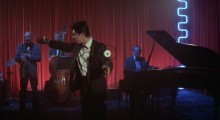
Second #1692, 28:12 “Ladies and gentlemen, the Blue Lady. Miss Dorothy Vallens.” And so Dorothy is introduced by the Master of Ceremonies, played by Jean-Pierre Viale, in what appears to be his only movie role. As one hand touches the vintage suspension-mount microphone, and one hand beckons Dorothy, the frame captures the tipping point of the film, as darkness is about to spill into Sandy’s and Jeffrey’s world as Dorothy takes the stage. Those curtains, otherworldly in the way they echo the blue velvet curtains from the film’s opening credits, signify a range of electrified meanings, none of them happy. […]
by Nicholas Rombes on Oct 31, 2011 -
The Blue Velvet Project, #35
Second #1645, 27:25 A slow dissolve, from Sandy’s house (she has just agreed to break her date with Mike and go to the Slow Club with Jeffrey) and the red neon sign of the Slow Club, in its elegant—but somehow slightly off-kilter–cursive. The dissolve, deriving from the pre-cinema technology of the magic lantern (there’s a nice example of a magic lantern dissolve about half-way down the webpage) to create transitions or to suggest time-lapsed effects, and isn’t there something magic in the very act of “dissolving” time? Two images: Sandy’s house, steady and unmoving, slowly overtaken by the Slow Club, […]
by Nicholas Rombes on Oct 28, 2011