Adesola Thomas
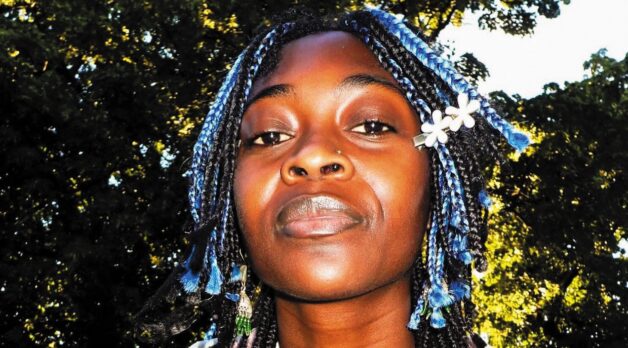 Adesola Thomas

Adesola Thomas was born in Los Angeles but raised outside Atlanta. “After my dad passed away, my mom thought, ‘Well, I can’t support three kids by myself [here],’” Thomas recalls, “so, she moved us from the second-biggest metropolitan city in the United States to rural Georgia.” Amid cow pastures, rolling fields and the Atlanta Motor Speedway, the Nigerian American self-proclaimed “latchkey child” spent her youth watching movies at home with older siblings. When she was 15, Thomas was introduced to punk DIY shows and rave collectives—an experience especially meaningful as it was the first time the queer Black femme had spent significant time in queer spaces.
Thomas told her family that she wanted to pursue filmmaking but was warned by aunts and uncles that “Nigerian immigrant people just don’t make movies.” They encouraged a more attainable career, potentially in the field of law, and Thomas chose, at the behest of her mother, to stay in-state for college, studying political science and English at Emory University in Atlanta. But her extracurricular activities remained film-centric: she served as arts editor for the college newspaper, interned and wrote reviews for the Atlanta-based Paste Magazine and brought the traveling, all-female film festival LUNAFEST to her campus. Her sister, film and television actress Adetinpo Thomas, often welcomed her younger sibling onto film sets and convinced Thomas that, rather than prioritize LSAT prep, she should figure out a way to study filmmaking. Selected for the Robert T. Jones, Jr. Scholarship, a year-long exchange program between Emory University and the University of St Andrews in Scotland, Thomas enrolled in the joint screenwriting and playwriting graduate program, experiencing culture shock when she “went from being such a Georgia girl, then going to the countryside of Scotland where there weren’t a lot of Black folks.”
While working part-time at the oldest movie theater in St Andrews, New Picture House, Thomas was inspired to write a satirical review of House of Gucci. (“The weekend it came out, every queer person in town went and saw it together.”) That piece caught the attention of Letterboxd’s then editor-in-chief Gemma Gracewood, who subsequently reached out about having Thomas serve as their East Coast producer covering the North American film festival circuit. Thomas interviewed filmmaking idols like Charles Burnett and Cauleen Smith for the platform’s journal and pushed for the company to cover more regional events, like the BlackStar Film Festival in Philadelphia.
An internship in A24’s development department helped Thomas realize that she wanted to learn more about film production in New York, but she eventually moved back to Atlanta and made her first short, the family drama Sister Salad Days. Influenced by Nollywood and magical realist literature, Sister Salad Days follows Deborah, a young Nigerian woman pressured into an arranged marriage by religious immigrant parents as a solution to the family’s financial struggles. Deborah confides in older sister Esther (played by Thomas’s own sister, Adetinpo), who’s revealed to be deceased, having died by suicide when faced with the same arranged marriage ultimatum as her young sister.
Sister Salad Days incorporates Southern gothic elements into a family dynamic that, while weighed down in guilt and loss, never loses sight of shared love and responsibility that comes from tight-knit co-dependency. “I love making films set in and about the American south,” Thomas says, “specifically, intergenerational domestic life across the Black diaspora and Southern subcultures, and [especially] as a practice of evidence-making for our posterity and proliferating images of community interdependence.” Her next short, Marigold Leaves Her Body, is currently in pre-production, with a screenplay based on her earlier experiences in the punk and rave scenes. Inspired in part by Steve McQueen’s Small Axe segment Lovers Rock and one of her favorite movies from 2000, Greg Harrison’s San Francisco–set underground rave film Groove, Thomas plans to shoot the short as a proof-of-concept for a feature version down the line. “I want to do it Shiva Baby style,” Thomas says. “[I’m] moving from the ‘Sister Salad Days world’ (which is very dialogic), to Marigold Leaves Her Body, which is still dialogue-centered but so much more atmospheric. I want to practice doing that in 15 minutes before I do it in 90.”—Erik Luers/Image: Xander Opiyo