Alexandre Singh and Natalie Musteata
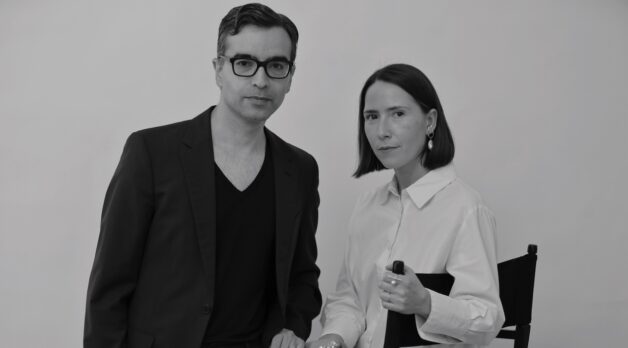 Alexandre Singh and Natalie Musteata

When producers at Paris’s Misia Films asked Alexandre Singh and Natalie Musteata if they had ideas for a short to be filmed at the French luxury department store Galeries Lafayette, Singh spontaneously blurted out an absurd premise: Instead of paying for goods with cash, the shopper would be the recipient of a slap in the face. To this day, the artist-turned-filmmaker is not sure where that idea for his and Musteata’s 36-minute short, Two People Exchanging Saliva, came from, but the positive response was instant. Running with that absurd concept, the filmmakers decided to add another layer. “As we were writing, there was the women’s movement in Iran,” says Musteata, “and obviously, the political landscape in general is not so great. So many civil liberties are being taken away from us on a daily basis, so I suggested this other rule, which is that people are not allowed to kiss.” The resulting dystopian love story is one of the most assured, elegantly made and deviously twisted shorts in recent memory, a story of forbidden love in which an surreptitious smooch in a fancy shopping place can lead to one’s body being stuffed in a cardboard box and dumped in a field.
Singh and Musteata both had full careers in the art world before coming to film. Born in France to French and Indian parents, Singh is a visual artist whose installations and plays reference language, literature, history and myth, as well as pop culture (Seinfeld and South Park, in two instances). The Marque of the Third Stripe (2008) is a critique of advertising and corporate branding done in the form of a PowerPoint lecture. The Humans (2013) is a three-hour play with actors and dancers inspired by Aristophanes The Birds and Shakespeare’s The Tempest. In her work, art historian, curator and lecturer Musteata often analyzes and critiques art world institutions and practices. Of Romanian ancestry, she says that there’s some Romanian New Wave in her creative DNA, which comes out in the grittier, handheld sequences of Two People.
The two met in 2012 when Musteata selected Singh for a show she was curating and soon realized they “were incredibly aligned in the way that we thought about art, life and film,” she says. “It took many years, but from day one, we were like, ‘We want to make films together,’ but we still had these separate practices. So, we slowly taught ourselves how to do the thing that we wanted to do.”
Their first short film collaboration was 2019’s The Appointment, which Singh directed and Musteata was a producer on. About a novelist unable to remember why he has a noon diary entry in his calendar, it’s a surreal, darkly comic work that lacks one thing that Musteata says the couple now know is essential in their storytelling: “Catharsis.” Says Singh, “I mean, we love all kinds of films, from social realist films to very cold and dry arthouse films, but what we really love are those films that are imaginative and cathartic.”
The two call The Appointment something of a test leading up to Two People, which the couple both wrote and directed. “We had now understood what it meant to be on set and how many setups you can do in a day,” says Musteata. To prepare for the next film, Singh began reading screenwriting books and found one particularly impactful—Will Storr’s The Science of Storytelling, which teaches about the concept of “the controlling idea,” created by humans at an early age, and how that relates to character. They also used the software Polycam to 3D-scan environments and Blender to virtually stage scenes to work out shotlists that would fit the five nights and only 30 hours they could be in the department store.
Starring Iranian actress Zar Amir Ebrahimi (Holy Spider) and with narration by Vicky Krieps (Phantom Thread), the original cut of Two People was 52 minutes. Further editing brought it down to 36. “Because we don’t come from cinema, no one told us that if you’re making a film between 30 and 60 minutes, you’re in no man’s land,” admits Musteata. But the two didn’t want to adhere to the prevailing ideology of making a short around one slender incident. “We want to tell a story with a beginning, a middle and end and attach ourselves to these characters and care about them. But because the circumstances of the world are not normal, [the short] needs time for these rules to unfold in a not-expository way,” says Singh.
For many festival programmers, though, the length was an issue. Rejections piled up, until filmmaker Barry Jenkins selected it to premiere at Telluride. It’s gone on to win prizes at Clermont-Ferrand, AFI Fest and San Francisco, and the couple are now at work on a feature version that keeps the same characters but more fully explores their surreal world. They’re also writing a second feature, which, says Singh, “takes place in a village, so its atmosphere will be somewhere between Happy as Lazzaro, The White Ribbon and Tess. The central conceit involves two warring villages, with the thing that sets them apart being very absurd. But I don’t know that we should say what that thing is.”—Scott Macaulay/Image: Tudor Cucu