Birdy Wei-Ting Hung
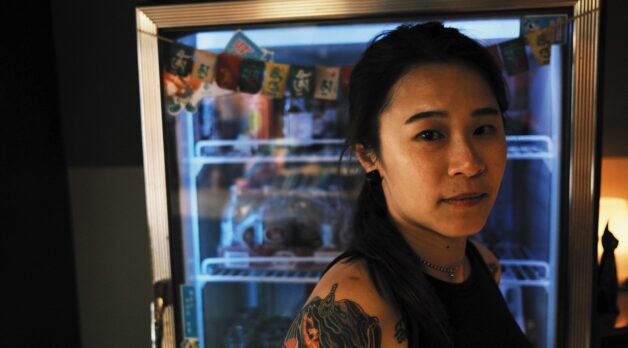 Birdy Wei-Ting Hung

Birdy Wei-Ting Hung used to hate watching scary movies. Now a self-described “genre filmmaker,” she only expanded her horror horizons after moving from Taiwan to California in 2018 to enroll in San Francisco State University’s Graduate School of Cinema. Hung already had eight years of production experience under her belt, with extensive credits on music video and documentary projects in her home country. Even so, she faced a steep learning curve. “I walked into my first seminar, and the professor was about to share a clip from a 2002 Taiwanese-Hong Kong co-production called Double Vision,” she recalls. “I knew this film and that the clip was going to have a jumpscare, so I walked out.”
Everything changed when COVID hit, and Hung began hosting a weekly Zoom movie night. Initially, her picks were “films that are sad to watch alone,” but then she had another idea: “I decided that giallo films from the ’80s are fun to trash talk with a bunch of people.” Ever the academic, Hung accompanied her picks with a hefty personal reading list. In her research, she discovered a link between genre films and Taiwan’s 38-year martial law period. “I was really surprised to learn that we have a history of smuggling in films with all the fun stuff, mostly giallo and pink films.” This was a particularly refreshing revelation for Hung, who grew exhausted by fellow cinephiles’ reverence for Edward Yang. “He’s a master,” she swiftly clarifies, “but I have a love-hate relationship with him.”
Yang and giallo are juxtaposed in Hung’s SFSU thesis project, A Brighter Summer Day for The Lady Avengers, completed before graduating last year. An essayistic mash-up of Yang’s nearly four-hour masterpiece and the 1981 rape-revenge exploitation flick The Lady Avenger by Yang Chia-Yun (a rare woman director of Taiwanese “black movies”), Hung’s film meditates on the idea that even within her culture, “we’re always so ready to sacrifice Asian women.” Despite its feminist slant, The Lady Avenger’s protagonist (Lu Hsiao-fen) must be defeated; even more devastating is the fate of teenage Ming (Lisa Yang) in Yang’s 1991 film.
Hung’s project, however, radically reimagines these characters’ storylines. Shooting on 16mm in Taiwan, Hung notes that the devoid-of-dialogue film was stylistically inspired by Belgian neo-giallo duo Hélène Cattet and Bruno Forzani, particularly their 2009 film Amer. (“They use a ton of close-ups and have this very rhythmic style.”) Indeed, the largely vacant expression of an unnamed schoolgirl (Wei Huang) dominates much of the frame, her visage only disrupted as she sits in a movie house and watches The Lady Avenger. As with Yang’s film, a young man (Yi-Chun Chen) looms a few rows behind the girl, his presence undeniably foreboding.
Although she frequently worked as a director for the metal band Chthonic, known as “the Black Sabbath of Taiwan,” Hung was dismayed to find that an early cut of the short played like a music video. “Of course, I shared a bunch of Argento with my editor, so there was [temp] Goblin music throughout,” she says. “A lot of the time you are driven by the logic of music in films, which was not what I wanted to do.” Instead, she wanted “sound waves to touch us, like ASMR.” She had her editor remove all music and sound effects and cut the film “purely based on visuals.” Because she had already abandoned the idea of capturing sync sound during the shoot, she was able to experiment with the short’s sonic landscape, which evokes unease via spine-tingling whooshes as much as its disquieting (though eventually cathartic) narrative.
Hung’s thesis film made its world premiere at Austin’s Fantastic Fest in September 2024. That same year, the film was honored with a Student Academy Award in the “Alternative/Experimental” category. This year, it has screened at more than 20 festivals, including Slamdance, Tribeca and Fantasia—a period of constant travel (reimbursed, in part, by the Taiwanese government) that suits Hung’s “very freelance” work schedule but has prompted feelings of anxiety whenever she re-enters the United States. She says, “This is a scary time that also allows me to really reflect on what my next step is.”
While her short has been well-received, Hung isn’t exactly setting her sights on filmmaking. “People ask, ‘What’s your feature film idea?’ I just have to be honest and say that I don’t have one,” she confesses. “I’m not even sure if I want to make a feature.” Currently, she’s considering U.K.-based Ph.D. programs that blend theory with practice. (“I want to continue this methodology of creating revenge fantasies.”) Eventually, she hopes to become a professor and “teach students like the former me who are just trying to stay curious and survive.”—Natalia Keogan/Image: Ai Chung