Jinho Myung
 Jinho Myung

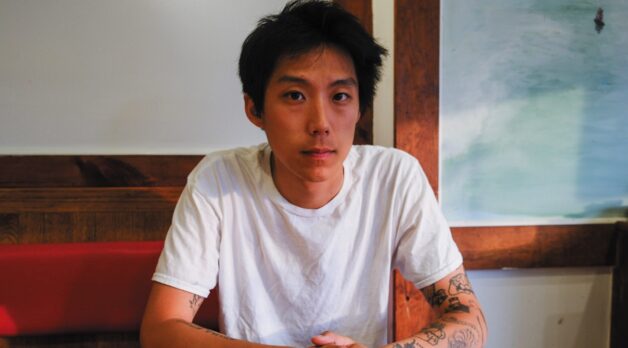
While studying film at NYU, Jinho Myung worked at a nearby restaurant where a cook told him, “I remember a day where I spiked 100 lobsters in the head with an ice pick. It does stuff to you.” That merged with a vague idea Myung had for a film following two Asian American siblings after their mother’s death, and the result was Softshell. Shot on 16mm, the debut feature builds on Myung’s mumblecore influences but is extremely of the moment, not least in trading that canon’s monolithic whiteness for Thai American characters Jamie (Caledonia Abbey) and her brother Narin (Legyaan Thapa). Their first-generation status is a low-key but important subtext for every interaction, especially romantic ones. Myung himself cameos, telling a story of going on a date where his fetishization by a white woman became increasingly clear, while Jamie’s off-on situationship with white chef David is perpetually butting against the boundaries of miscommunication, cultural and otherwise. Those gaps reach their apex when the titular turtle meets a grisly fate, an unexpected disruption in a film that’s superficially modest while carefully toying with audience expectations of what is and isn’t expected, let alone acceptable.
Raised in southern Pasadena by Korean immigrant parents, Myung’s early exposure to film came via his dad’s USB TV and a collection of movies downloaded from a Korean website. “I didn’t know how it worked,” Myung recalls. “I just knew if I plugged in the HDMI cable and could read enough Korean to get through the login, I could get the movies.” They included his childhood fave Fantastic Mr. Fox and dad-canon staples like The Bourne Identity; his pivot to “A24 teen” came in high school with the release of Moonlight. While listening to the FilmWeek podcast, Myung learned the term “mumblecore.” His first reaction was, “That’s a cool word”; his second was to seek out the Andrew Bujalski films forming the cornerstone of the movement. “It was interesting because it felt attainable,” Myung says, noting an affinity with the similarly modest work of Hong Sang-soo.
After a year at a liberal arts college, Myung decided to pursue film and transferred to NYU. By packing required general education courses into between-semester slots, Myung ensured that in his final undergraduate year he would only have one required course each semester—both of which were production classes. “I was like, ‘I’m probably only gonna have a good shot at doing this during my last year of school,’” he recalls, adding that his enrollment gave him “the student discount [to buy 16mm film].” Most of Softshell was shot with only four people: Myung’s two lead performers, the director (also sound recordist), and cinematographer Rhys Scarabosio.
An exception is a scene where the siblings take a trip down south and meet an unnervingly friendly, potentially threatening desk receptionist at a hotel, who, in turn, recommends that they meet his father. The receptionist is played by Scarabosio himself, so Myung had to operate the camera (hence, he notes, moments where the shot goes out of focus). Then, the siblings meet the clerk’s adoptive father Ken, a middle-aged Korean man with an incongruously deep Texan accent. “I was scrolling YouTube shorts at one point,” Myung says of how he found that non-performer. “Occasionally, YouTube will throw you one that has no views just to see what the algorithm wants to do, and it was him, in a selfie video, talking about how to do a certain kind of fishing lure. It felt like a human glitch. There[‘re] tons of Korean American adoptees, but to hear someone who has this very distinct Dallas-Fort Worth accent and the face of my uncles and grandfathers was really quite bizarre.” The two began corresponding, and while Myung initially wanted to interview him as a point of curiosity, that proposed documentary meeting became part of the narrative film’s texture.
Following Softshell’s premiere at last year’s New/Next Film Fest, the film has gone on to play at festivals including Belfort and the Asian American International Film Festival. Of his future plans, Myung notes “a documentary that is an extension of the documentary segment of Softshell. Right now, I’m calling it Pak’s Kingdom, which is an homage to Doc’s Kingdom, because I got really into Robert Kramer. I’m interviewing Korean men my dad’s age who are in different pockets of America to paint a broader picture.”—Vadim Rizov/Image: Iris Erwin