Loren Waters
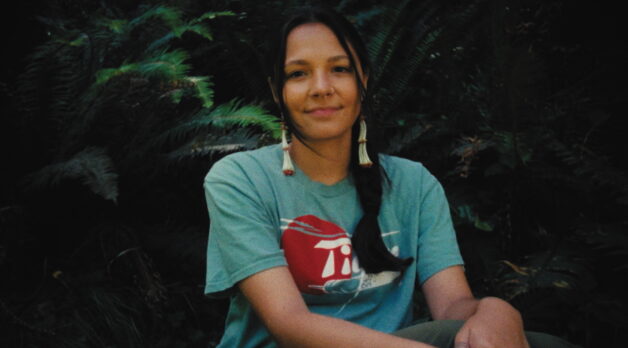 Loren Waters

Growing up in Tulsa, Oklahoma, and graduating from University of Oklahoma with a degree in environmental studies, Loren Waters says she “had no idea that I wanted to make films or tell stories.” But making two environmental-themed shorts—one, Meet Me at the Creek, is about a tribal elder and the superfund site Tar Creek—convinced her that filmmaking could “shift community perspective on important topics.” Waters also worked at the Cherokee Film Commission and on Sterlin Harjo’s FX series Reservation Dogs, where she began as a production assistant and continued to extras casting. But Waters was always developing doc projects on the side and, after meeting the painter Dana Tiger, realized she found her subject. “She paints Indigenous women in really powerful looking positions, like lawyers and warriors,” says Waters. “I had never seen myself represented in any type of paintings before.” While hanging out in her gallery, Tiger would tell Waters stories about her family, and when she’d repeat one, “it was like she was telling me for the first time. She’s an incredible storyteller.” Waters’s cinematographer partner, Robert L. Hunter, had a camera package between jobs, and she told him, “We have to shoot Dana—maybe we can capture something beautiful.”
Waters’s 2025 Sundance-winning documentary short Tiger is indeed beautiful, a tale of a family’s resilience in the wake of tragedy given extraordinary emotional weight by the transportive on-screen narration of Tiger, now 63 and living with Parkinson’s. Waters began filming the day Tiger and her son, Lisan, relaunched the family’s storied t-shirt business. Speaking directly to camera in a series of haunting locations, including the diving board of the family’s drained swimming pool, Tiger describes how her mother and uncle began the business after the accidental death of her artist father; silk-screening his designs was a form of tribute. The venture took off, and soon the distinctive Tiger logo appeared on shirts stocked in JCPenney around the country. But when Tiger’s brother Chris was murdered, both her mother and the business shut down. In Waters’s film, we meet Tiger 34 years after Chris’s death as she begins the business anew, silk-screening not just her father’s designs but her son’s in a gallery that remains, the artist says, “filled with memories and ghosts.” Says Waters about Tiger, “Her way of working through grief is by talking about it, and her way of keeping her family members close to her is by telling people about them.”
At only 13 minutes, Tiger is an astonishingly moving experience; in its exultant flow, it recalls Terrence Malick as well as the work of Kahlil Joseph, who Waters calls her biggest influence, particularly his swift edits and the way he “centralizes music in his filmmaking.” Waters also avoids familiar tropes. “I didn’t want it to be a typical talking head documentary,” she says. There are no celebrities wearing Tiger t-shirts, and achievements like the Tiger family winning a Best Minority Business award aren’t even mentioned. She also doesn’t focus “on the identity politics of being an Indigenous artist,” an approach found in “more typical identity-based documentaries you see on the circuit.” Instead, Waters imbues the film with a kind of transcendental poetry, as past and present, sadness and triumph all interweave. The joy of restarting the business—“When you see one of those shirts, it’s just like seeing a family member,” says Tiger in the film—is balanced by the artist’s realization that Parkinson’s may cut short the time she’s able to continue to be a part of it.
Waters is working on a short ’80s-set coming-of-age drama loosely inspired by Chris Tiger’s story. There’s also her work as executive director of the Lindy Waters III Foundation, the charity launched by her brother, the San Antonio Spurs player. The foundation’s “mission is to give back to Native youth,” says Waters, “providing access and opportunities through education, mental health, any other opportunities with a really holistic approach. We do culture camps, and we’ve given over $50,000 in scholarships to Native kids going to school. We are now developing new film and storytelling programs for not only Native youth but Indigenous communities, bringing in other storytellers to screen their films and talk about the career path that Native kids can have. My brother had a dream of being in the NBA; I had no idea I’d be in film. But there are not a lot of people who come from a cultural background like ours who have gotten to the levels that we have, and we want to open doors and provide opportunities where we can. It’s a lot of work but really fulfilling.” —Scott Macaulay/Image: self