Back to selection
Considerations
Covering the annual film industry awards races, with sharp commentary on the pictures, the players, the money, and the spectacle. by Tyler Coates
The Spinoff Comes of Age
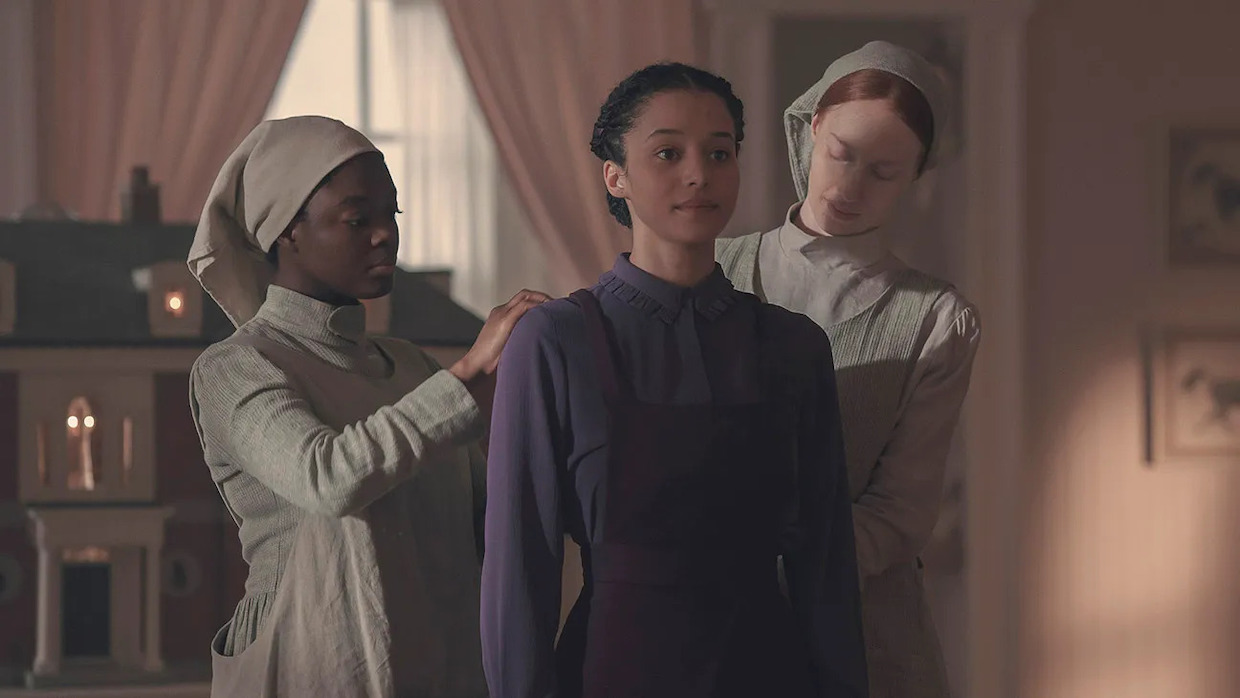 The Testaments
 Showrunner Bruce Miller admits that when he first read The Handmaid’s Tale, he thought the ending of Margaret Atwood’s dystopian novel was a little unsatisfying: “I was like, ‘Well, I hope there’s a sequel!’” Two decades later, Miller was at the helm of the Hulu series based on Atwood’s book. The show was an immediate hit—it premiered in 2017, during the first Trump administration, at a moment when its themes were particularly resonant. The evocative image of the red cape and white bonnet donned by star Elisabeth Moss and her fellow handmaids became not only an image of subjugation, but one of resistance. It became the first streaming offering to win an Emmy for best drama series (it would collect 13 more over five additional seasons).
The idea of continuing Atwood’s story beyond the scope of the novel was already beginning to simmer in Miller’s mind. Unbeknownst to him, it was also a notion Atwood herself was pondering as a novelist. “I’m sure it had been suggested a zillion times before,” says Miller of the prospect of a sequel. “I think with the show, and especially with her personal relationship with some of the cast, [she got to see] the fun of television in terms of expanding stories.” As production began on the second season, Atwood came to Miller with the news that she had begun writing a sequel. The Testaments, set 15 years after the events of Handmaid’s, was published in 2019, by which point Atwood had already shared the details of her expanded vision, giving Miller one big directive for the ending of his Handmaid’s Tale: Don’t kill Aunt Lydia, the menacing figure played by Emmy winner Ann Dowd, as she would return in The Testaments.
The Testaments is set 15 years after the events of Handmaid’s. In Miller’s version, Moss’s Offred (whose real name is June) escapes the totalitarian society of the Republic of Gilead for Canada, leaving her daughter behind (the original novel is Offred’s account of her life, detailed after her capture and death). Its sequel follows Agnes (Chase Infiniti), a handmaid-in-training unaware that she’s June’s daughter.
Miller says he was reluctant to change too much of The Handmaid’s Tale for TV, as it’s one of his favorite novels, but he admits that Atwood’s story needed to evolve in order to fit the medium of television. “She was very encouraging for me to take the book and interpret it,” he says. Halfway through the writing of each season of Handmaid’s, the pair would meet and Miller would share his ideas for her input. And knowing the central premise of The Testaments gave Miller the freedom to fill in the gaps between Atwood’s first novel and his eventual sequel.
“The sequel made me realize that Margaret was comfortable with expanding the world,” Miller says. “I got a sense [when I read The Testaments] that she was thinking about the end of The Handmaid’s Tale, where the characters would be placed. It really encouraged me [to consider] some victories for June.” That led to the biggest departure from the source material: June dies in anonymity in Atwood’s novel, while in Miller’s show, she survives. Thus, the plot details ofThe Testaments would naturally deviate from Atwood’s novel—but its larger story and prescient themes remain intact.
While The Testaments’s award-winning predecessor may boost its Emmy chances this season (Infiniti won a Gotham Award for her lead performance this week), two other drama series hope to break through with their small-screen visions of cinematic terror. Like Miller, director Andy Muschietti was inspired by on-set conversations to begin thinking toward a spinoff series of Stephen King’s It. While working on his two-part adaptation of the novel, he and Bill Skarsgård, who played the murderous Pennywise the Dancing Clown, began trying to understand the character’s motivation through his backstory. “When you’re close to your actor and talking about character a lot, you go into depths that transcend the story you’re telling,” he explains. “Soon we were very excited about the potential exploration of Pennywise’s origins—when did the monster become the clown? It’s very enigmatic in the book, but intentionally cryptic.”
Muschietti and his producing partner and sister Barbara Muschietti are executive producers on the prequel series, HBO’s It: Welcome to Derry, which takes place 27 years before It: Chapter One. Although the first half of King’s book is set in the late ’50s, the first film took place in the late ’80s (with the second, centered around the characters as adults, set in the present day), partially because that’s the era the Muschietti siblings first discovered King’s writing. (“That was our childhood,” says Barbara.) Starting their show in the early ’60s allowed them to weave in historical context; the backdrop of the Cold War and the Civil Rights Movement hangs over the characters—another group of young outcasts reminiscent of the original novel’s “Loser’s Club”—while they battle the supernatural.
The Muschiettis stage their origin story for Pennywise’s human alter ego, Bob Gray, at the end of the Depression: He’s a dancing clown on the carnival circuit with his young daughter, only to be lured away by the unnamed monster who eventually assumes his persona in order to attract his young victims. It’s an evocative use of vaudevillian imagery, but also sets up a larger plan for future seasons of Welcome to Derry to take place during historically significant periods.
King’s work has seen numerous adaptations, both faithful and not. The Muschiettis keep the novelist in the loop about any potential changes they’d like to make. “Whenever we want to test the waters, we let him know immediately,” says Barbara, who describes King as the mastermind behind the whole enterprise. The Muschiettis understand the challenge of expanding on a novel like King’s: how do you explain an iconic horror villain’s motivations without spoiling a sense of mystery? “Over the three seasons that we’re planning, we’re hitting the character’s motivation right in the face,” says Andy, “and it’s very clear what he wants. It’s not something that people necessarily will expect, but it’s very exciting.”
Unlike Miller and the Muschiettis, Alien: Earth creator and showrunner Noah Hawley had never worked on an Alien film before embarking on this FX series set in its universe. But Hawley, who helmed the Emmy-winning anthology series adaptation of Fargo for the same network, wasn’t overwhelmed by the task. Set just before the events of Ridley Scott’s 1979 film, Alien: Earth stars Sydney Chandler as Wendy, a human-cyborg hybrid (the first of her kind) who leads a team of fellow hybrids to investigate the crash landing of a research vessel in which a (you guessed it) xenomorph is running rampant after killing the ship’s crew.
Hawley says the larger canvas of a 10-episode series helped him bring the larger themes of the franchise into the present. “What is [the original] movie at its core?” asks Hawley. “If it had just been a monster movie, I don’t know if there would be a television series there.” In Hawley’s series, Wendy is caught between two corporations: Weyland-Yutani, which owns the vessel and similarly claims the alien specimen, and Prodigy, the tech company behind the hybrid program. This builds on a dynamic in Scott’s film: it’s not just the xenomorph that poses a threat to Sigourney Weaver’s Ripley, but also Ian Holm’s android, who serves to protect potential Weyland-Yutani assets rather than its human contractors. “You realize she’s trapped between nature and technology, and they’re both trying to kill her,” Hawley says. “That seems pretty on point with our moment on Earth right now.”
Hawley also had the freedom to create new extraterrestrial creatures—some are deadly to humans, but others are surprisingly friendly. “It’s called Alien. It’s not called Xenomorph, right?” he says. “That allows me to introduce a bunch of new characters, basically, where you don’t know what they eat or how they reproduce. We get to make it fresh again for the audience.”
“If you say, ‘Here’s the world of Alien, here’s the creatures and premise that you love, and let me see if I can do something additive to it,’” Hawley explains, “the hope is that people will feel happy about that.”