Back to selection
Considerations
Covering the annual film industry awards races, with sharp commentary on the pictures, the players, the money, and the spectacle. by Tyler Coates
Colbert, Kimmel, and the Battle of Late Night
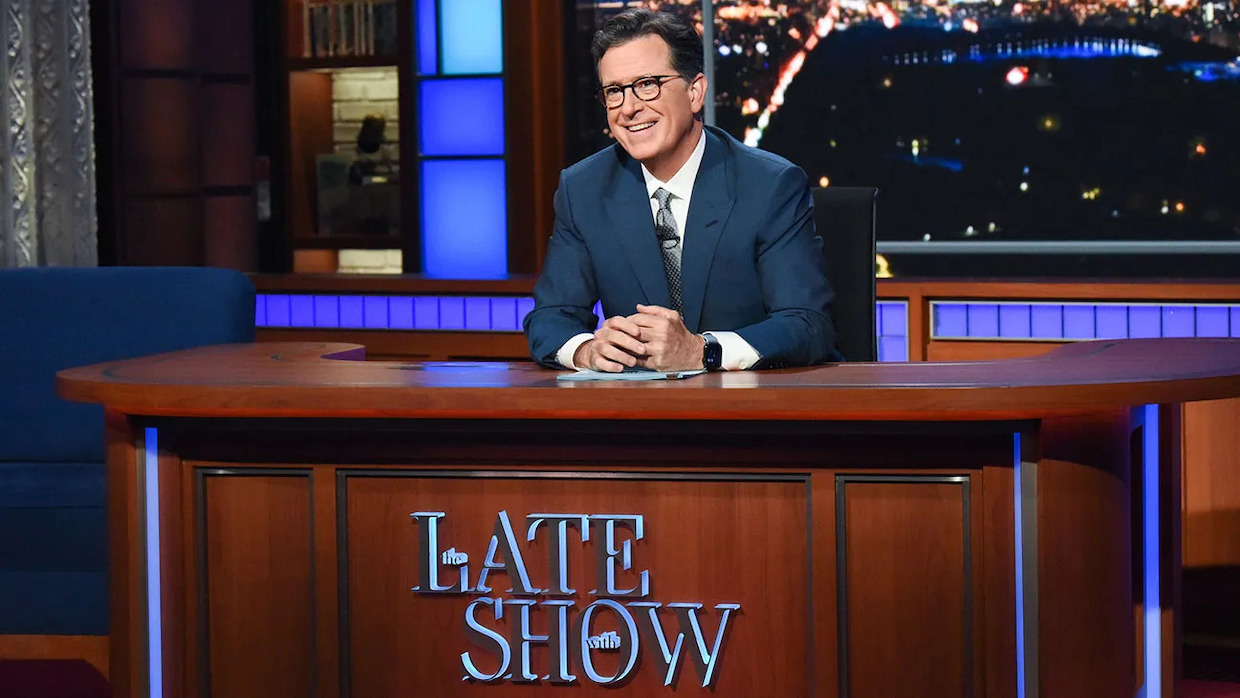 The Late Show
 While covering the Academy Awards may have its challenges, the Emmys are a much bigger venture. Twenty-three awards will be handed out at the Primetime Emmys on September 14, honoring nominees across the comedy, drama, and limited series categories, plus variety and reality competition shows. Meanwhile, about 100 more Emmys are awarded in craft-focused categories (and, randomly, guest acting) at two Creative Arts Emmy ceremonies a week before the main show. If all of this weren’t enough to keep up with, the Television Academy’s ever-changing rules and regulations also mean its award categories are in constant flux.
Take, for example, a new rule this year that prevents a performer from being nominated as a guest actor for a role they’ve previously been nominated for as a lead or supporting actor. A somewhat recent example would be Claire Foy’s 2021 win for her brief appearance as a young Queen Elizabeth in the fourth season of The Crown, a role which won her an Emmy for Best Actress in a Drama in 2018. The rule change resulted in Jon Hamm being disqualified for his guest spot on Apple’s The Morning Show, as the streamer mistakenly submitted him as a guest actor despite his 2024 supporting actor nomination for the same role. (Don’t worry, he’s still eligible for two other Emmys this year.)
But a category change that I find more interesting affects the variety series category, which will result in a big battle between late night hosts Stephen Colbert, Jimmy Kimmel, John Oliver, and NBC’s long-running sketch comedy series Saturday Night Live.
The variety series category has evolved since it was established in 1951. Briefly, in the early 1970s, it was split into two subcategories so that talk shows like The Tonight Show with Johnny Carson and The Dick Cavett Show would not compete with musical/sketch series like Rowan & Martin’s Laugh-In and The Carol Burnett Show. But from the mid-’70s through 2014, the category was a single entity—and its lineup often included mismatched competitors. In the 1990s, you’d see bizarre outcomes like Jay Leno beating MTV Unplugged in 1995, or Politically Incorrect facing off against Muppets Tonight (both lost to Dennis Miller Live). By the mid-aughts, late night talk shows hosted by Stephen Colbert, Jimmies Fallon and Kimmel, Bill Maher, Conan O’Brien, and Jon Stewart dominated a category once more open to sketch comedy and musical revues. Saturday Night Live may have received the occasional nom, but the men of late night reigned supreme, with Stewart’s The Daily Show setting a record for its 10 consecutive wins.
In 2015, the category was again split, this time into variety talk series and variety sketch series. The first two winners in the latter category were Inside Amy Schumer and Key & Peele before SNL began a six-year winning streak until 2023. That’s when the Academy decided that HBO’s Last Week Tonight with John Oliver—which won seven consecutive Emmys for variety talk series—would compete in the scripted variety series category, where it has earned three additional Emmys. This year, however, the two categories have been merged again, meaning the seemingly unbeatable Last Week Tonight will once again compete against the network late night shows—plus SNL.
It’s interesting timing, of course, given the Trump administration’s targeting of late night shows, particularly those hosted by Stephen Colbert and Jimmy Kimmel. Colbert’s The Late Show, which he began hosting after David Letterman’s exit in 2015, ended its 11-season run on May 21 after CBS canceled the franchise—a network staple for 33 years—following parent company Paramount’s sale to the David Ellison–run Skydance Media. The company line was that the long-running show was losing $40 million a year; critics dubious of that explanation suggested this was really about Colbert’s sharp criticism of Trump over the years and the friendly relationship between the Ellisons and the current administration. While Colbert is now out of a job, one couldn’t imagine a better swan song for the 11-time Emmy-winning host; ahead of a triumphant final season which saw guest after guest ruminate on Colbert’s abrupt termination, The Late Show won its first talk series Emmy last September (Colbert, as a presenter, also received a standing ovation early in the ceremony).
Right on the heels of Colbert’s cancellation came another controversial late night fiasco. Jimmy Kimmel Live! was pulled from the air on September 17 under pressure from the Trump administration and FCC chairman Brendan Carr after Kimmel made a comment about Charlie Kirk’s assassination in an opening monologue. With Nexstar Media Group and Sinclair Broadcast Group threatening to pull the show from their ABC affiliates, Kimmel’s future was momentarily uncertain—but an immediate public backlash and threats of audience boycotts saw Kimmel back on TV within a week, with his September 23 return episode pulling in 6.26 million viewers (a series record) and Kimmel’s monologue netting 26 million views across social media.
It’s difficult to imagine Colbert and Kimmel’s experiences over the last year not having an effect on their Emmy outcomes. The Late Show has the edge here; voters could see this as not just the last chance to reward the show and Colbert, but a possible vote against Trumpism. (Plus, imagine Colbert and his team’s possible acceptance speech.) Jimmy Kimmel Live!, which has been nominated in this category (despite its changing focus) for the last 12 years, has yet to win the variety series Emmy, putting it in possible second place—that is, if Emmy voters are thinking politically with their choices, and if John Oliver’s HBO show fails to continue its winning streak and claim the category once again.
The similarly topical Saturday Night Live, which doesn’t ruffle Trump’s feathers as often as these late night hosts (he was, infamously, a host during his presidential run in 2015), will likely find its place among the nominees. As an SNL apologist (I still watch it every week), I think the sketch series—which is still riding high off of its 50th anniversary last year—is a deserving contender. Its 51st season saw the December departure of Bowen Yang, a fan favorite who earned four acting nominations during his time there. Despite that, the show has maintained its energy in 2026, leaning harder into the absurd rather than the political timeliness. That the debut season of SNL UK, which airs live from London, has been a surprise hit only further solidifies Lorne Michaels as a comedy institution.
The Daily Show, which now features Stewart back at the desk on Monday nights and a rotating group of hosts throughout the rest of the week, will likely nab the fifth slot in the category if recent history serves as a reliable predictor. (The Trevor Noah–hosted edition won the talk show Emmy once Last Week Tonight was moved to the script variety category, and the multiple-host version earned a nom last year.) But the more exciting, and unpredictable, race is between Colbert, Kimmel, and Oliver. For liberal-leaning Academy members, of which there are many, the Emmy ballot offers another chance for a political statement—and no matter the outcome, we can probably expect a rambling rant from the president on Truth Social by the time the award ceremony ends on September 14.