Back to selection
La Clef Revival Occupies the Cinema
 Photograph by Chiara Marinai
 I first heard about the reopening of the community-run cinema La Clef shortly after arriving in Paris this January. A friend, an American lecturer at the Sorbonne, took me there and proudly pointed at the two-story building with a signature key (clef) on its facade. “Do you know they used to illegally squat in the cinema for more than two years?” she asked.
Founded in 1973 in Paris’s Latin Quarter, La Clef became known for championing independent and political films underrepresented in the commercial mainstream. After its owners announced plans to sell the building and closed the venue in 2018, a collective of cinephiles, filmmakers, and activists occupied the cinema for more than two years, organizing daily pay-what-you-can screenings while fighting to keep the space in public use.
The struggle resonated far beyond Paris, transforming La Clef’s fight to remain a cinema into a global movement, with high-profile filmmakers and cultural institutions weighing in. Following years of legal battles and fundraising campaigns, the collective succeeded in purchasing the building in 2024. The cinema officially reopened on January 14, 2026, as a grassroots, volunteer-run venue, retaining a pay-what-you-can (à prix libre) model. The inaugural screening was Suhaib Gasmelbari’s Talking About Trees (2019), in which members of the Sudanese Film Club struggle to revive an old cinema.
La Clef has come to symbolize the importance of preserving open, autonomous cultural spaces capable of showing militant and thought-provoking films outside the homogeneity of the current distribution system. “We think of La Clef as a space that can host and welcome other forms [of distribution] and other collectives,” says Taddeo Reinhardt, a programmer who joined after the occupation. “If we receive a proposal from a collective that is looking for a space to screen, and if it aligns with our ideas, we would welcome them, as we did tonight.”
When I spoke with Reinhardt in early May, it was a particularly cheery evening at La Clef. The cinema was taken over by members of the Comité du Solidarité avec les Peuples du Chiapas en Lutte (Committee of Solidarity with the Peoples of Chiapas in Struggle) and the collective Mujeres y Disidencia de la Sexta en la Otra Europa y Abya Yala (Women and Dissidents of the Sixth in the Other Europe and Abya Yala). Together with filmmaker Valentina Leduc Navarro, they presented the activist documentary The Dreams We Share (2025), which traces the solidarity of grassroots eco-socio-political communities across the world fighting injustice in their own ways, with the Zapatista movement at its center.
The main hall—where all the pre- and post-screening mingling happens and which conveniently houses a very affordable bar—was occupied by the guest collectives. Energetic Latin music was blasting through the space while people lined up outside to get their tickets. Among the excited crowd, I spotted documentarian Claire Simon.
La Clef has cultivated a form of engagement that is fun and community-driven, but also rooted in material support. The guest collectives sold merchandise—including film posters, t-shirts, and hand-crafted souvenirs—alongside books on decolonialism and Indigenous struggles. The volunteers distributed leaflets outlining ways to help the Zapatista community. All proceeds would support the peoples of Chiapas.
“When you go to La Clef, you come for an event,” says Occitane Lacurie, programmer and film critic at Débordements. Not only did the evening feel festive, but it was palpable how political commitment was woven into the social life of the cinema itself. Inside La Clef’s largest screening room, able to seat 120, the audience cheered after a pre-roll clip that documented the cinema’s fight against its closure and its eventual reopening. The room was full of people of different ages and walks of life, from retirees to students. “They’re all just cinephiles,” Lacurie says.
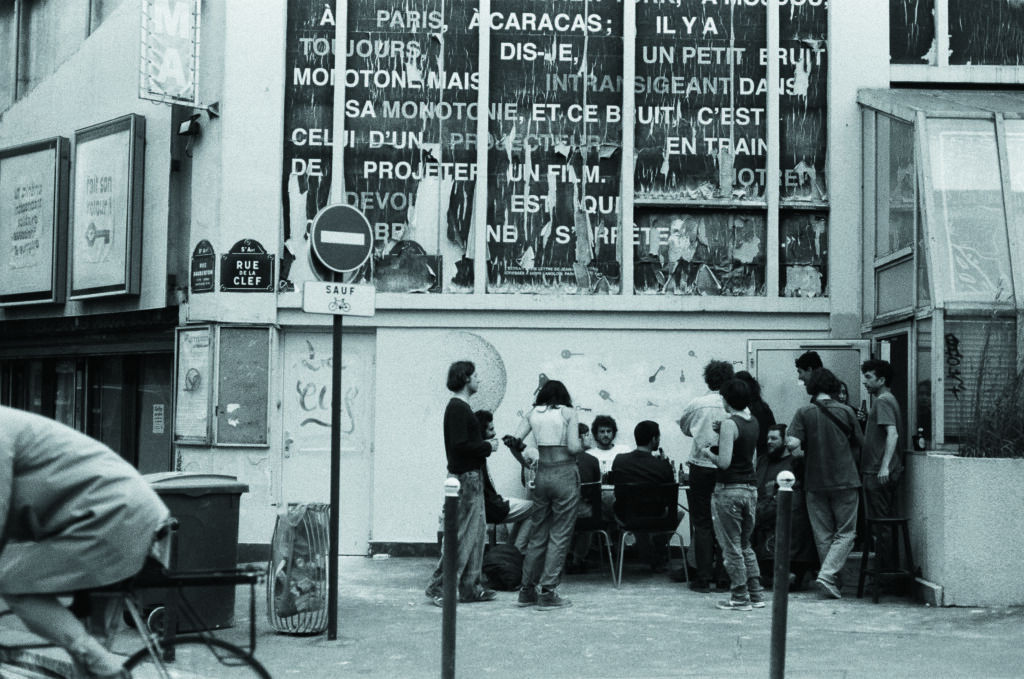
La Clef was established in 1973, when its founder, Claude Frank-Forter, used money inherited from his parents’ textile manufacturing business to open a three-screen cinema. A passionate cinephile, Frank-Forter had attended a business school to learn how to operate arthouse cinemas. After taking advice from UGC—now one of France’s major multiplex chains—Frank-Forter found a building tucked between Rue de la Clef and Rue Daubenton, only minutes away from the verdant Jardin des Plantes, France’s second largest botanical garden. Through his connections at UGC, Frank-Forter recruited Bernard Martinand of the Cinémathèque Française to be the cinema’s programmer.
Frank-Forter recalled in a 2019 interview how impressed he was by Martinand’s enormous notebook filled with filmmakers’ contact information. From the beginning, the place attracted a wide range of cinephiles, students, and film workers by screening French New Wave films, rare arthouse films, and revival titles from France and abroad.
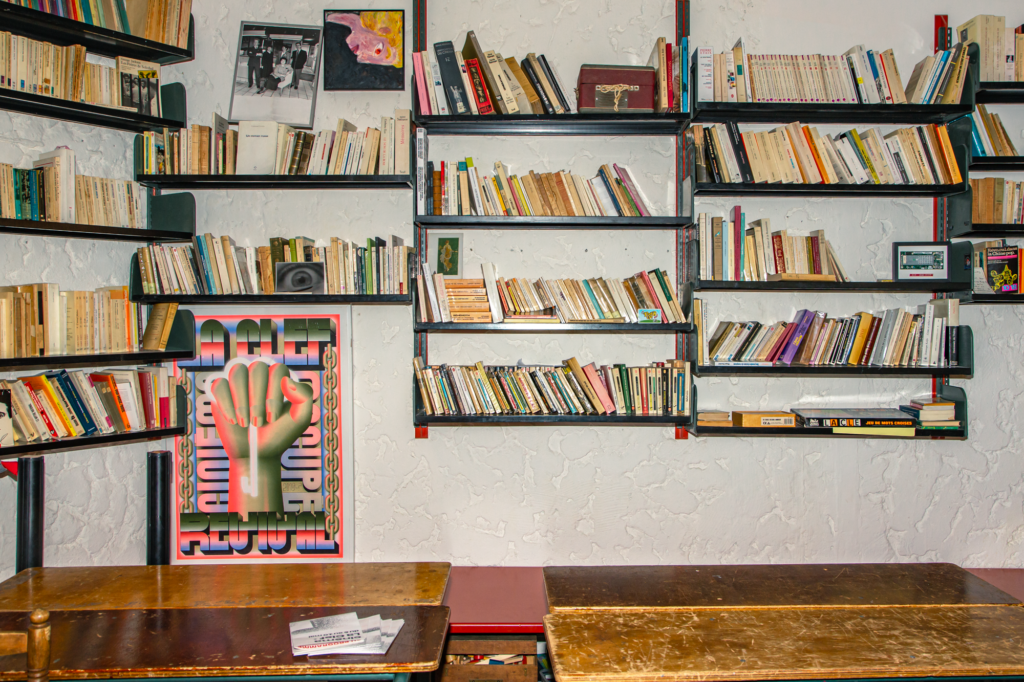
By the 1980s, it became difficult for arthouse cinemas to compete with color television, as well as emerging technology like Dolby Stereo sound in multiplexes. In 1981, Frank-Forter sold La Clef to the Works Council (Comité d’Entreprise) of La Caisse d’Épargne d’Île-de-France, the cooperative banking group, which converted the building into a cultural center for their employees. Centre Culturel de la Caisse d’Épargne kept two of La Clef’s screening rooms—120 and 65 seats—while transforming the third into a painting atelier. The collective now uses the studio as a storage room for their growing collection of books donated by cinephiles and academics, some of which they also display in the main hall. Among its many titles are works by Gramsci, Derrida, Adorno, and other 20th-century leftist intellectuals.
From 1990 on, Caisse d’Épargne occasionally rented out the screening rooms to outside associations. This is when Beninese-Togolese filmmaker and poet Sanvi Panou entered the cinema’s history. Having completed a film editing course at La Clef, Panou was frustrated about the near absence of Black representation on screen. He registered an association at the CNC (National Center for Cinema and the Moving Image) and created the program “Images d’Ailleurs” (“Images from Elsewhere”), which would remain at La Clef for the next 20 years. Under Panou’s stewardship, Spike Lee’s She’s Gotta Have it (1986) and Do the Right Thing (1989) were screened. “Images from Elsewhere” became a landmark for audiences seeking out Black cinema. Over time, according to Panou, relations with the cinema’s owners deteriorated due to large crowds of people of color gathering there. In 2009, Panou decided to walk away, clearing room for a new association helmed by Raphaël Vion. Their curation, known as “L’Usage du Monde,” revolved around global cinema. As audience numbers continued to decline, in 2015, the Works Council of Caisse d’Épargne decided to sell La Clef, eventually closing its doors in April 2018.
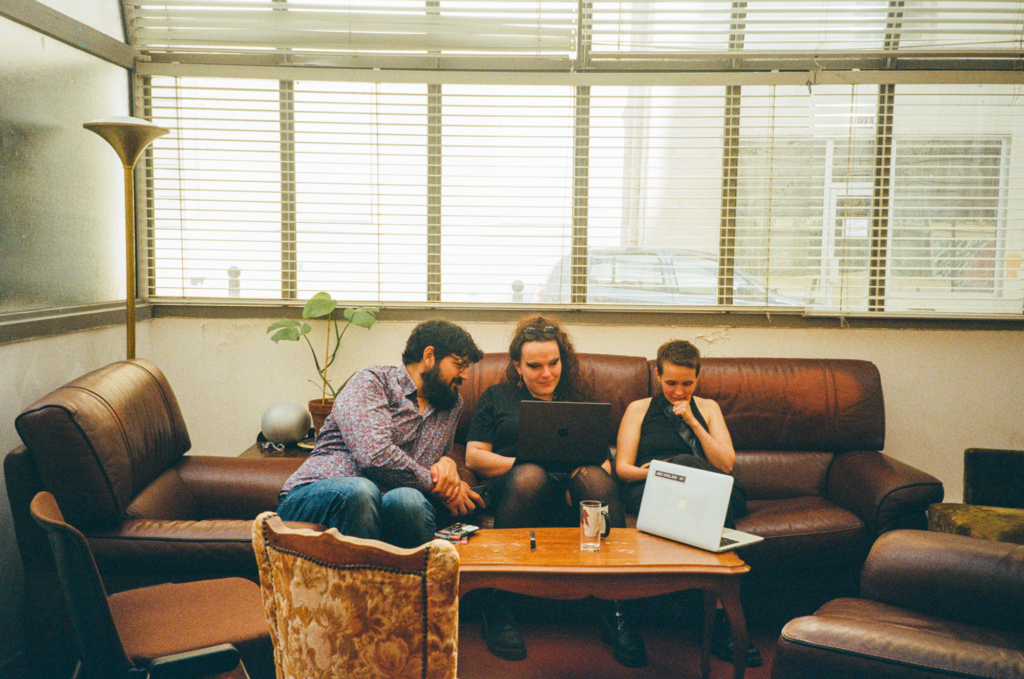
The occupation began on September 20, 2019, when film buffs, filmmakers, activists, and artists from squats (including the Curry Vavart collective, Le Post, Jardin Denfert, SMAC, and La Serrure) illegally occupied the building under the umbrella of the Association Home Cinéma (AHC). Programmer and collective member Héléna Delamarre points to the place in the main hall where she slept during the occupation. The AHC needed to be in the building at all times to avoid eviction. The collective immediately began organizing pay-what-you-can daily screenings. Delamarre recalls reaching out to various filmmakers, collectives, and distributors, asking to give them films for free; most agreed. Claire Denis presented No Fear, No Die (1990) and U.S. Go Home (1994). Leos Carax showed Une Chambre en ville (1982).
A court order demanding evacuation arrived by December. “It was really intense,” Delamarre says, “but the mood was great. We were learning new skills, like What would you do if the police came at 6 a.m.?” Maria Beas, who was a regular during the occupation, also tenderly recalls the high-spirited ambience: “It was packed,” she says, noting that the philosopher Jacques Rancière even dropped by to show support. The building’s owner sued the collective in January 2020, levying a daily €350 fine against them, which was later overruled by a local court.
Then came the COVID-19 pandemic, which forced the collective to cease indoor screenings and instead project films onto the building’s exterior wall. The lockdown proved to be a blessing in disguise, as it gave the members time to launch a crowdfunding campaign to try to buy the building. Donations came from hundreds of individuals—Parisians and far-flung supporters of La Clef alike—including filmmakers like Wang Bing, Quentin Tarantino, and Céline Sciamma (now a member of La Clef Revival’s board).
In October 2020, La Clef’s former owners signed an agreement to sell the building to the entrepreneurial firm Groupe SOS, which had offered €4.2 million. But the collective pushed SOS to withdraw its bid, fearing the cinema’s mission would be derailed under its management. On March 1, 2022, the police evicted the squatters. That same day, SOS pulled out of the sale in response to strong public support for La Clef. The success of the crowdfunding campaign then allowed the collective to make its own bid to the owners. Rebranded as La Clef Revival to turn over a new leaf following legal disputes, the collective acquired the venue in 2024 for €2.7 million. “We’re still a very fragile structure economically,” Reinhardt says, referring to monthly repayments on loans taken out for renovations. Instead of ads before screenings, La Clef projects slides listing the cinema’s ongoing needs: a larger fridge, a dishwasher, 35mm film splicers, a video projector, and gardening tools.
The core collective at La Clef consists of between 20 and 30 active members working across communications, programming, security, building maintenance, projection, ticketing, and the bar. Around 300 volunteers also contribute by working shifts at the bar and box office. The collective rejects fixed positions or a hierarchy; when I came to see Toronto-based Canadian filmmaker Sofia Bohdanowicz’s Measures for a Funeral (2024), the person who sold me the ticket was later serving drinks at the bar across the room. Most collective members become jacks of all trades, learning to operate digital and 35mm projectors while working on building upkeep. This way of working brings different classes of Parisians together: Léa Picquart, a collective comrade, says that she helped install zinc on the cinema bar with “a zinc worker who usually works on the rooftops of Paris.”
To become an active member, one goes through what the collective calls the “chemin du bénévole” (“volunteer’s path”), organically progressing from volunteering to joining committees, with responsibilities growing according to each person’s skills, availability, and interests.
There is also a programming pool of around 20 people, which is currently training another 20 members to independently organize screenings, which includes clearing rights, securing prints, and managing the venue and volunteers. The aim is total autonomy. Programming is planned collectively each month, and every screening is assigned to a pair of programmers. Their varied backgrounds inform the diversity of the films they choose to show. “Some would program documentaries,” explains Reinhardt, “some would go for political films, and some prefer theoretical screenings, inviting researchers.”
Lacurie, for example, is responsible for the cycle called “Ni auteur ni maître” (“Neither Author nor Master”), which she cocurates with sociologist Jérôme Pacouret, author of Qu’est-ce qu’un auteur de cinéma? (Who Is a Film’s Author?, 2025). The series questions the central role of the auteur in French cinema, which overshadows the collaborative labor behind any film. It exclusively highlights films made by collectives, in which the role of the auteur becomes moot.
But the auteur is certainly not dead. The militant and grassroots spirit of La Clef has attracted many a cineaste to present a film to the cinema’s receptive audience. During the occupation, film historian Nicole Brenez invited Jean-Luc Godard to curate a seven-film series. This May, Payal Kapadia introduced a beautiful restoration of an Indian slacker classic, In Which Annie Gives It Those Ones (1989), scripted by Arundhati Roy and directed by Pradip Krishen. “It’s like Linklater’s Dazed and Confused,” Kapadia said before the screening. When she was a student at the Film and Television Institute of India, the film had not yet been restored, making it hard to source. “So, naturally, everyone wanted to see it.”
The film, which follows a group of leftist hippie architecture students, is my favorite I’ve seen at La Clef. Very often, films about architecture fail to capture the design process in full: how much thought it requires; how unglamorous and chaotic it can be. Here, we see students messing up their drawings, coming up with utopian ideas, and building models and miniatures; one character rants about the logic of commercially driven urbanism. It is a natural fit for La Clef.
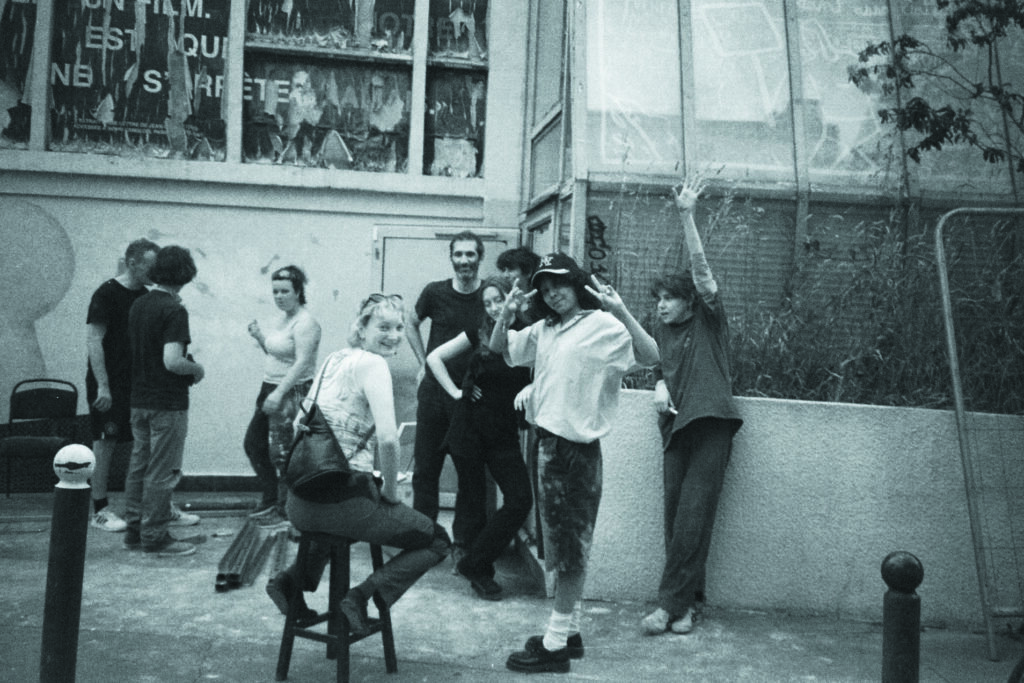
At La Clef, preserving the building also means preserving a political ethos. This, perhaps, is what continues to attract cinephiles, workers, and activists from inside and outside the film world. Simon Thomas, a Building & Security committee member and a physics researcher by training, tells me he was drawn to the political dimension of the project, which aims “to undermine the forms of power conferred by property ownership; to concretely create a legal structure, an organizational model, and an economic system that, instead of being fundamentally independent, allows for collective management from start to finish, like a common good.”
Today, the cinema operates through an official ticketing system tied to France’s CNC distribution model. In France, distributors obtain a CNC visa that authorizes films to be screened and integrated into the national ticketing network. Ticket revenue is automatically divided among exhibitors, distributors, rights holders, and the CNC, which collects a tax on each ticket sale that is reinvested into future film production. “It’s a system that aims to be virtuous,” Reinhardt explains. “When you buy a ticket, you support a film that’s about to be made.” Because of its pay-what-you-can structure, La Clef had to negotiate a special arrangement with the CNC. The collective hopes this arrangement might push the national model to become more accessible, paving the way for more independent cinemas to embrace collective structures.
La Clef also rents out screening rooms for private events and festivals, including this year’s Cinéma du Réel documentary festival. Several organizations pay an annual membership fee to organize up to ten screenings in the building, which they program and coordinate autonomously. Among these groups are La Branlée, a collective which programs queer porn and erotic films; L’Etna, which is dedicated to the production of films on celluloid; and Le Chien qui Aboie, an association dedicated to Latin American cinema.
The Latin Quarter in Paris’s 5th arrondissement is known for its many repertory theaters. “They have their own habits,” Lacurie explains. “They show films they have in their catalog, which they show more or less once or twice a year—a Robert Altman cycle, a David Lynch cycle—and then it repeats every year.” Rue Champollion alone boasts three cinemas, one after another: the art-deco Le Champo, the more eclectic Reflet Médicis, and the unassuming La Filmothèque du Quartier Latin. Isabelle Huppert owns two rep houses just a stone’s throw away, Christine Cinéma Club and Écoles Cinéma Club.
La Clef is different. Every time I went to La Clef, something unique was happening: an anti-imperialist book club, a collective cooking event, a solidarity party. Lacurie tells me that in Paris, “we don’t really have social centers that self-organize events and where people can hang out and discuss politics.” Beas adds that “having a pay-what-you-want cinema with such a diverse program, as well as a café-bar with affordable prices, allows for a more democratic and empowering access to culture.” Lacurie believes La Clef has the potential to become a place of political and militant activity tied to cinema and art.
“We’re sometimes invited to program in a lot of different venues,” Reinhardt says, but affirms that their project is about La Clef as a space: a building, a community hub, a place to organize against the status quo, and a model for an alternative future for film culture.
“We’re not a programming collective,” Reinhardt affirms. “We’re a collective that is saving a cinema.”