Back to selection
Personal Effects: Boots Riley and His Collaborators on Crafting I Love Boosters
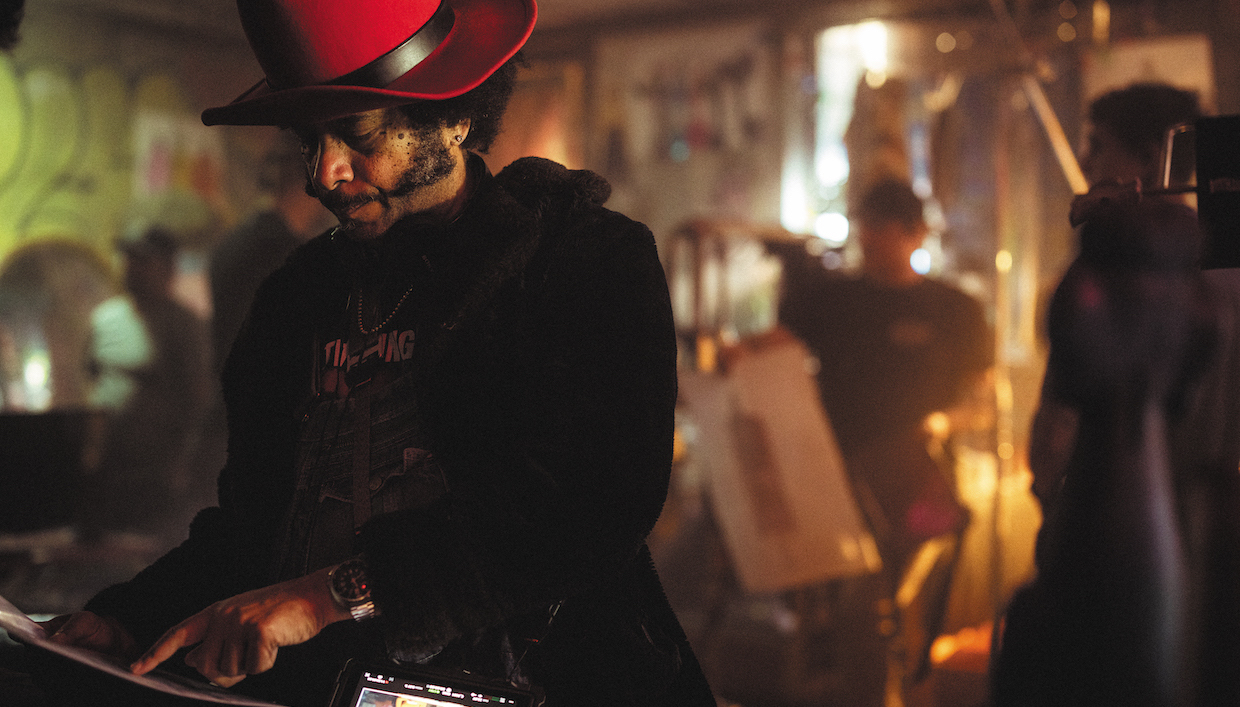 Boots Riley BTS on I Love Boosters
 Boots Riley has directed two movies and one TV show over the past decade, but he’s been telling stories through music for more than 30 years. “I usually think about my songs the same way I think about movies,” said Riley, whose Oakland-based hip hop group The Coup started 35 years ago. “Music was a way for me to cheaply make movies.”
Now, music fuels his movies in other ways, though he’s still on the lookout for inventive ways to stretch his budget. Riley officially transitioned into filmmaking around 2015, when his time at the Sundance Labs laid the groundwork for his zany workplace satire Sorry to Bother You, which started as an album in 2012. His surreal second feature, I Love Boosters, stems from the title of a song on The Coup’s 2006 album, Pick a Bigger Wagon.
Made for about $20 million with a blend of practical effects, innovative set designs, and other visual trickery, the movie showcases Riley’s artistry and ambition while staying true to his roots. After Sorry to Bother You, he directed the equally inspired series I’m a Virgo, somehow convincing Amazon to fund a $50 million show about corrupt superheroes and the teen rebels who take them down that goes to many wild, unpredictable places before resolving itself in a workers’ revolt.
Now that Riley has expanded his toolbox, the songs are a natural breeding ground for his movie career. “I look for ideas that I’ve always wanted to make,” he said. “It’s like when you have a notebook full of ideas, and you go back looking through them to decide what could be good. It’s always chock full of angles.”
The original “I Love Boosters” track functions as an ode to women shoplifters who repurpose stolen clothes at a lower price point (“a booster is a person who jacks from the retail / and sells it in the hood for dirt-cheap resale”). That only describes the first act of the movie, which finds sneaky clothes thief Corvette (Keke Palmer) and her merry gang of boosters joining forces to take down the capitalist machinations of fashion mogul Christine Smith (Demi Moore) by targeting her stores. Among the many outrageous conceits throughout the movie, Christine occupies a slanted office that emphasizes—in Riley’s characteristically off-kilter way—the economic imbalance that enables her to profit off cheap labor.
“I always thought this idea about fashion and art was somewhat unexplored,” Riley said. “It comes to fruition when people are trying to survive.” An avowed communist whose surrealism reflects an unequivocal worldview, Riley’s filmmaking is littered with meaning, even as it adheres to its own internal logic. I Love Boosters careens in so many directions that it practically defies spoilers.
The discursive plot includes a high-minded sci-fi device that both transports its users and dissects existence itself. There’s also a secret cabal of corrupt influencers whose grotesque arrival in the third act deepens the movie’s absurdist energy and amps up its scathing indictment of modern-day materialism. If that sounds hard to follow, well, it is—but I Love Boosters is intentionally confounding and incredibly entertaining, in that distinctive sublime-silly balance that marks Riley’s work.
The film’s scope, and originality, presented an array of unusual filmmaking challenges. “The days were just packed,” said producer Allison Rose Carter, whose previous credits include the equally audacious Everything Everywhere All at Once. “Every day had a unique, fun aspect to what we needed to capture. It was never just a few people on a couch talking. It was like, ‘Oh, today we’re going to be pulling off a miracle again.’”
Christine’s slanted office was one of the more dramatic undertakings mandated by the script. Riley’s preference for practical approaches over visual effects led to the decision to build an entire set at a 15-degree angle.
“We spent part of our prep wondering, ‘Should we put ourselves through it?’” Carter said. “But it really catered to a lot of the comedy and gags. We thought a 15-degree slant was nothing. That was wrong.” Over the course of the multiday shoot, the canted set led to a series of complications. “The weirdest thing we experienced when we stood on the set was that the forced perspective made everyone a little dizzy,” she said. “We had to take Dramamine—and take breaks.”
Safety precautions were ubiquitous. “Everything was bolted down,” Carter added. “Anyone who had to do anything remotely physical in that space was on harnesses, which meant stunt riggers and stunt teams helping them.”
But the Boosters team insisted they got what they signed up for. “If you’re having too much fun on a movie, it probably means the movie isn’t going to be very good,” said production designer Christopher Glass, whose credits include Angels & Demons, Sam Raimi’s Spider-Man 3, and The Jungle Book. “It’s fun coming up with stuff with Boots. He’s a nut in the best possible way. [But] it was very serious in terms of execution.”
Carter said the department heads were onboard with the nontraditional filmmaking decisions that dominated the production. “With projects this ambitious, every collaborator knows what they’re getting into,” she said. “It requires a lot of creative problem solving, which organically builds a lovely team. We just had very generous, hard-working creative collaborators, from costume design to score.”
The multifunctional teleportation device alone demanded feats of ingenuity from almost every department. According to Carter, “It was special effects building rigs, stunts building out the choreography of jumping through and doing pre-viz work on it, props actually building a dozen-plus versions of the device that can light up in different ways. It was lighting design and color grade. What’s cool about a project of this ambition is that every department has to talk to each other and collaborate to make sure it’s done right with the world building we want.”
Glass knew he was signing up for an unorthodox experience when Riley sent him a playlist along with the script. “No director has ever done that for me before,” he said. “It had polka dances and some other interesting, weird stuff. Having seen his other work, I got the vibe and the visual style.”
For the vibrant color palette, Glass and cinematographer Natasha Braier turned to Ladurée macarons and other unusual reference points. For scenes shot at a Chinese factory, Glass saw a special opportunity for further experimentation. “I was looking at actual fabric factories, mainly dye factories,” he said. “I noticed a lot of lint and dust floating in the air, getting stuck in machines, and it was very colorful and inspiring. We had a lot of references from that. I thought about it almost like a liquid candy world. We wanted it to be different and surreal with things kind of melting colorwise.”
In other cases, the crew used volume stages, but the VFX were minimal. “This movie had one-tenth the budget of Jungle Book but less than one-tenth of the pre-viz artists,” Glass said. While working on a much smaller scale, they used a similar VFX pipeline. “You can take that tech and scale it,” he said. “The biggest questions here were about how far we could go for certain things with the amount of money we had.”
The movie’s opening nightclub scene, for instance, had to be shot on location because it was too brief to justify building a set. “It’s so hard to find nightclubs that will let you shoot when you want because they get more money from selling alcohol,” Glass said. “We found this place, but it was all white.” They had to pump in colorful lights from the ceiling. “The great thing about white is it reflects everything you put in,” Glass said. Such invention kept the Boosters team engaged on a regular basis, in contrast to the monotonous routine that afflicts many more conventional productions. “You know Boots is going to want to do something really insane and different,” Glass said. “He’s like a big kid in a way.”
Riley welcomes the budgetary conversation. “I have to make something that wows me and wows the people I want to fund it,” he said. “They may say they love it but want it to be cheaper, but without the ‘ooh, we love this,’ there’s nothing else.”
Riley refused to cut costs by shooting overseas, an increasingly common tactic among U.S. productions to sidestep the rising costs of unions, and instead settled for Atlanta over the actual setting of Oakland. “Right now, we need some art that’s tied to a place that has a commitment to people and make the art that you can there,” he said. “All kinds of stupid money is wasted in moviemaking. It’s easier to put it down on paper. We could afford this movie in Atlanta.”
Even with the resources at his disposal, Riley had to cut corners for certain sequences, including an extensive chase scene that led to the use of miniatures rather than the original plan to shoot on location. “I’m bored as fuck when action happens in movies, when it’s just a chase,” Riley said, citing his preference for action-comedies like The Blues Brothers and Kung Fu Hustle. The miniatures lend a playfulness that heightens the cartoonish quality of the scenes in question. “In indie film, as a way to get budgets down, we’ve simplified things,” Riley said. “I didn’t cut the story beats. I cut methodology.”
The resulting ingenuity harkens back to the slapstick era. Riley was thrilled when he showed a rough cut to Guillermo del Toro. “Not since Buster Keaton has there been such cinematic invention,” del Toro wrote Riley. “That’s the person I wanted to impress,” Riley said, adding that his unconventional techniques were part of what kept him engaged. “I take something to the brink, then figure out how to keep myself interested,” he said.
His collaborators echoed the sentiment. “Boots likes to figure out the most basic way to do something insane in a lo-fi way,” Glass said. “And he makes it special.”
Riley described his process as an improvisatory one, regardless of the extensive planning mandated along the way. “You think things are going to happen one way, and then you find out more stuff,” he said. “And that’s when they get more complicated.”