Back to selection
Fix Your Heart or Die: Adrian Chiarella on Leviticus
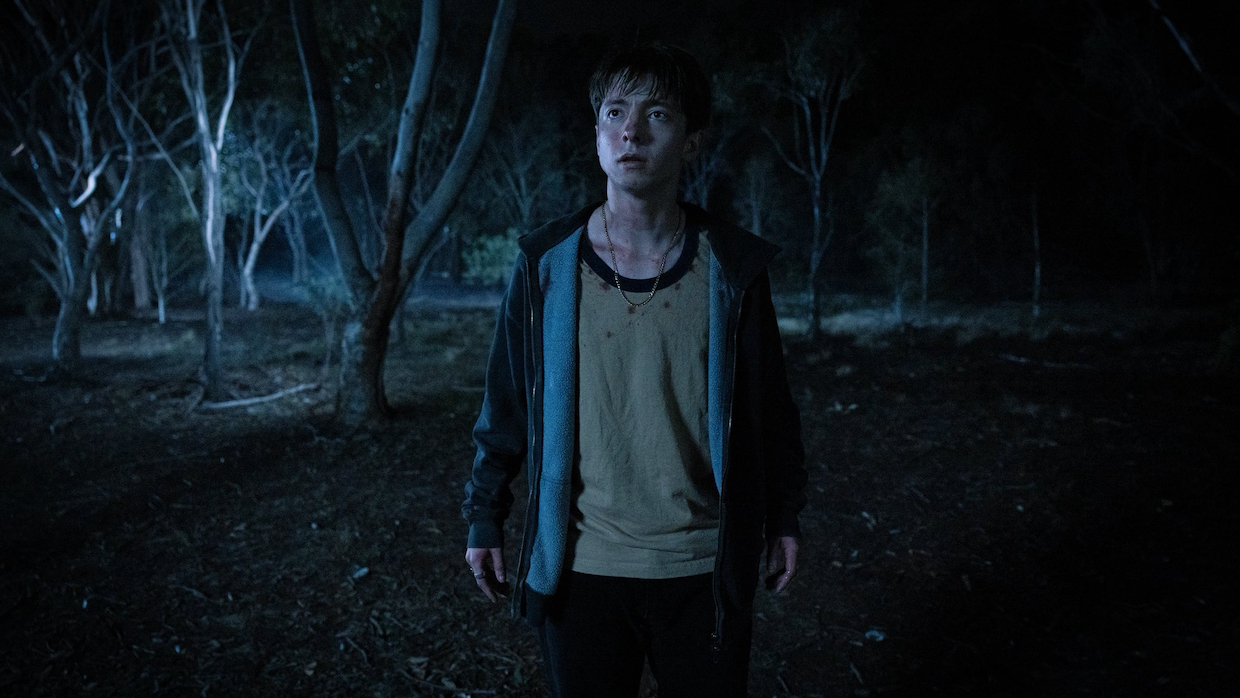 Leviticus (2026)
 Leviticus (2026), Adrian Chiarella’s debut feature, begins with an archetypal horror image: a “little death” that begets a big one. In this cold open, a lesbian lifeguard succumbs to the lubricious persuasions of an invisible lover in a poolside shower, a moment of illicit pleasure that ends in her murder. The sinister seducer, which appears to its victims as the person they desire most, is the spawn of a hex cast upon gay teens by their local church as a form of conversion therapy. This conceptual hook, already a clever spin on the horror genre’s predilection for teenage sex and death, is premised upon the pious dictum so often used to keep queer youth in line: your desires will kill you.
This metaphor for homophobia––permeant and inescapable, twisting private lust into public fear––is a blunt instrument of identification in Leviticus, a brute-force appeal for empathy in a callous age. Chiarella’s creative impulsion was a response to this recent rise in bigotry, a backward slide in the past decades’ progress toward the ever elusive goal of queer security and safety.
“I started thinking about what would be personal for me,” Chiarella says, “and horror movies were something that I turned to as a young queer teenager. I don’t think I was alone in that. The genre has been important to the community for a very, very long time.” He waxes nostalgic about the Nightmare on Elm Street series, whose second installment, Freddy’s Revenge (1985), many interpret as an allegory for life in the closet, and about The Thing (1982), which also plumbs “the tension between the self and the other, not really knowing if you can trust the person in front of you,” as he puts it. “I was always told not to watch those films, which only made me want to watch them more.”
These forbidden, fruitful lodestars are a convenient entry point (and selling point) for Leviticus, but this tersely tender parable is rooted in specificity. Spiritually and spatially confined to an industrial town in the Australian boondocks, and the cultlike religious community that constricts it, we follow the shy new kid on the block, Naim (Joe Bird), as he falls for his brashly charismatic classmate Ryan (Stacey Clausen). “Is there anything you’re not afraid of?” the bolder boy taunts as he pins Naim to the floor of an abandoned building, moments before their macho skirmish is sealed with a kiss. Mid-lip-lock, Naim catches his own reflection and balks, evincing the fear of the self that holds the film’s queer characters in thrall.
The plot thickens when Hunter (Jeremy Blewitt), the preacher’s closeted son, crashes their burgeoning romance in a bizarre, violent tryst with Ryan. Naim acts upon his jealousy in the most destructive way possible: expecting a lesser punishment than full-on exorcism, he tattles, and spends the rest of the film atoning for it. “Horror movies,” Chiarella says, “are always about someone committing a transgression, and whatever horrible thing that comes after is because of this.”
In this case, the horrible thing that comes after demonstrates the desperate, life-or-death need for queer camaraderie as the preyed-upon boys are further isolated in their plight. Due to the nature of the monster stalking them––it only comes when you’re alone, but it could replace your lover when your back is turned––Ryan and Naim resolve to separate, lest an encounter turn sour. They seek out the partner of the woman killed in the opening scene, who now haunts a local hospital; in a brutal twist on the trope of the crazed recluse, this woman must surround herself with people to survive, but she’s more alone than ever.
Our leads are in a similar position, wrapped in false allyship and predatory love. Hunter’s sister extends an olive branch to the boys, but a bait and switch reveals her true nature. A brief but devastating gesture of care for Naim by his mother (Mia Wasikowska) immediately follows a moment of abject betrayal. “We need fear,” she later tells her terrified son, blurring the line between protection and oppression. “I wanted to create a world where you weren’t sure you could trust even the real people around you anymore,” says Chiarella.
The isolated boys drift through barren landscapes and weathered architecture, the production design dripping with dreary, vacant hostility. These vague, slightly anonymous settings reflect Chiarella’s desire to craft a “modern biblical parable” in a setting with contrasting industrial and pastoral features. “We wanted to play with this theme of what’s man-made and what comes from the universe,” he tells me, evoking the tension between human nature and “the rules and the edicts we live by.”
On a visual level, the film is not only metaphorically rich, but also vividly cinematic. Much of the action––glimpsed furtively via windows, mirrors, and cameras, or impassively by uncaring bystanders––is dictated by what the characters can and cannot see. Those unburdened by the curse are unable to perceive it, a blinkering that echoes the willful ignorance and denial queer teens often feel from those who think that their sexuality “is just something they’re putting on, or that other people have convinced them to do,” as Chiarella tells it. Even Naim’s eyes deceive him, constantly, against all reason, mistaking Ryan’s demonic double for the real deal. In this film, seeing is believing.
Befitting the film’s dramatized link between perception and empathy, Leviticus demands attention. Arriving at a time when queer media has largely moved beyond stories of crisis and prejudice, the film is a timely, back-to-basics confrontation of the adversity and disquietude we too often imagine to be things of the past. But the film’s ambiguously hopeful ending also exemplifies its modernity, eschewing the oppressive doom in queer films of yore for something more complex: “We took that idea of how, in the final frame of a lot of horror movies, the monster comes crawling back, and you realize it may not actually be dead,” Chiarella says. “I thought about what that would mean in this film––that whatever trauma these boys have been through may not go away for a very long time. It may never go away.” The film’s savvy enactment of horror convention fuses with its figurative design, using the genre’s visceral tremors to unearth something terrible and intimate and true.