Back to selection
John Travolta on Propeller One-Way Night Coach
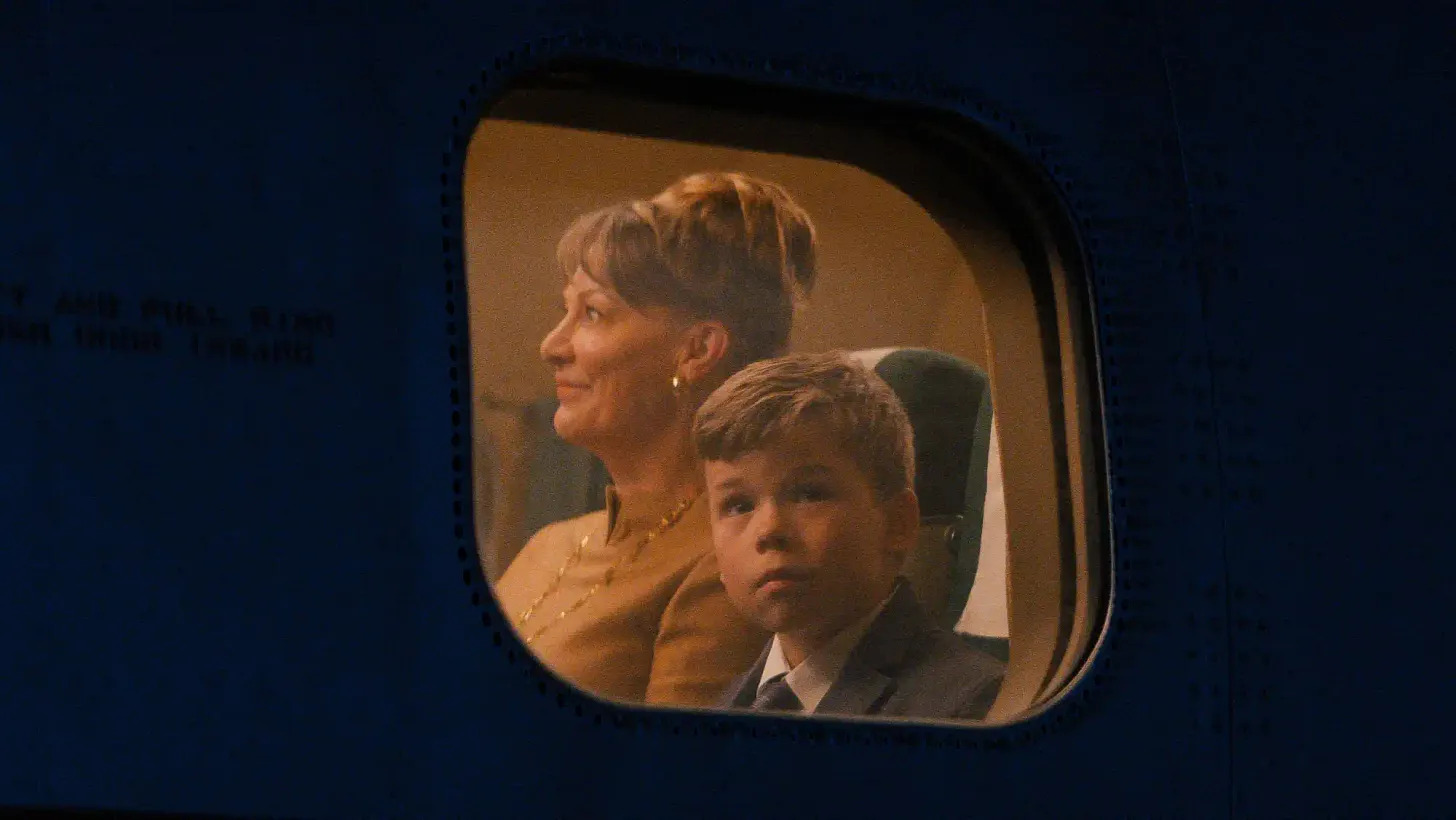 Propeller One-Way Night Coach
 When I was asked for my favorite discoveries at Cannes this year, “the Travolta” was high on the list. Propeller One-Way Night Coach (2026), John Travolta’s feature directorial debut, premiered on the frantic first Friday night, when no one knew exactly what to expect. Before the screening, and following a highlights reel of the star’s career, Thierry Frémaux bestowed an honorary Palme d’Or on Travolta, who was touchingly grateful. But what, we in the packed theater wondered, would his film about a boy’s first airplane flight in 1962 look like?
The answer was an absolutely charming portrait of experience, with a loving attention to detail and sense memory that arrives on screen in living color as if intact from Travolta’s own childhood. Propeller One-Way Night Coach adapts Travolta’s 1997 novella by the same name, based on experiences with his mother, his sister, and, as I learned, other family members. Thinking back to his highlights reel, with scenes from Saturday Night Fever (1977) and Pulp Fiction (1994) readily accessible in the minds of millions, it’s tempting to see Propeller as something like a total-recall excerpt from the movie of Travolta’s life.
Fascinating voiceover narration offers a kind of internal monologue and commentary from the perspective of the boy, Jeff. He’s played by Clark Shotwell, whom Travolta’s daughter, Ella Bleu, described in another interview as evoking her father (“He’s a little him”). She in turn plays a flight attendant who captivates Jeff, while Kelly Eviston-Quinnett plays his mother, Helen, with a keen interest in the world that has clearly proved contagious for her son. This joie de vivre likewise characterized my experience speaking with Travolta, whose generous answers at times recalled the wonderfully observant detail of the film’s voiceover (which, of course, he wrote). It likewise came through in his introduction of the film at Cannes, in which he described himself as a “voyeur, an observer of life.”
Shot over 15 days (five in New York, five in Kansas, five in Los Angeles) after a month and a half of prep, the 60-minute film feels like nothing else out there, and, for me, was a welcome, frankly uncynical oasis amid the frenzy of Cannes. It is now streaming on Apple TV, where the director says it has been the most-streamed film this week.
Nicolas Rapold: Congratulations on the Cannes premiere and the Palme d’Or!
John Travolta: Thanks so much. It was a great experience. And so many beautiful surprises have happened since then. And, you know, Nic, I was just happy to have a premiere at Cannes. That was a complete and 100% honor. So everything that followed, the Palme d’Or, then becoming number one around the world for seven days in a row, I mean, this has been an extraordinary thing. It almost follows the theme of the movie, when the little boy says, “Just when I thought life couldn’t get better, it did.”
Rapold: I felt like the movie really gets the experience of being a child, the sincerity and the richness of a child’s experience, you know?
Travolta: Well, you know, that really was what I was like as a child. I was precocious, and I was also absorbing every minute of my life, especially because it all seemed so special—when I would meet someone, usually my mother’s and my sister’s friends, their experiences in the theater, or whatever I was experiencing. But at the same time there was this glorious trend in music and in fashion and this new freshness in architecture. And the design of aircraft was very beautiful. It appeared to be that the big architects and the artists of the world had vision. The people who designed clothes had vision, who designed cars had vision, who designed planes had vision. Mid-century artists, Marrot and Calder and Picasso, all had this fresh new vision of life that reflected on how we absorbed everything. It was very easy to differentiate moment to moment each new thing that was happening. And as a little boy, or any child really—they’re not distracted. They’re paying attention solely to that new thing that’s happening. So it’s absorbed in your memory banks as a very vivid and colorful memory. And everything in that movie happened. Whether it happened with that particular person or a different character is another thing, but it all was based on truth.
Rapold: In terms of flying on a plane in 1962, what did you especially want to get right?
Travolta: I wanted to get right several things. [Chuckles.] I was more than tenacious about getting it right. I was a little boy that collected airline tickets and schedules and paid attention to all the advertising that airlines offer, along with other advertisements of cars and buildings that were being built. This is all resonating in my memory bank. So what I wanted to get right was the impact of each visual: The colors of an interior of a plane were far different than the colors of an interior of a plane now. The meals that were served were colorful and exotic for the day. You know, it was Chateaubriand and chicken cordon bleu, and they were served with colorful veggies. And the plateware was divine, and the glassware, and everything about the style. The flight attendants, which we called stewardesses then, were in these beautiful outfits that were designed by famous designers: Don Loper and others in the early ’60s, and in the ’50s, Dior and some other big companies. I wanted to get that right. I wanted to get the emptiness of planes. They never felt sold out. They always felt like, because I think people couldn’t really afford to fly, so they felt like they were always a fourth full, you know. I wanted to get right the smoke in the cabin that was mixed with the scent of the food.
I wanted to get right the music that was playing on the radios in the day. There was this beautiful onslaught of Brazilian samba music—Jobim, Sérgio Mendes—and suddenly worldwide, it became popular. And then, of course, the popular tunes of the day: Frank Sinatra, Tony Bennett, Barbra Streisand. All that was my soundtrack. Because we were not just listening to the radio, we were playing records at the house that had all these fabulous sounds. And they correlated with my vision in this movie. They matched everything. When I first saw Breakfast at Tiffany’s [1961], my God, I was seven years old, I think. But that was the perfect song to do walking down that red corridor of the TWA terminal. I walked down that red corridor, you know! The opening credits are designed by Shag, and I put this [Stéphane] Grappelli whimsical violin with it because it reflected the movie’s mood. Then pulling up to [Dave] Brubeck’s “Take Five,” which happens to be the most famous or popular piece of jazz music in history, went with that architecture. That song was out when that architecture was being built. So it could be playing on the radio as you were arriving to that terminal. All these things are when I was a little boy. Also, An American in Paris [1951] had come out with “Rhapsody in Blue” and that beautiful dance that Gene Kelly did. It was a phenomenal sequence.
When I saw a plane I was going to fly on for the first time, that music matched what was going on in my heart and my head. So looking through the window at night with [softly echoing the melody] “quiet nights, with quiet stars, quiet mood for my guitar” just resonated. Or taking off with “Come Fly With Me,” or Tony Bennett, “The Good Life,” with the food coming in, and “A Man and a Woman” at the end—that was, oh my God, just delicious. I could not resist. I said, okay, how do I get the mother next to the dad of Skip, where I see them, how did they wind up [there]? I said, Oh, we don’t have to explain that. Just start with the boys and the hot dogs. I’ll slide over and I’ll play “A Man and a Woman” at the same time. Oh, my God. They got applause at Cannes and applause in LA at the Directors Guild. It’s all these delicious moments that I couldn’t resist.
Rapold: How do you translate these memories into a movie, on the level of shots?
Travolta: Well, the novella 33 years ago was very visual. If you take a look at the book, it’s identical to what is up on screen. It directed itself. It invited visuals that were articulated in the book. Thierry from the Cannes Film Festival said, “How did you get the screenplay?” I said, “Thierry, this is based on a book.” He said, “I didn’t know this was based on a novella you wrote.” And I said, “Yes.” He said, “Well, but who wrote the screenplay?” I said, “I did.” He said, “Well, how did you do that?” I said, “I just lifted the dialogue and the storyline from the book. And it followed itself.” So it was just so easy to frame those visuals and move the camera in a way that grabbed—for instance, in the book, I talk about my mother lighting up a cigarette. That blue box, that half-moon, Newport filter cigarettes. The way she lights up, the way she removes the cigarette—whatever my dialogue was over the narration. I thought, well, all that matters is what that little boy is looking at. So that’s one frame. I need nothing else. And then when I wanted to describe, “but everybody smoked in those days,” there was another angle on her face that rose above the cabin, where you see everybody smoking. So do you see how easy that is to invite?
Rapold: Yeah!
Travolta: So when he first sees the plane, what is he looking at? He’s looking at the engines. He’s looking at the body. He’s looking at the landing gear. It’s massive. It’s in this beautiful setting of an airport. It’s got the dark sky at night. Or when he’s in bed. You know, when I was a little boy, and the planes were flying over the house, I could see them through the window sparkle in the sky in the distance. You need to see me in the bed with my hands up, and all you needed to see was that window with the plane going across the sky and the narration going, “I wonder who was on that plane. Were they sleeping? What were they doing?” It invited the visuals, you know. It was so wonderful that way.
Rapold: You mentioned all these contemporaneous artistic trends that were happening. Were there any more movies that inspired how you wanted this one to feel or look like?
Travolta: One hundred percent. It was eclectic. Because I view this movie—like Thierry said to me—as more than an homage to aviation. This is an homage to movies and actors and cinema and soundtracks and music. He said it’s an homage to many things in this film. And he said, for instance, we forget how big Paul Newman was and what he meant to the movie industry at the time. That was based on a true story. I was trying to impress someone with something when I was younger, and it wasn’t working, and finally I said, well, I’m going to pull out the big card, I’m going to mention Paul Newman. Of course it wasn’t true. But I just wanted to make that impact. And it got so big, the impact, that I was embarrassed and I just left the scene, you know? So the actors I mentioned: Liz Taylor from The V.I.P.s [1963], Paul Newman, Kirk Douglas, Grace Kelly is an homage at the end, Audrey Hepburn and Breakfast at Tiffany’s, A Man and a Woman [1966], Two for the Road [1967]. It was eclectic. There’s a little Bertolucci, there’s a little Fellini—the ten-foot tall man really happened, but it was a Fellini move! The Last Tango in Paris [1972] from Bertolucci is the mother and her whole one-night escapade. So these visuals were also from important movies of the time that affected me. They were over the various years, but they still had strong impact. Black Orpheus [1959], the South American film, was stunning, and the music was stunning.
I was affected by so many, but I can’t say it was one style. It was an homage to all of the era, just like the music was simpatico to each other. They were variations of a theme. But it all fit because it could. It’s as if you designed a house with a little bit of Saarinen and a little bit of Lapidus and a little bit of Frank Lloyd Wright. They would all match because they’re of a similar era. Calder and Marrot, if you had them on the same wall, it would be okay, because they speak to you in a similar way, you know? So I felt like I could really jump around and mix and match, because that’s what my life was. My life was viewing these different visuals, but they reflected what was also happening in film, especially in the ’50s, ’60s.
So I found it cathartic, if you will, to express myself with these visuals stylistically, but it was organic. It felt very steady to me. Having Ella, my daughter, walking slow-motion to the little boy in the aisle felt so perfect. What movie that would be reminiscent of, I don’t know, but I just knew that for this little boy, in his mind, this woman is going slow-motion because she’s so beautiful. And I thought, how do I capture that? “You know what? Film it normal, but give me a take in slow-motion, because I have an idea.” “So, Ella, we’re going to do one now and now do the same energy in your walk, but we’re going to slow the camera down.” So then we did and I went, oh my God, “A Girl from Ipanema” will go so beautifully. And it did. And then when he runs after her to ask more questions, and she’s heartbroken about her boyfriend breaking up with her, and she’s 21, I thought, oh my God, “Two for the Road.” That would be so good here. Then when the mother is talking about her experience in summer stock, where they compared her to Crawford and Stanwyck, and in the book I write about, “We were headed westward, and the light through the window seemingly danced on my mother’s face.” And I thought, Barbra Streisand’s “Lazy Afternoon” always felt like golden light to me. If she’s saying that, and I time it right… So I say, grab me that “Lazy Afternoon” song. And oh, my God, this can’t be: the intro times out where as soon as she finishes her dialogue, Barbra starts to sing. This is perfect. So do you see all these kismetic things were happening? It was like another world, the way these bits were all falling into place, to give the ultimate homage to mid-century everything: architecture, design, clothing, music, the spirit in which we viewed things.
Equally bad things were happening in the world, but we had a little more resilience to what was happening. That’s why I added these bits in the book of hearing horrible things, but the child recovering from them easily, you know, like a child does. It’s not like he’s avoiding it, he’s just having empathy and then his survival instincts go, Okay, well, I’ve got to move on. So it also reflected the spirit of the day. Think of what was happening in the ’60s. You had the Bay of Pigs, the Cuban missile crisis, Russia with the threat of atomic bombs. But we still had this resilience of character. My neighbor, the Liz character, was really in the concentration camp. That was our neighbor, this gorgeous girl that was an actress, who my mother was teaching acting. She told the story of her family. That would be 17 years later, but we still had the post–World War II hopefulness where the economy was good and everybody had a car or at minimum could afford to go away for a week or had an above-ground pool in the back or could afford new clothes for school. It wasn’t a desperate time. Even the World’s Fair, when it came out in ’64, it was, Wow, that’s the future. And when I walked down those hallways at TWA when I was a little boy, it was “The Jetsons”—where’s the flying car that’s going to be waiting outside? That was the kind of hopefulness we had. Dreams felt possible, you know?
Rapold: I love that part of our access to his world is through the voiceover, which is kind of his internal monologue. How did you approach that?
Travolta: I approached it like I was an adult stating what were the fleeting thoughts of a child, with almost a childlike tonality about it. In other words, when you recall a memory—for instance, I remember being on a flight, and it was a fairly empty cabin, it was late at night, and this cordon bleu was being served. I was so excited because it looked like fried chicken. Now, today I would love cordon bleu. But in those days, I wasn’t so sure. So here I am hungry because it’s late and I hadn’t had dinner yet. And I poke into it, and all this cheese oozes out. And I remember thinking, well, I like chicken, and I like cheese, but I don’t know if I could eat them together. That was an innocent thought. But it’s stated like a child, in a child’s cadence, do you know?
Rapold: He’s also noticing more than he sometimes can let on about his mother, which is funny.
Travolta: Yeah, he was aware of everything that was happening—her flirtatiousness, her proclivity to drink and smoke. But he wasn’t judgmental. That’s what made that little boy special is he didn’t judge anything. And even if she did something with Harry, what was more important is that we got back to the airport. He gave everything the correct importance. He didn’t evaluate or judge character based on that. He was asking questions, he wanted answers, but he was observing correctly, you know? When he said, “I felt bad for Liz,” he had some understanding of that, because Sunday night there was the late night program about the concentration camp, so he knew what she was talking about, the pain. The airplane crash really did happen. That was that famous airplane crash in 1960 at Idlewild. My sister’s father-in-law really was booked on a plane that was going from Chicago to New York and would not be let on. He was kicked off the plane. He was furious. He goes back to Park Ridge in Chicago, and he turns on the TV—and it had crashed. So that character reading the paper and shaking the whiskey glass was true, you see. All these memories I have. But look at the boy’s point of view. He’s going, “I could understand why that man is frightened, but how could I help him? My toy is broken. It’ll scare him just to look at it.” And then, “Oh, I have a good idea.” He recovers. “I’ll go to the cockpit. Maybe the pilot could fix my plane.”
Rapold: I love how it’s a child’s train of thought.
Travolta: Exactly. And then the pilot does. But I love how he observes his mother. Like when she’s talking about summer stock, he’s really giving his mother space to pontificate about herself, you know. And then when he’s watching her have dinner. He’s enjoying watching. He doesn’t want anything that’s in that fancy food. But he loves that she’s enjoying it. He’s observing her look at the back of the plate, because she loved expensive china and glassware. It’s a beautiful quality for a child to have if he’s cognizant of others’ behavior and he’s an observant child. He observes all these things in detail. So that’s a stream of consciousness.
Rapold: I was telling people about that quality of the movie—all the sense memories and a kind of stream of consciousness. And in terms of being observant… You’ve acted in movies with directors like Quentin Tarantino, Brian De Palma. What did you glean from being on those sets that you might have taken to directing this movie?
Travolta: Well, if you took each director one at a time, I could break down some of the things that I remember. I watched people make great movies, mediocre movies, not-so-good movies, and just okay movies. And you have to learn something from that, right? So I sifted down the things that were valuable and mattered. I realized, for instance, with Quentin, you can tell a story efficiently without having to cut to every single thing that is described in a script. People are smart when they’re watching movies. In Pulp Fiction, I was so worried after I did the speech in the movie about how I had to go home, and I can’t take advantage of this moment with this girl, I’ve got to just get out of here, and then he discovers her overdosed on the floor. I said, “Quentin, do I really have to, you know, respond to her and then take her out to the car?” And he said, “No, no, no. We’re not even going to see your response. We’re going to hear you, but I have a close-up of her vomiting, just a tight close-up. We’re cutting right to the car.” You know what happened. I don’t have to tell you all the details of what happened. Efficiency, you know.
What I also learned was not to do too many takes. Be well rehearsed. The better you’re rehearsed and the better the actors know what they’re doing, they won’t be rehearsing on screen. Then in your post work, putting the editing together, you won’t have to look hard to find the best moments. They’re going to be there right in the first takes. And it really worked. It also gives a speed where your actors are excited because they’re moving quickly. The crew is excited because they got a good setup. They got their product. They’re moving on to the next scene or the next angle. People like feeling a sense of productivity during the shoot, do you know?
And then casting. Mike Nichols felt—and Brian felt the same way—90% of your issues are: is everyone right for those characters? And if they are, you don’t have to work very hard at getting performances. It’s what my mother said when people would come to her and say, “Can you make my son or my daughter an actor?” She said, “No, it’s an inborn thing. It’s a natural thing. I can help guide them, but I can’t teach them how to act.” So I could help tweak them and recommend and suggest, but I can’t give them that talent. They have to have it. And that’s what I feel about casting. If you’ve correctly cast, they already own that character. Now you can just suggest little things that might make that character even more alive, or give color and dimension to the character and to the scene. And that’s the fun part, you know. That’s delicious. But if you miscast and you’re having to really micromanage everything an actor does. That’s a problem, you see. So there are many things that I’ve picked up over the years.
Rapold: I also wondered about how you shaped the movie, because some people might expect that there has to be some big conflict or drama. The boy’s going to get lost in the airport or something. You know what I mean?
Travolta: [Chuckles.] Yes.
Rapold: Did you feel that pressure?
Travolta: Oh, gosh, no! I felt the opposite. Because I knew it was a cool journey, and I knew these people were very interesting and bizarre, some of them. I knew these experiences could hold interest by their nature, do you know? I just knew that there was a minimum amount of conflict needed, because I felt like I was transporting people to another era. In that journey, nothing dramatic had to happen other than the observation of these fascinating people that he sees along the way. And that would be enough as long as the experience and the visuals and the music held your attention. All the stated drama, you didn’t need to see it actually. I mean, you saw a reflection of it: the nervous passenger, the crazy behavior, and the acceptance of a person’s past. That was enough because it was more interesting to take you on a trip and let you experience what it would be like. And every stop offered a different vibe, a different feeling. I feel like it awakened the senses, like when you go to a Michelin-star restaurant and they give you something that you’ve never tasted before and everything becomes alive in your mouth. That’s the drama—the effect that it’s having, more than you have to have drama within it. The little boy’s plane that breaks, and this stewardess is so kind to tell him that even real planes break—it’s enough because you’re transported to this time where that becomes the most important thing.
I trusted the vision of it. I trusted that it would be compelling. And it’s the right length. An hour was perfect. Even Thierry and Eddie Cue [of Apple] both said to me, “You know, you could have made this longer and you could have made it shorter, but it wouldn’t have worked. You made it exactly what it had to be.”
Rapold: You wrote the book first, Propeller One-Way Night Coach, which was published in 1997. Why was this the right time to make the film?
Travolta: Well, it was like the book, because I wrote it in ’93 for my family. I made 70 copies. Everyone loved it so much that they encouraged me to release it as a novella. And so I found a book agent and they said, “You know, Warner Brothers would be willing to publish this. You don’t have to change anything. They like it.” I went, “Let’s do it.” So in ’97, I released it as a book. Then I got a lot of interest, people wanting to produce it as a little movie. But I thought, it’s so personal, it’s so intimate, that I just couldn’t afford for them to get it wrong, because it was so subjective. So I just waited and waited. And then, to be perfectly honest with you, a year and a half ago I said, you know, Come on, John. I was 70 and turning 71. I said, if you don’t do it now, you’re never going to do it. So just freaking finance it, produce it, get your vision, get exactly what you want on screen. Don’t let anyone interfere with it. And then go sell it, just like you did with the book. You wrote it for your family. Make this movie for yourself and the vision that you imagine, like someone would a painting, and see if the painting is relevant and people respond to it.
So I did. The first person I took it to was Eddie Cue [at Apple], and he said, “This is spectacular.” He said, “John, you have to sell me this movie because you want the world to see it, don’t you?” And I said, “Yes.” He said, “I will make sure the world sees this.” He said, “This is an important movie.” So then, cut to three months later, I go to Cannes and Thierry watches it, not knowing that Apple purchased it. And he said, “I can’t see anything wrong with this movie. I love it.” And then he asked 45 minutes of questions about it. And he said, “I’ve never done this before, but I’m going to accept you as the first selection of the Cannes Film Festival five months before. We’ve never done it before. And I’ll make sure it’s a very special night for you.”
So I was crying, because I didn’t know what to do with that. And he said, “Has anyone seen this yet?” I said, “Well, actually, Apple did, and they want to buy it.” He said, “Oh, darn, I wanted to be the one to introduce it to the world, but I could still introduce it to the world,” he said, “so let me lead the way, and let Apple lead the way, and together we’ll make this beautiful for you.” And they did. I went to the Cannes Film Festival with two pillars of strength. And it’s because I think it was new to them and fresh and had hope. And then when they found out how much it cost, Thierry said, “Now you’re the most important film in the festival, because I want your piece of art to show everybody that film can be made at a low cost and still be impactful.” It was really remarkable, when people declare something and then make it come true for you. I love it. It’s so not show business. It’s so human. It’s special, you know.