Back to selection
I Shot I Shot Andy Warhol
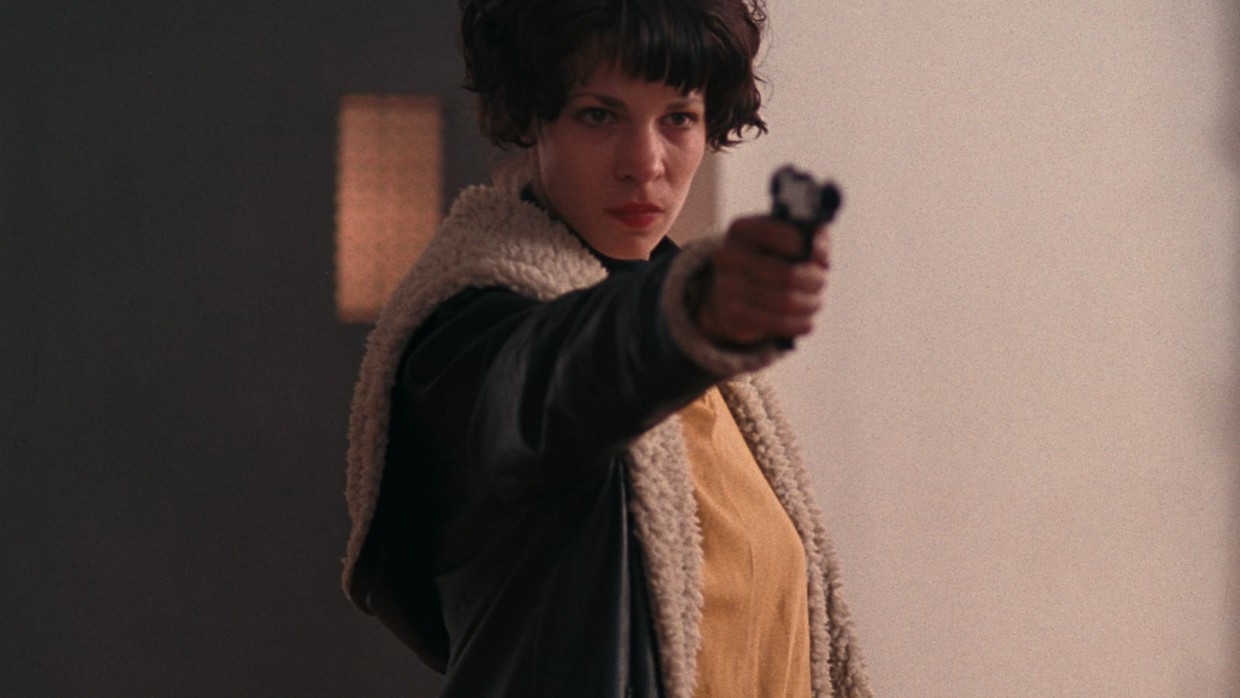 I Shot Andy Warhol
 Before she brought the charismatic serial killer Patrick Bateman to life in American Psycho (2000) Mary Harron devised a portrait of another kind of New York pathology with I Shot Andy Warhol (1996). When I went to college, there was a poster for the film hanging in the hallway of the cinema studies building: Lili Taylor, patron saint of 1990s indie cinema, staring down the camera with a gun in her hand. Even then, I knew the story carried a particular charge. Valerie Solanas was the radical feminist who shot the pop artist, nearly killing him, and her 1967 SCUM Manifesto remains one of the most intriguing documents of 20th-century radical feminism.
Harron’s debut feature follows Valerie (Taylor) through the margins of New York’s downtown art world as she hawks copies of the manifesto (”Two dollars for men, one dollar for women”), struggles to get her play Up Your Ass produced, and drifts into the orbit of Warhol’s Factory. Taylor brings a deadpan swagger to Solanas, playing her as an outsider who can be neither contained nor ignored.
The cast—Martha Plimpton, Michael Imperioli, and Stephen Dorff (as Candy Darling) among them—captures the spirit of the decade’s independent arts scene, as does a soundtrack featuring Yo La Tengo and Pavement. After Lou Reed denied Harron permission to use Velvet Underground songs, she enlisted John Cale to compose the score. The result feels less like a direct period reconstruction and more like a living document of New York at a particular moment.
Now returning to screens in a new 4K restoration, Harron’s first film remains as provocative and alive as ever. Following up on Rose Troche’s Spring 1996 cover interview with Harron in these pages, I spoke with her about the film’s long journey to the screen, what the restoration reveals, and why Valerie Solanas continues to exert such a powerful fascination.
Elissa Suh: Have you seen the film recently?
Mary Harron: I watched the playback after Ellen Kuras had finished supervising it. I watched it without sound, which is a beautiful way to see a movie sometimes. It looked amazing.
Suh: Did anything surprise you, watching now, in that way?
Harron: You’re just able to see Ellen’s beautiful lighting and the colors. It’s very naturalistic. The Factory is this kind of dream world, but it’s all realistic, so it made sense to have colored light in different places. I’m really impressed with how she created this slightly magical world while keeping its grunginess. It looks both gritty and beautiful—but not too beautiful, which is important.
Suh: SCUM Manifesto has had a long cultural life, claimed and reclaimed by feminists, radicals, even TERFS. What was the consensus around it in the late 1980s and early ’90s when you were making the film?
Harron: At the time, it was really a very small group of people, radical feminists, who even knew about the manifesto. Valerie had been giving it out, and [Maurice] Girodias published it, but I don’t think it was part of the conversation the way that other significant feminist texts were, like Shulamith Firestone’s. It would’ve been seen as a weirdo outlier. I first learned about it as a kind of joke, amid my obsession with Warhol, the Factory, and the Velvet Underground. This crazy woman had this manifesto. It felt darkly comic. She had formed this organization, of which she was the only member. I think it wasn’t until some French feminists republished it—and I believe someone did a graphic-novel version, too—that it started to circulate more widely. I found a copy in a left-wing bookstore while I was working as a researcher on a Warhol documentary, and I was completely stunned by how brilliant it was.
Since then, I’ve always been impressed by its reach, because it spoke to other people the way it spoke to me, like a lightning bolt. I remember sitting on the subway after I’d bought it, reading the first line: “Life in this society being, at best, an utter bore…” I thought, Oh my God, this is so elegant, like Evelyn Waugh. The way she writes is so stylish and sophisticated, her irony so spot on. I love good writing, and nobody ever said she was a great writer. Nobody said she was funny. But as I kept reading, her dissection of the absurdity and injustice of modern society, built on this assumption of female inferiority, that really hit me. Even in the ’80s, I was still struggling against a lot of condescension.
Suh: It reminds me of when she says in the film, that Andy had too much control, the publisher had too much control. In a sense, she’s right, maybe not literally, but it is the men who have control over her and over women in general.
Harron: Even the ones who were sort of her allies. You’ve got to give Warhol credit. He had such an eye for talent. The way he discovered people in the ’60s Factory was pretty amazing: Ondine, Candy [Darling], Jackie [Curtis]. He saw something in all these brilliant people. Girodias, who had discovered so many writers but ripped them all off, didn’t pay royalties. Valerie wasn’t wrong about that. But she joined a pretty amazing group of people he had published. She was starting from such a position of despair and outsiderdom that she was always too much trouble in the end, even to people who had supported her, about whom she’d been so hopeful.
Suh: The Factory has been so thoroughly mythologized. We go in with Valerie as our POV, our guide into this world, and your Warhol occupies this strangely passive position. He and Valerie can’t figure each other out. They are simultaneously drawn to and repelling each other.
Harron: I had met Warhol twice: once at a friend’s birthday party in the ’70s, and once when I came to interview him at the Factory. What struck me most was his incredible fragility and elusiveness. Twenty minutes into the interview, he said, “Oh, Brigid [Berlin], you come do the interview,” and just passed it on. That was his dynamic. But the other thing he did was take a very intense interest in people, and all these hungry-for-attention people would blossom, and then he would just turn away. Some people went off the deep end because they couldn’t take that loss of attention, that rejection, including Valerie. I thought of him as a great artist and a flawed human being who could be cruel and cold but was also kind and sensitive. When Jared Harris came in, he was the first person to catch that vulnerability and play it from the inside. I never wanted heroes and villains. I was obviously more focused on Valerie’s story, but I wasn’t out to assign blame. I got criticized for it at the time—for not delivering a clearer narrative of who’s right and who’s wrong. But to me, the point is to make you think. Your sympathies will ping-pong around, and out of that, hopefully something real will come.
Suh: A lot of the subjects of your films are kind of people that the culture can’t easily metabolize. Is that a preoccupation you came to consciously?
Harron: I’m not entirely sure. My first two films defined what subjects came my way and shaped what people thought to send me. When I was at the BBC, where I started directing, much of my work was comedic: parodies, satires. I think of all my films as comedies in a weird way. But I think there’s a part of me that has always felt like an outsider, even with a full family life and everything, and my heart responds to loners, outsiders, people who have been disregarded or despised. I’m very drawn to that.
Suh: You were very much an outsider at the time as a woman filmmaker when the film was made. What was it like getting it made with a subject this explicitly feminist? Did you have to argue for Valerie’s legitimacy?
Harron: I was very lucky. I had one friend, a BBC producer who was remarkably interested in radical feminism, and he said, “If you can find other funding, here’s £100,000.” So I came to New York with a little money promised. Then, after five years of working on it, I was incredibly lucky to meet Christine Vachon and Tom Kalin at the very beginning of New York independent film.
Suh: You mentioned satire and one of the things about the SCUM Manifesto is that people always wonder: Is she serious? Is she being satirical? Is she crazy? Is she sane? Was it ever your intention to settle that question, or to keep it productively open?
Harron: Leaving it open was always my instinct, because I don’t think you can categorize it. It shares elements with [Jonathan Swift’s] A Modest Proposal, but it’s not a completely self-contained work of satire with a specific political goal. Categorizing it as satire almost keeps it in a safe place it doesn’t really belong in. It’s not really reconciled. It’s both brilliant and fantastically well-written but also disturbing and awful at moments. I never lost that feeling of wonder whether she really means something. The ending is very nihilistic: Who cares about humanity? Why should we even reproduce? Those elements don’t discount what is great about it. You have to take the whole package and make up your mind.
Suh: I know you have daughters. Have they seen the movie?
Harron: Yes. I was very excited when they came to see it a few years ago at a screening Madeleine Olnek had organized. I love Madeleine’s work, and she chose my film to present. My daughters were in their late teens or early twenties, and they loved it. I was really pleased, because afterward they said they felt that I had handled the gender politics well, which they don’t always feel when watching films from that era.
Suh: The film meets the moment in a particular way right now, especially given internet culture and the way things can be so sarcastic, so many things at once. Valerie might have been more successful today.
Harron: She might have thrived. You can make your own fame now in a way you couldn’t in the ’60s. I find that exciting about Gen Z and the opportunities to create, to find an audience. You get the terrible side of it too, obviously. Clavicular just made an American Psycho film entirely untouched by irony [since deleted]. But Valerie could have found a voice, found an audience, in a way she really couldn’t then. When I first read the manifesto, I was deeply frustrated. I hadn’t yet started directing, hadn’t found a way to express myself. I totally related to her longing to make something. I sympathized with that completely.
Suh: The film has a different energy from most biopics. Would you even call it one? What were your models at the time?
Harron: I don’t think I had a model. I had learned a lot from working as a researcher on documentaries, particularly a major Warhol documentary, and from making short films for the BBC on various artistic subjects. I had filmed essays where I’d shoot on Super 8, combine formats, do voiceover, parodies. I was working out my aesthetic, pushing back against quite conservative BBC crews who didn’t want to do what I wanted to do. By the time I made the film I’d had maybe seven years of directing, and in that time I’d learned to trust my instincts against opposition, which is one of the most important things you can learn as a director.
Ellen Kuras and I really loved the look of Kids (1995), that kind of poetic realism, naturalism, available light. And I had all these photographic sources. For the hotel sequences, I brought in Diane Arbus: a lot of negative space, empty rooms, just a couple of things on the wall. We rented a lot of photos from Magnum. I got everybody looking at documentary sources from the period for the shooting style: energetic, naturalistic. I never watch dramatic films when I’m working on a period piece. They’re too stylized. If you’re trying to recreate a period, go look at magazines, real life, documentary material. Then you’ll create your world.
Suh: The film is being rereleased at a moment when feminist rage and debates about what forms it’s allowed to take are very live. Do you think it means something different now than it did in the ’90s?
Harron: It’s funny—in the early-to-mid ’90s, there was that book Backlash [by Susan Faludi], about the conservative reaction to feminism. Nobody wanted to come out and say they were a feminist. Nobody wanted to hear about angry women. Then, a few years later, everybody was claiming the label; it became the thing to do. Now there’s been this extraordinary, brutal, clumsy backlash that’s almost beyond parody—like a Dr. Strangelove that, if it were satire, you’d say was heavy-handed. It all happened so fast. You’re in one world, and suddenly you’re in another. I’ll be very interested to see whether the film strikes a chord because of our current awful situation.
Suh: You’ve spoken about the ending being a little different than what you had originally intended. It concludes with a note that SCUM Manifesto has become a classic radical feminist text, instead of the biographical detail that Solanas died in a welfare hotel. Do you still have misgivings about that decision?
Harron: I think now it makes more sense. At the time, it seemed like a stretch, but the manifesto has been republished and discussed so much since then that there’s more justification for it now. There’s a part of me that still likes the bleakness of [the biographical note]; I’d rather focus on the poignance at the end than do anything more ideological. I’m fine with it, really. It’s become true in a way it wasn’t 30 years ago.
Suh: The Factory is full of women who were celebrated and then discarded. Did you think of it as a specifically gendered economy, in terms of what it offered to women and what it extracted from them?
Harron: In a lot of ways it had the ruthlessness of a Hollywood studio. When Edie Sedgwick becomes too difficult, she’s no longer the star. You bring in someone new and easier to deal with. That’s classically Hollywood. What I find fascinating is how Warhol brought in people who were otherwise completely shut out: the drag queens, the trans women. These completely brilliant people who he gave, at least briefly, a form of stardom. He changed America in that way. I think Warhol had more to do with bringing a gay sensibility into the mainstream than anyone—he just slipped it in. In some ways, he found trans men easier to deal with than biological women. I think that was probably a source of rage for Valerie. He did put her in a film, but there was a ruthlessness to it. People like her would be discarded.
Suh: Would you say Valerie was transphobic?
Harron: In a way, yes—and yet she was friends with all these people. But you can’t really look at someone through the ideology or language of now. If you’re going to understand somebody in 1968, you have to go back and think about how people then thought and talked. She had a very essentialist philosophy. She’d studied biology, and her thinking about what men and women were was based on chromosomes. Men were missing a chromosome and therefore biologically inferior. I don’t find that the most interesting part of her theory, personally. What I love is her analysis of politics and power, the way people conform to absurd stereotypes. That’s what’s brilliant. But because of that essentialist framework, she held that men cannot be women—whereas now, almost 60 years later, we understand gender and identity very differently. I don’t think we can simply impose our current thinking onto her.
Suh: Some contemporary critics have actually argued the manifesto is a trans-affirming text.
Harron: I know, and God bless them. I think people get what they need from a text like that, and interpret it the way they need to for now. Personally, I think that’s a stretch, but I’m open to it. People get what they need, and I’m happy with that.