Authors — Holly Willis
-
The Art of Angling: The Making of Rose Troche’s Classic Microbudget Lesbian Love Story, Go Fish
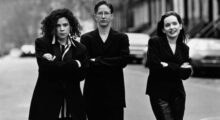
1994’s Go Fish, Rose Troche’s smart, punked-out work of guerilla filmmaking, combined a playful take on lesbian dating with discursive dialogues around gender politics and the cultural history of gay female representation. Part of the late ’80s and early ’90s low-budget boom of what critic B. Ruby Rich dubbed New Queer Cinema—films such as Poison, Swoon, The Hours and Times, Born in Flames and The Watermelon Woman—the Chicago-set Go Fish finds hip college student Max (Guinevere Turner, also the film’s screenwriter and producer) in a romantic rut and set up by friends with a hippie-ish older lesbian, Ely (V.S. Brodie). […]
by Holly Willis on Dec 15, 2023 -
Crash Course: A Professor Quickly Learns about AI
Earlier this year, as ChatGPT, Midjourney, Runway and a long list of other AI tools ignited a national conversation about artificial intelligence, many of my colleagues in the School of Cinematic Arts at the University of Southern California shuddered in horror over the displacement of human craft and creativity by visuals created through simple text prompts. Published in The New York Times in February, columnist Kevin Roose’s description of his creepy conversation with Bing added gasoline to the fire, prompting a desire to prohibit the use of all AI across all of our programs. And what about plagiarism?! The general […]
by Holly Willis on Jun 27, 2023 -
Paradigm Shifts: TV-Focused Curriculum Changes at Three Film Schools
A couple of years ago, I was chatting with writer Jack Epps, a colleague of mine at the School of Cinematic Arts at the University of Southern California. We were marveling over the rise of the limited series as a format, and he explained that it allows for an expanded second act. “You can really develop the relationship between a protagonist and antagonist,” he said, using Killing Eve as a great example. I was intrigued by the idea that new formats could allow different aspects of storytelling to emerge so, for this issue’s column, I asked the heads of three […]
by Holly Willis on Mar 16, 2023 -
Daydreaming, Neuroscience and Screenwriting: The Imaginative Teaching of Mary Sweeney

“I have always had a hard time explaining my creative process to people,” says Mary Sweeney, a professor of screenwriting in the John Wells Division of Writing for Screen & Television at the School of Cinematic Arts at the University of Southern California. Sweeney boasts a long list of filmmaking credits but may be best known for her collaborations as a producer, writer and editor with filmmaker David Lynch. In particular, Sweeney edited Lost Highway and Mulholland Drive, two deliriously dreamy films that highlight a form of poetic cinema and a creative process that Sweeney hopes to share with students. […]
by Holly Willis on Dec 15, 2022 -
Field Trip
Technically, Sara Velas is not an educator, nor does she work for a film school. She doesn’t fret about curricula, teaching styles or shifts in filmmaking technology. Instead, she operates the wondrous Velaslavasay Panorama in the West Adams area of Los Angeles, where, semester after semester, I take groups of students on a field trip to experience old-school immersive media and think about ways in which media forms shift and change over time. Ninety feet in circumference, Shengjing Panorama—the panorama currently on view—features a painting of the Chinese city of Shenyang between the years of 1910 and 1930. Created in […]
by Holly Willis on Oct 11, 2022 -
Still Looking: Gail Segal and Sheril Antonio’s Dramatic Effects with a Movie Camera
In their new book, Dramatic Effects with a Movie Camera, Gail Segal, a poet, filmmaker and associate arts professor, and Sheril Antonio, an associate arts professor in the department of art and public policy, both at New York University’s Tisch School of the Arts, describe a form of shot-by-shot film analysis that can teach filmmakers the nuances of cinematic storytelling. Recently published by Bloomsbury Publishing, the richly illustrated book is based on an NYU graduate filmmaking course taught more than two decades ago by Segal. “This class was an investigation of film technique,” Segal explains, “with the goal of applying […]
by Holly Willis on Jul 14, 2022 -
Simple Machines: The Inspiring Teaching of Experimental Animator Jodie Mack
“Find the note, and then deviate,” urges experimental animator Jodie Mack. The colorfully clad artist is a third of the way through her antic presentation to the November 2021 Film Friends gathering hosted by the Echo Park Film Center. Now in its second year, the monthly online series this go-around is focused on “simple machines” for filmmaking. Mack has been cheerfully showing some of her own creations, like a bicycle-driven zoetrope, but speedily moves on to her love for singing. “My voice is a simple machine!” she rhapsodizes before breaking into a wide-mouthed croon, one or two notes above the […]
by Holly Willis on Apr 14, 2022 -
Pedagogical City Hopping: the DocNomads Film School
“What if we create a curriculum for a school we’d like to attend ourselves?” That question was the foundation for a group of five educators who gathered in Lisbon, Portugal, in 2011 to brainstorm an entirely new two-year Masters-level film program dedicated to documentary production. The partners came from Lusófona University in Lisbon; the University of Theatre and Film Arts in Budapest, Hungary; and LUCA School of Arts/College Sint Lukas in Brussels, Belgium. Vítor Candeias, who represented Lusófona University in designing the program and is a course director as well as a documentary filmmaker, says that the original idea was […]
by Holly Willis on Jan 18, 2022 -
Environmental Storytelling
In August 2021, the United Nations’ Intergovernmental Panel on Climate Change issued a new report on the global state of the environment, highlighting the shrinkage of glaciers, warming of oceans, massive forest loss, extreme heat, devastating drought and more. While the report is crushing, it is also fuel for action. Indeed, the BBC’s climate editor, Justin Rowlatt, suggested that 2021 could be the year for finally making climate change a top priority, citing the upcoming UN Climate Change Conference in Glasgow in early November as just one landmark event that could help consolidate action. For filmmakers teaching in universities, the […]
by Holly Willis on Oct 11, 2021 -
Wanda: Film from the Future
Still Life: Notes on Barbara Loden’s Wanda (1970) Anna Backman Rogers 154 pages Punctum Books, 2021 One of the complaints made about feminist films of the 1970s and ’80s was that they were too experimental, too avant-garde, too elitist. They refused the pleasures of pop cinema. They skipped the well-told story and refused the escapism of character identification. And beauty? Forget it! Take Barbara Loden’s Wanda, from 1970: it’s a desolate portrait of what New Yorker critic Paulene Kael dubbed an “ignorant slut” in a film described by Jump Cut’s Chuck Kleinhans as “flat and opaque.” Indeed, Wanda, who is […]
by Holly Willis on Oct 5, 2021