Leonardo Pirondi
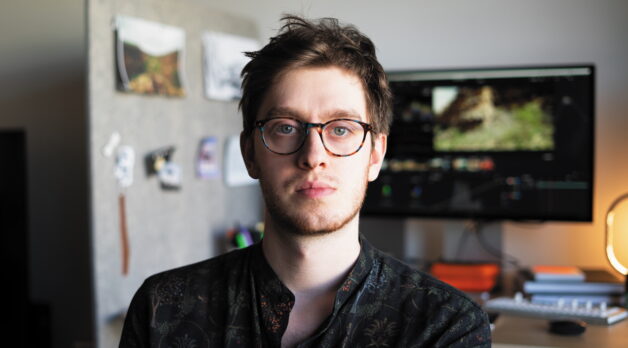 Leonardo Pirondi

In Leonardo Pirondi’s upcoming debut feature Fractais Tropicais, a small crew of Brazilian archivists aboard a biodome spaceship tend to Earth’s few living remnants in the aftermath of civilization’s collapse. While the team digitizes copies of plants and birds into an intelligent system that slowly gains sentience (and control), a lone man roams across an Earth in ruins. Combining analog film practices with digital imagery, the dystopian narrative examines the politicized substructures inherent in preservation during times of crises—who or what gets saved and why? Pirondi connects with post-apocalyptic frameworks as a response to living through our current fraught moment. “I think there’s an anxiety that’s very particular to my generation, but also particular to anyone living in this time of wars and rising dictatorships,” he explains. “How can we, through cinema, create this possibility of a reset?
Growing up in São Paulo, Brazil, Pirondi absorbed a media diet of cartoons, Star Wars and the work of Cinema Novo pioneer Glauber Rocha, which inspired him to embrace tactile visual images and a “low-tech way” of creating moving pictures. As a teenager, he began editing videos for a Brazilian production company’s YouTube channel, eventually directing music videos for them. Pirondi enrolled in CalArts in 2018, where he studied under filmmakers like James Benning, Rebecca Baron and Calum Walter in the school’s film and video program.
“It’s a pretty avant-garde program, sometimes to a fault, but [they] give you the tools and allow you freedom,” Pirondi says. “They allow you to make your own films, which is the reason why [I was able to] develop my career while I was in school for a long time.” He attributes his relative productivity—completing 13 short films in eight years—to CalArts allowing him to keep gear at home for long stretches, a creative boon in the early days of COVID.
CalArts was also where Pirondi locked into 16mm as his chosen medium, citing film’s fundamental limitations as a positive artistic influence. “I think it aligns with the way I work,” he says. “It makes me think about what I’m working through, and it makes me more considerate about how to frame things.” He mentions the “self-contained” nature of the camera, which supports his practice of working with smaller crews and condensed structures, and the therapeutic ritual of hand processing the film itself. “I also have astigmatism,” he continues, “which makes everything a little soft, even with glasses. 16mm specifically matches that softness.”
Though Pirondi is committed to shooting analog, his films routinely embrace modern, evolving technologies. His short film Vision of Paradise uses virtual reality and 3D modeling to explore the ways human beings have always tried to “expand the frontiers of the visible,” whether via cartography or computer simulations. Two recent shorts—When We Encounter the World (co-directed with Zazie Ray-Trapido) and Adrift Potentials, which screened at NYFF and TIFF, respectively—similarly use reflexively metafictional structures to examine how depictions of reality intersect with the fuzzy, politicized nature of memory.
Hybridized frameworks come naturally to Pirondi, who views cinema as a natural blend of fact and fiction. “As you turn a camera on, even if it’s a VR camera that shows every side, you still chose that one single location in the world [to film]. There is a choice, and it’s not pure reality.” This worldview connects with the impulses animating Fractais Tropicais, which uses a science fiction premise to explore the insufficient ways we remember a dying world. “I’m trying to experiment with the ways of seeing and perceiving these images as a way of documentation. Digital [replicas] produced by 3D models of specimens of our world—they’re trying to justify it as a real way to preserve these things. But they’re still digital objects that are extremely flawed and hollow, right?”
As he wraps up post-production on Fractais Tropicais, which is set to premiere next year, Pirondi is currently in the process of writing two other narrative features: Amerika’atinga and Contos do Céu à Margem do Rio (Tales from the sky to the riverbank), both films that continue the director’s practice of using the fantastic to investigate how we adapt to a displaced, precarious culture. “I don’t want to make personal films,” he says. “I want to make films that expand the idea of how we should be thinking about what other civilizations might emerge within the scope of our world.” —Vikram Murthi/Image: Zazie Ray-Trapido