Yeelen Cohen
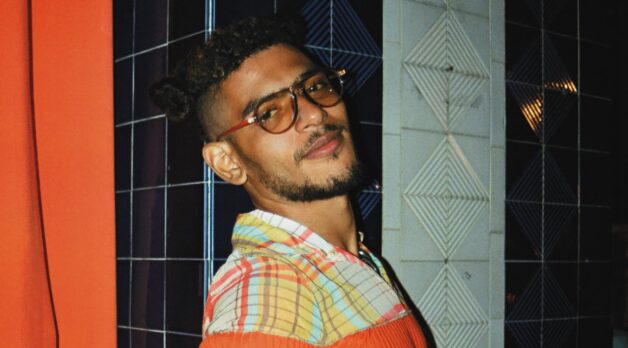 Yeelen Cohen

Yeelen Cohen was two years old and running around a Malian restaurant in Paris when their mother called out their name. After confirming the child was named after Souleymane Cissé’s landmark film Yeelen, the owner promised to put them in touch with the African filmmaker, who was in town at the time. In short order, the young Cohen met Cissé. Their parents, both documentary filmmakers, captured the experience. “We have these iconic pictures of us just staring into each other’s souls,” Cohen says.
Decades later, after reconnecting with the director, Cohen set out to make a film about and with Cissé. A work in progress, Lights of Passage chronicles Cohen’s relationship with their mentor as they embark on an initiation journey that parallels the personal voyage of the young sorcerer at the heart of their namesake film. By hybridizing documentary portraiture and the first-person coming-of-age film, Cohen chronicles the story of Cissé’s life and career, as well as their own developing creative voice.
Describing the film as about “time, consciousness and light—[the] three factors that also make up what cinema is,” Cohen explains that, like Yeelen themself, it explores ideas of power, knowledge and generational clashes. “The apparatus of a camera and the art of cinema [is] loaded with power dynamics. [In] my relationship to Souleymane, [I’m asking,] ‘Are you going to teach me, or are you gonna throw me in the pool so I can learn how to swim’? It’s kind of the latter but with certain guidance, too. That’s why I’m calling it my ‘initiatic journey,’ because I’m piecing together the secrets of my purpose but also learning how to harness and master images and light.”
The Brooklyn-based director traveled regularly to Mali and Paris to meet with Cissé and, by their own estimation, became a part of the filmmaker’s family in the years leading up to his death earlier in 2025. But filmmaking has always been a family affair for Cohen. Their parents relied on their extended family to help with their nonfiction projects over the years. Cohen worked as an assistant director on their mother Guetty Felin’s film, Ayiti Mon Amour, alongside their father Herve as well as partner Jazmin Jones; the latter two worked camera on this. Later, Cohen worked as a cinematographer and editor on Jones’s documentary Seeking Mavis Beacon, also produced by Felin. “My filmmaking practice is really informed by the village and ecosystem of [family] filmmaking,” Cohen says. “[Since] the boundaries are so porous, the type of rawness and vulnerability you’re able to capture is completely different. It’s definitely prepared me for this massive undertaking, this sense of community filmmaking.”
Cohen moved around a lot as a kid before calling New York their home. They attribute an early internship with Cheryl Dunye while she was in residency at the San Francisco Film Society FilmHouse program to learning how to be multidisciplinary in their approach. “[Working with Cheryl], you’re not just there with one job. You have three jobs. That also prepped my own filmmaking practice of directing projects. I want to be around people who are Swiss Army knives.”
Later, they attended the New School, where they took a class, Personal Documentary, taught by director Caveh Zahedi, that “changed [their] perspective as a filmmaker” and which they calli the Project Runway of documentary filmmaking. Cohen had to shoot a film every week with a different theme, which ultimately forced them to carve out their voice. (“I literally don’t remember any other classes that semester because I was so focused on that class.”) While in school, they assistant edited Zahedi’s metafictional series The Show About The Show, which allowed them to apply the skills they learned in class onto a project with greater visibility.
Lights of Passage is being produced by their mother as well as Kirsten Johnson. They hope to finish the film in the next year, mentioning Cissé’s passing as a sign that the end may be near. When asked whether they felt like they got what they needed from their mentor while he was still alive, Cohen says that Cissé not only gave them so much but that he spent his entire life “giving back to the youth. [On] the day he died, he was having a conference with film students in Bamako. One thing he would always say is, ‘I’m projecting myself in the future.’ Of course, there’s so many things [you wish you asked], but part of sitting with all of my footage after his passing was [being] grateful for every second of him on screen. I think right now my job is to synthesize all of that.” —Vikram Murthi/Image: Jazmin Mnones