Blue Velvet
-
The Blue Velvet Project, #149
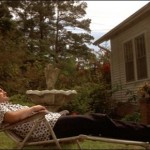
Second #7003, 116:43 The camera pulls back, low like in the beginning when it entered the lawn grass, to reveal Jeffrey, lounging, Sandy just having told him that “lunch is ready.” A concrete angel looks over him as he suns himself in his black pants and heavy black shoes. Order has been restored, but something has changed, something is different. You can feel it in the framing of the shot, in the oddly canted way that Sandy and the house bend inward, towards the center. In his recent book In the Dust of This Planet, Eugene Thacker questions the assumption […]
by Nicholas Rombes on Aug 10, 2012 -
The Blue Velvet Project, #107
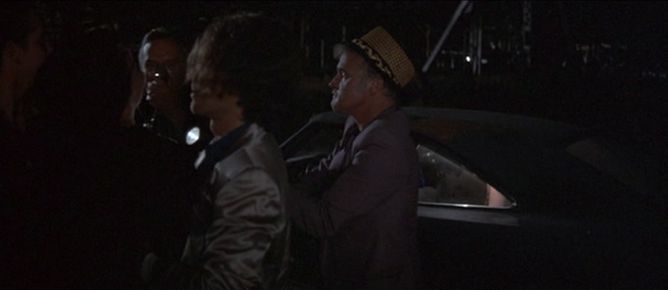
Second #5029, 83:49 “Now it’s dark,” Frank has said previously, like some incantation, and now it really is dark. Jeffrey, his back to the camera, is practically swallowed up alive by the blackness, as Frank inhales whatever it is that unleashes his id. There is a flashlight, the dome light of the Charger, and the very small light in the distance that give shape and depth of space to the frame. For the psychoanalyst and philosopher Jacques Lacan the coherent, unified self is an illusion, a fragile thing constructed gradually during an infant’s Mirror Stage, a stage when the ego […]
by Nicholas Rombes on Apr 27, 2012 -
The Blue Velvet Project: A Confession

As author of The Blue Velvet Project—which owes a moral debt to the Dogme 95 movement, whose practice of constraint was an inspiration—I feel obligated to make this public statement of confessions regarding the rigors of the project. This is done in the spirit of Thomas Vinterberg’s confession regarding his film The Celebration. Despite the fact that I promised Mr. Macaulay, Filmmaker Editor-in-Chief, that I would compose each entry “well ahead of time,” I confess that the following posts were composed the day of posting: #12 #27 #28 #77 #93 I confess to posting—out of unreasonable affection for the frame […]
by Nicholas Rombes on Apr 23, 2012 -
The Blue Velvet Project, #87

Second #4089, 68:09 1. Dorothy to Jeffrey: “Do you want to do bad things? / Anything . . . anything. / I want you to hurt me.” 2. Ralph Waldo Emerson, from Experience (1844): It is very unhappy, but too late to be helped, the discovery we have made that we exist. . . . Ever afterwards we suspect our instruments. We have learned that we do not see directly, but mediately, and that we have no means of correcting these colored and distorting lenses which we are, or of computing the amount of their errors. Perhaps these subject-lenses have […]
by Nicholas Rombes on Mar 7, 2012 -
Blue Velvet 25th Anniversary Blu-Ray Edition
Blue Velvet remains a masterpiece of American cinema – one of the defining films of the 1980s, and arguably still director David Lynch’s best work (personally, I actually slightly prefer Lost Highway, but I’ve become gradually fatigued over the years with people looking at me like I’m insane when I divulge that) – and it still retains every bit of its power today. But to have seen it upon its original 1986 release was like experiencing a bomb going off inside the theater. American films during the conservative Reagan decade were going through an awkward transitional period (and, outside […]
by Travis Crawford on Nov 15, 2011 -
The Blue Velvet Project, #17
Second #799, 13:19 “Jeffrey can connect different worlds,” David Lynch has said. “He can look into Sandy’s world, he can look into Dorothy’s world, he can get into Frank’s world.” The secret subtext to this scene is Life Begins for Andy Hardy (1941), starring Mickey Rooney and Judy Garland, number 11 in the movie series, where Andy learns that adult life is dark and impure and trip-wired with temptation and so struggles mightily to gear-shift his life into reverse. Andy, in New York, away from his future wife Betsy Booth (Judy Garland), is tempted by the “wolfess” Jennifer Hicks (Patricia […]
by Nicholas Rombes on Sep 14, 2011