Back to selection
Speculations
by Joanne McNeil
Analog Treasures: Joanne McNeil on Digitizing VHS
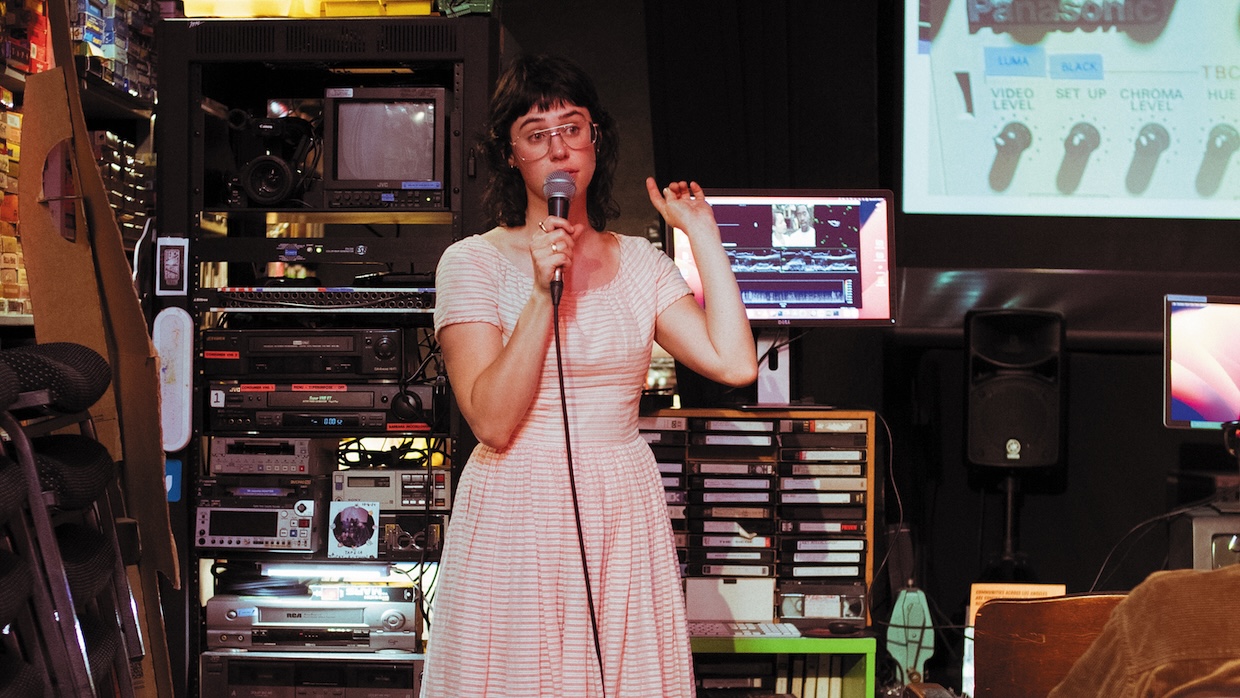 Jackie Forsyte at TAPE
 The word nostalgia tends to come up whenever analog media gets discussed. “I’m not against it,” Jessica G.Z., the founder of T.A.P.E. (Teach. Archive. Preserve. Exhibit.), told me. “It’s just not my interest.”
What interests G.Z. is the durability and continued potential of formats and technologies that were more widely used in the past. Take home movies, which are at the heart of programs at the Los Angeles–based nonprofit. The organization offers magnetic media digitization services to the public at a sliding scale. Someone might come in with a video tape that has been stored in terrible conditions for decades. It could show signs of deterioration, even mold. But what usually happens is, “it gets cleaned, and we play it and it’s still so viable,” G.Z. said. “And the image looks incredible.”
I met with G.Z., at Whammy!, the video store and microcinema in Echo Park that they also co-founded in 2022, where T.A.P.E. is currently headquartered and hosts screenings and workshops that help disambiguate how a movie is created and viewed. Students might learn how to maintain a VCR, or, in a workshop developed with filmmaker Erica Sheu, receive hands-on instruction in direct animation—drawing right on film stock. Programming related to computer hardware and software, including events like “Hard Drive Office Hours”—where T.A.P.E. volunteers offer support—likewise rolls back the illusion of digital devices as inalterable and unknowable black boxes.
Sitting in on a recent workshop, “Intro to 16mm,” I was struck by G.Z.’s persuasive enthusiasm for shooting with “limber” Bolex cameras. The class explored the practical uses of these wind-up cameras—this was no trip down filmmaking memory lane. T.A.P.E. rents out Bolexes and other equipment like CRT televisions and Lomo developing tanks.
I had come to Whammy! with a handful of VHS-Cs of my own to transfer. After my parents’ basement flooded, wiping out some family photo albums, my mother became a regular customer of pricy mail-in digitization services. I asked her to mail a few tapes to me instead.
“She uses something called Legacybox,” I told Jackie Forsyte, the technical director of T.A.P.E. Forsyte’s eyes lit up. She told me about the treacly ads the company runs on Instagram and said she was excited to steal one of their customers.
In the back of the shop, volunteers work on digitizing home movies. There’s a computer station beside a towering setup of VHS equipment and a patch bay that Forsyte compares to the old switchboard plugs that telephone operators used to connect calls. She joined the organization as a grad student at UCLA and trains the volunteers with skills that she acquired in her “very expensive” MLIS program.
There are class barriers when it comes to “who gets to transfer tapes,” G.Z. said. T.A.P.E. approaches preservation as a community practice both in its services and in training non-professionals with the equipment and processes used in museums, libraries and other institutional settings.
The more technicians there are who can preserve videos across formats, the greater the chances this media has to survive. Even the VCR repair workshops at T.A.P.E. come back to its mission. People regularly store old VHS tapes in boxes alongside old machines. If all someone wants is to play a video again, one approach is to prolong the life of a deck.
In addition to the value of home movies as personal memories, a cultural record emerges when this work is transferred to accessible formats. T.A.P.E. highlights the historical importance of home movies through public screenings at Whammy! and other venues across Los Angeles. “If you think about all the home videos that were actually being made at that time at the peak of videotape happening, that’s just a tremendous amount of cultural information,” said G.Z.
There could be trillions of hours of home movies, digital and analog—and, inevitably, in time, regardless of format, any recording risks being lost, damaged or difficult to access. To Forsyte and G.Z., the solution is at its source: home movies, created by communities, need to be cared for by communities. An archive doesn’t have to exist within an institution. Home tapes, after all, have been stored in people’s homes.
“There’s a lot of discourse right now [asking], ‘Are archivists ready to handle how much digital stuff there is?’” said Forsyte. People can catalog and preserve digital files, she said, because “people are already doing it.” “You’re also closer to the source of what digital information is,” G.Z. added. “It’s information that was created to be organized. You’re seeing the obvious connection there.”
I returned to Whammy! the following week to observe how Forsyte and volunteers digitize VHS tapes. The process happens in real time with the home movies playing on a computer monitor as the file is being created.
Forsyte told me that while she doesn’t ordinarily sit and watch the whole way through, sometimes in quality checks, she’ll catch moments in the videos that reveal “the everydayness of life.” If “something catches my attention,” she said, “I’ll sit with it in an intentional way.” The experience, Forsyte said, is “deeply human. You cannot help but feel instantly connected to other people.”
Forsyte asked me which of the tapes I wished to transfer first, and I picked up the one marked “Prague.” That’s where I’d spent my junior year abroad. My mother got a passport for the first time just to visit me. I wanted to see what my parents had captured from their trip. I also hoped to see my young idiotic self with my hair then dyed a Run Lola Run–inspired shade of crimson.
At first, I couldn’t help but feel a little disappointed by the footage that appeared on screen as it was processing. Instead of the faces of my friends and family, I was looking at long takes of various landmarks around the city: Old Town Square, Prague Castle and the Charles Bridge. In the first seven minutes of footage, my father—looking so young I didn’t recognize him at first—appeared only in a glimpse.
Forsyte encouraged me to put on headphones as I watched the video. I had expected to hear nothing more than the rustling sound of the city and the conversation of strangers walking past. But what I heard was my mother’s voice. My mother had been narrating what she was looking at as she recorded this tape. “That’s the Charles Bridge,” she said. And, as she panned to more nondescript architecture, “those are the buildings along the river.” It was classic my mom, and I could hear in her voice her excitement to be there. I was ported back to a time I had forgotten. This memory was dislodged from a little plastic box that had been sitting in storage for years and years.