Back to selection
Take Care: Georgia Bernstein on Night Nurse
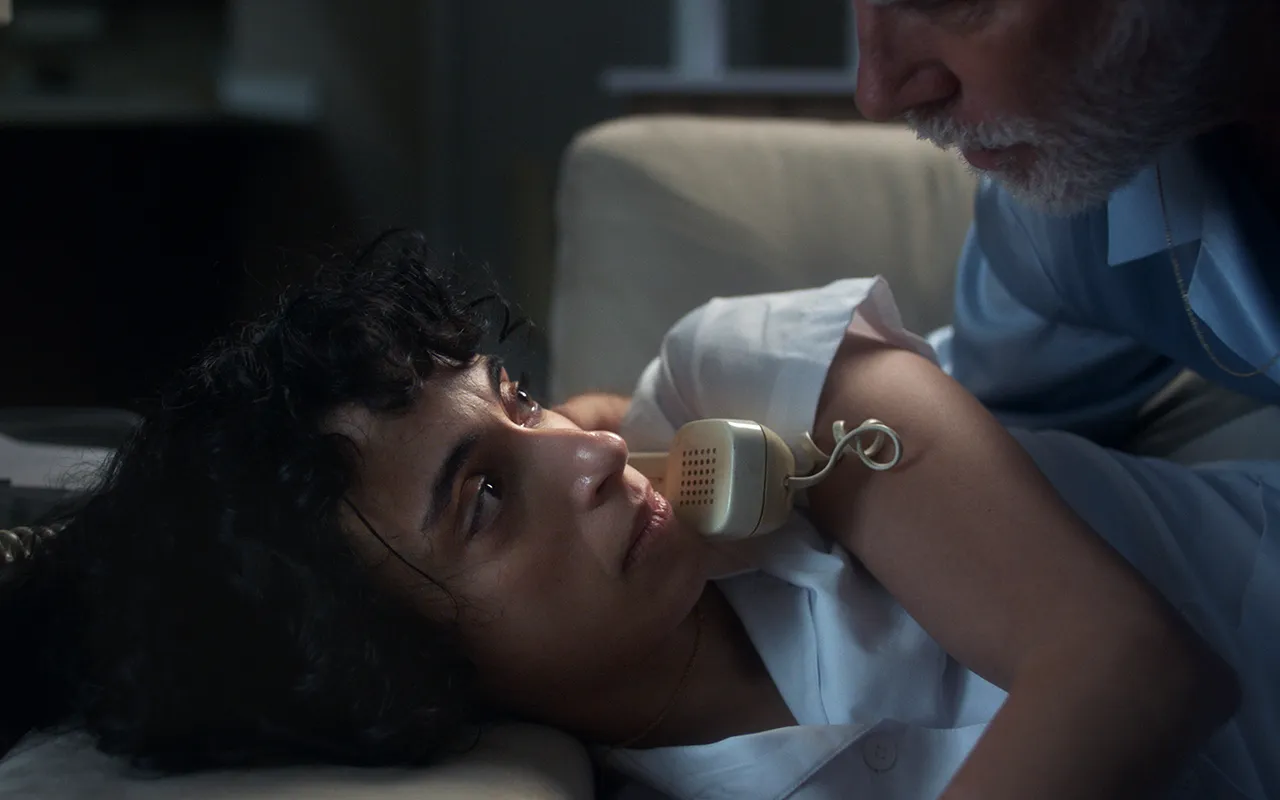 Night Nurse
 I could tell by the title sequence alone—the camera gliding along a body, following the path of a telephone cord—that Night Nurse (2026) would not be like the other movies I had been seeing at Sundance. While the festival in aggregate leans toward safe picks, Night Nurse, which premiered in the NEXT competition, is anything but.
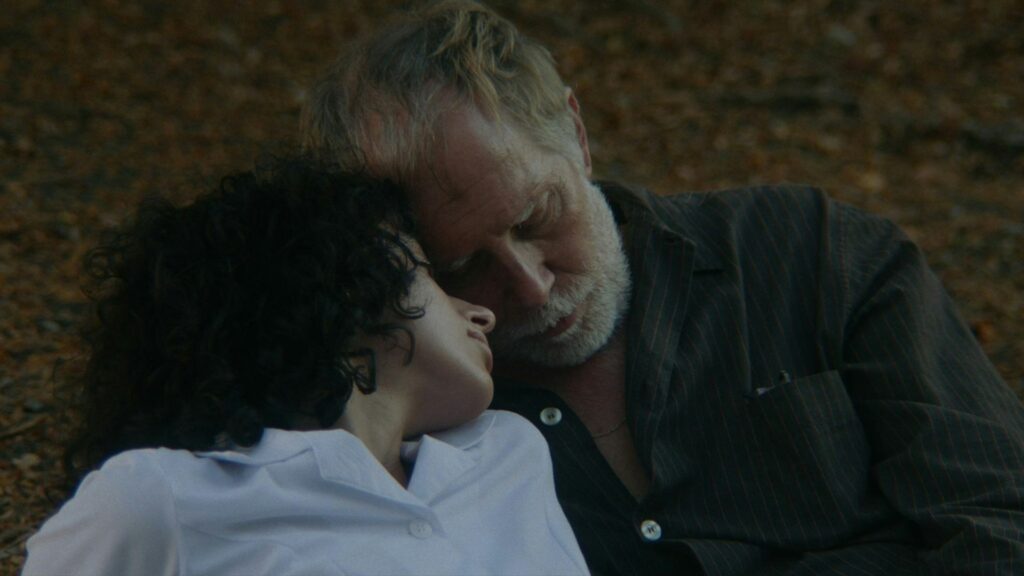
The film follows a new nurse, Eleni (Cemre Paksoy), as she gets acquainted with a patient being evaluated for early onset Alzheimer’s, Douglas (Bruce McKenzie), during overnight shifts in the memory-care unit. Eleni quickly slips under Douglas’s spell and becomes his accomplice in a phone scam on other elderly people, posing as their granddaughter in trouble and in need of quick cash. Both characters experience a sexual thrill in addition to the monetary rewards of their confidence game. Bernstein shoots their first call in an aching long take, with Eleni’s reactions often obscured when the audience most desires them. Douglas wraps himself and the phone cord around Eleni, and she holds her back to the camera to process what just happened as Douglas seals the scam. Her faunishness flips as she turns around to kiss Douglas, from which he recoils: “If you’re looking for a pogo stick, I’m really not your guy.”
Night Nurse blends the cerebral psychosexuality of Atom Egoyan with the twisted and troubling power dynamics of Catherine Breillat, transplanting them to the languid, out-of-time world of a retirement community. Bernstein’s confidence with her material is immediately apparent; she guides the audience through the film’s machinations, like the nurses who walk their patients around the pool in endless circles.
At the center of the film is one central instinct: “It’s amazing to be needed, isn’t it?” Mona (Eléonore Hendricks) asks Eleni. “It feels good to mean something to somebody.” Bernstein follows this feeling beyond logic, digging into how far it can be taken as a guiding principle, even to its most problematic ends. It’s what Bruce is getting out of Eleni, and Eleni out of Bruce. Even when Eleni is having second thoughts about their scam, Mona comforts her about their victim: “He was numb to life before today. You gave him purpose. You helped him.”
Ahead of the film’s July 10 wide release via IFC, I got together with Georgia Bernstein to talk developing the film with friends, laying down dolly tracks in her grandmother’s house, and what Bernstein describes as “something in the air” that has blown from J. G. Ballard’s England, to the psychosexual Toronto of David Cronenberg and Egoyan, and across the Lakes to Chicago.
Alex Lei: Almost everyone I’ve told about your movie has asked me if it’s a remake of the Barbara Stanwyck film from 1931.
Georgia Bernstein: It is not a remake, but of course, I love that film. Kind of bold of me to name it after that. Actually, the name came from watching Roger Corman’s nurseploitation trilogy. One is called The Student Nurses [1970], which Stephanie Rothman directed—it’s a very cool movie. I was interested in nurses and doing something kind of like an offshoot of that trilogy.
AL: I’ve seen people compare the film to Crash [1996], and I know that David Cronenberg is a big influence for you, but, to me, it feels more directly Ballardian. It reminds me, for instance, of his novel Cocaine Nights [1996], which is about a cult of personality that takes over an old people’s community on the Spanish Riviera. The psychological space of your film feels very in line with that.
GB: I haven’t read it, so that’s funny. I think what I love about Cronenberg is his pacing and his lighting. My DP [Lidia Nikonova] and my editor [Alex Jacobs] and I would watch Crash over and over again. I love how Cronenberg photographs Toronto in Crash because he doesn’t make it like a beautiful place; the film is beautiful, but the place is so gray. I tried to approach Chicago and suburbia in a similar way. I find the suburbs of Chicago to be quite bleak.
Atom Egoyan’s Exotica [1994] is another reference. Both of those movies are so perfectly paced. My DP and I also watched a lot of Lucrecia Martel, so I think that’s where the feeling of the film differs from Cronenberg. It has that perspective of me and my DP, who’s also a woman, and the “gaze,” if you will, permeates the film and definitely has a strong feeling to it.
AL: Egoyan, too, loves these very contained spaces in his films. I think the one that this reminds of is The Adjuster [1991], which also deals with this really strange, watery suburban malaise.
GB: He’s amazing. He’s so remarkable. What’s his film called where him and his wife go on a trip?
AL: Calendar [1993]?
GB: Yes. God, I love that film. It’s funny because sometimes we get comments like “the Canadian influences on this film” or something. I’m not Canadian, but I do love those two Canadian filmmakers.
AL: You’ve worked a lot in Chicago. You produced Alex Phillips’s first two features.
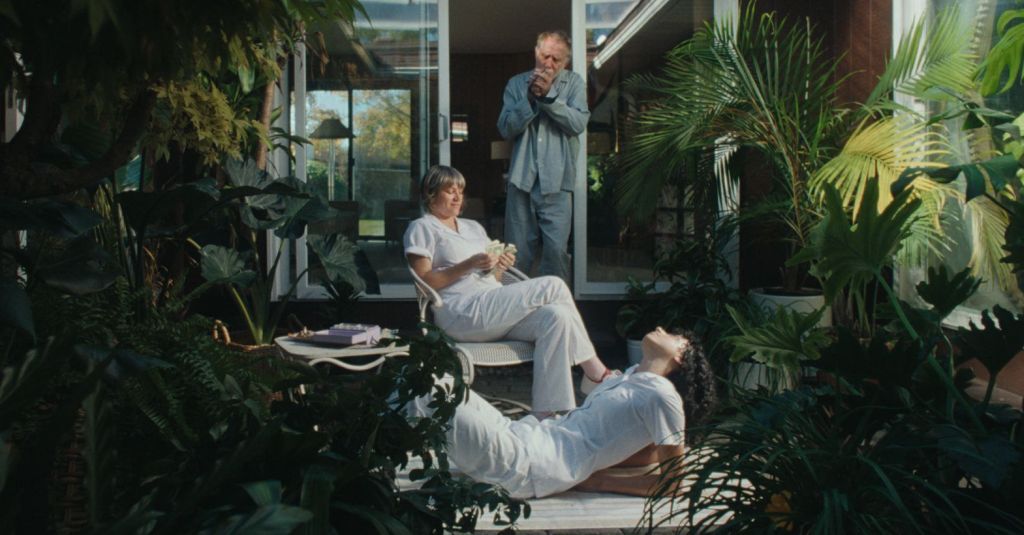
GB: Coming from producing—and going back to the Egoyan point—I made some practical decisions in making the film. We shot almost the entire movie in my real grandmother’s house. I wrote it for every specific room—walking from this room to the next room, to that, to the atrium. That was a practical decision. But it also seeped into the script, too, the feeling of her house being out of step with time. We don’t know what time period we’re in, we have ’70s wallpaper from when she first moved in, but then we have last-gen landlines, and we don’t see smartphones. I like that really disorienting feeling.
AL: And you have those really old $100 bills.
GB: I’m glad you think that it looks old, because I sometimes worry it just looks fake.
AL: This is your first feature. How’d you go about getting this off the ground?
GB: It came about in a kind of funny way. When I produced [Phillips’s] Anything That Moves [2025], my producer, Eddie Linker, who is Chicago based, and I worked closely together—and with Liane Cunje, who was also a producer on this. After we filmed Anything That Moves, [Linker] was gonna teach this class at Northwestern, and he needed a subject. He was like, “Send me your script, maybe it can be the subject for the class.” He read it, he liked it, so he said, “Let’s do this.”
So we and my other producer, Veronica Barbosa, taught this class based on the script [for Night Nurse]. It was basically like preproduction. It was a super practical class where we taught the kids how to open an LLC, how to make a budget, how to apply for the tax credit. It was kind of a “how to make a first feature” class. By the end of the quarter, we had done a lot of the preproduction.So [the film] really came from these relationships that I had been building in Chicago for some years, and then I got to work with the community that I had worked with out there.
AL: This film is so confidently directed. How do you bring that confidence to set?
GB: That is a hard question. I think part of it is just that I had such a good team. I want to highlight my DP, who I actually scouted on the internet. I had seen a movie that she had shot called Family Portrait [2024], and I just loved her sensibility. Actually, she didn’t respond to my first email, but eventually we got in touch. She read the script, and I sent her a deck I had made, and we had this call where she was like, “I was born to shoot lusting nurses.” We just became so in lockstep about the film. At the time, she was living in LA, and I was living in Chicago; she came out, and we spent time in my grandma’s house, took photos, and spent time in the neighborhood. We wanted to pull out all of the real feelings that come from that place and bring them into the film.
AL: That seems sort of like a similar process to how they shot Family Portrait.
GB: Yeah, I do think they’re quite similar. I guess it was [director Lucy Kerr’s] family house in Texas. That’s how you gotta do it.
AL: But also, tonally, they have a similar sort of lethargic, humid atmosphere that creates this really mutable psychological space that’s always shifting.
GB: They actually are more in sync than I had realized. We’re totally sister movies.
AL: A lot of these scenes you’re shooting, they’re happening in long takes or are otherwise very precisely sequenced. Were you doing many takes for these?
GB: We would choreograph everything really specifically. I was lucky that we got to do some rehearsal, specifically with Cemre and Bruce, who play Eleni and Douglas. We spent a couple days in my grandma’s house. First, it was just me and Bruce and Cemre. We would block the scenes, and then I would take photos, and then Lidia would come and we would take more photos and talk about where the camera would go, and we would rehearse. Purely for scheduling reasons, we did all of the intimate scenes our first week. Literally the second day we did the first phone call. It really set the tone for the movie. At first it was like, “Whoa, we’re gonna do all the hard scenes first,” and then I was really glad because we were super prepared.
The other big piece to making the film was we shot almost the entire movie on a dolly, which was really important to me. There was a lot of discussion at the time that Steadicam might be easier, might fit in the space better, but I just don’t like the Steadicam look, especially for this film. It’s not heavy enough; I really wanted the weight of the dolly, the camera’s ga-dunk on the dolly moving really slowly. And it fit perfectly in my grandma’s house, which is pretty small—literally just through the doorway.
We would do takes around making sure that we got the movement that we wanted. Again, influenced by Cronenberg and Atom Egoyan, I really wanted the movie to have that kind of pacing where it’s like you’re moving in slow motion. That started to influence performances and how Cemre would move through the space. She’s crawling on the ground. Everything’s carpeted, so it kind of made sense to get from one room to the next by crawling. Everything just kind of mushed together.
AL: The dolly also lends it a look that doesn’t look like a low-budget film.
GB: I didn’t want to shoot like a low-budget film; I wanted to shoot like Fassbinder. I wanted to make it feel big.
AL: You talked about writing scenes specific to the environment. Were you also writing specifically for the actors you had in mind?
GB: Yes, every part was written for the person that played the part, except for Bruce, because I didn’t know him when I wrote the script. His part was the only one that I did a full casting process for, because I wrote that part thinking it was like Cassavetes or Humphry Bogart or something—some kind of older man that doesn’t exist anymore. I wrote it for someone that’s literally dead. We actually had strong mutual friends, and they were like, “You should talk to Bruce.” He read the script and brought something really specific and unexpected that I hadn’t considered and hadn’t written.
But yes, for every other part I had a person in my head. Including Eléonore, who I was just a fan of. I love her work and think she has this whimsical, magical quality. We had some mutual friends. I was like, “I feel like I could get to her.” And Colleen [Rose Trundy] is a friend. I had seen her do some performance art when I was living in Chicago and thought she was so good. So it’s kind of pulling all the good, cool people together from different parts of my life.
AL: What made you want to bring Steven B. Jackson and Samm Clapp in to compose the score?
GB: They did the two movies that I produced [All Jacked Up and Full of Worms (2022) and Anything That Moves]. That’s how I met them, and they are both just so talented. A fun thing about working with them is that they each have a brother they bring in, and then it’s two sets of brothers. They also play the music live to picture, which I think is really fun and a little bit old fashioned. They also bring in a ton of other musicians, so we can bring in instruments that they don’t play, like a flute and a violin. Flute and piano are the two big instruments in the score.
I showed them the script, and they started making melodies. We looked at a lot of references, and we landed on Coppola’s The Conversation [1974] as a big reference for score. I wanted it to have a theme, sort of contributing to this idea that we’re spinning in circles in the pool. I wanted the whole movie to feel like we were spinning in circles and that we would never get out. Once we had a really recognizable theme, they would riff. Some of the music was written in advance and played to picture with musicians. And then other pieces were improvised based on an established melody.
AL: The subject matter and the power dynamics of the film could obviously make a lot of people pretty uncomfortable, and you’ve approached it with a really interesting ambiguity. Why did you decide on that approach?
GB: Well, one of my favorite filmmakers is Catherine Breillat. Obviously, so many of her movies are about a young woman and an older man, and she explores power dynamics. A lot of her films are about the power that a young woman has, which I love. But I felt like it was something that had been done a lot of times, in a lot of ways. So I was like, “What’s a newer way to do this?” I thought, “Let’s push it to the extreme”: she’s a young nurse, and he’s in a retirement community and may or not have dementia. As I pushed it and added these layers, it became more complicated. Who’s taking care of who? Who has the power? The circumstance that I created ended up adding so much complexity to the power dynamic, even beyond what I had written in the script. I think we really found it, too, just in doing the scenes and in the performances. Yes, I always wanted it to be full of ambiguity, but all the pieces contributed to making it feel even more so.