Back to selection
Speculations
by Joanne McNeil
Making Sense of Lynn Hershman Leeson’s Monumental Life’s Work
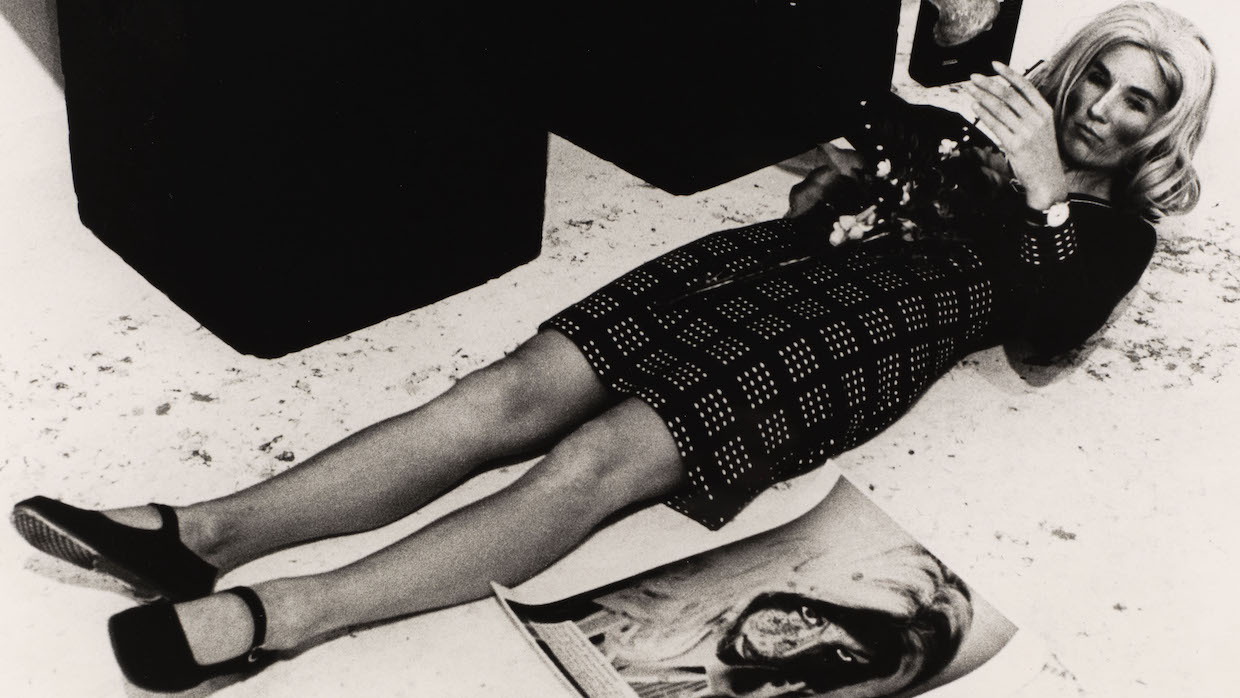 Lynn Hershman Leeson, Roberta Multiple Lies Down Beside Construction Chart (Michelle Larson), 1978. Courtesy of the artist and Hoffman Donahue, Los Angeles / New York. Copyright Lynn Hershman Leeson.
Last year, I stumbled on a bootleg copy of Twists in the Cord (1994), an experimental documentary shot on video by Lynn Hershman Leeson. I’ve followed the prolific artist for years, but I had never heard of the piece until it appeared in a search result when I was looking for something else.
It’s classic Leeson, depicting technology as a catalyst to subvert identity and authenticity. She was an established—if unsung—artist in the 1970s when she started making films and videos, and her just-published memoir, Private I, reveals this turn was less of a second act than a lifelong pull toward new frontiers of expression.
In Twists, Michelle Handelman plays a not un-Leesonesque filmmaker assigned to make a documentary on the history of the telephone. Her discursive research takes her to a museum of telephony history. Through nascent digital portals—by way of the telephone, with a modem—she has cybersex with Mondo 2000 editor R. U. Sirius, gets hacked, and video-calls a figure from classic literature, brought to life in pixels.
You could look at Twists as a nonfiction-ish trial-run of ideas and techniques Leeson would come to refine in her first full-length narrative feature, Conceiving Ada (1997). The film and video both are infused with the felicitous point-and-click spontaneity of art and educational CD-ROMs from the ’90s, delivered in a linear format. Where Conceiving Ada is polished, Twists in the Cord is more overtly improvisational. Both merge documentary and fiction, a throughline from her earlier art practice, including her ongoing performance as Roberta Breitmore.
Roberta was a character Leeson constructed in the 1970s who shared her own “heartbeat and breath.” A solo show of Leeson’s work at Hoffman Donahue in Los Angeles earlier this year included photographs documenting the series. Leeson opened bank accounts as Roberta, went on dates, leased an apartment, and took part-time jobs in character, returning home at the end of each stint to her real life as a wife and mother in the Bay Area.
Back then, Leeson, who became friends with Eleanor Coppola while they were carpooling their children, began attending screenings that Eleanor’s husband Francis hosted at their home. Inspired by the presenters (George Lucas, Wim Wenders, and Martin Scorsese, to name just a few), she signed up for night classes on 8mm filmmaking. Later, she would turn to video as a rapid and accessible alternative.
One of Leeson’s first video projects was recorded in secret. She turned the camera on herself, speaking candidly about suffering and loss, including the physical violence and sexual abuse she survived as a child. In Private I, she reveals the impetus for The Electronic Diaries (1984–): her husband had walked out on her, leaving her financially devastated, unable to afford sessions with her therapist.
Her video diaries are direct and raw. Watching them can feel like intruding on a private moment—even though Leeson has publicly screened selections of these tapes since the 1980s. Considered alongside Leeson’s abstract and analytical time-based art and installations, the series offers grounding texture. For an artist who is otherwise reticent—sometimes maddeningly so in her own memoir—her confessional turn in this work is a reminder of the very human drives that plumb the depths of technology.
After reading Private I, I went back to watch and rewatch other films and videos by Leeson. I was scheduled to talk with the artist, but she was unavailable before my deadline. Still, Leeson’s work speaks for itself. I noticed how she consistently tests herself, determined to grow. Each of her films and videos seems to develop from what she learned from the last. The quasi-documentary format she first explored in shorts from the 1970s and deepened in Twists and Conceiving Ada builds once more in the disquietingly monumental Strange Culture (2007).
Strange Culture chronicles Steve Kurtz, who was then under federal investigation, flagged as a potential bio-terrorist (later indicted for mail and wire fraud) because of biological equipment he used in his art practice. When Kurtz appears on screen, he mentions the case he “can’t talk about on camera” on the advice of his lawyers. Leeson has Thomas Jay Ryan and frequent collaborator Tilda Swinton take over from there, performing reenactments, but even the actors cross back into reality. She includes scenes of the two commenting on the case as they rehearse their lines.
Leeson tackles the PATRIOT Act–era frenzy of suspicion without losing sight of the emotional stakes. Her signature blend of reality and fiction facilitates political dissent and elegiac tenderness. For Kurtz, his nightmare began when his wife, Hope, died in her sleep in what later was found to be congenital heart failure. Kurtz can’t discuss the case in Leeson’s film, but he can talk about Hope, which he does in specific aching details, bringing to life the quirks and brilliance of a woman who is deeply missed.
Josh Kornbluth, who plays a professor in Strange Culture, is listed in the credits as “Lynn Hershman.” Fictionalized campus discussions were taken from her own experiences teaching at UC Davis. Leeson says in Private I that she originally planned to hire an actress to play Roberta but couldn’t find anyone until the work gained traction. She’s employed a number of stand-ins ever since. Francesca Faridany, the actress who plays Emmy in Conceiving Ada, strongly resembles photographs of the artist when she was a young woman. Swinton, in one of several roles she plays in Teknolust (2002), is styled like Leeson. There’s a character in Virtual Love (1993) who records “electronic diaries” with a camcorder, and a girl in Seeing is Believing (1990) shares a name with Leeson’s daughter.
Watching these films, I wondered whether the performers were aware they were playing fictionalized versions of the director. “I did,” Michelle Handelman told me. “She never talked to me about that, though, and I don’t think she would ever say that.” The opening scene in Twists in the Cord was filmed in Leeson’s own bed.
Curious how Twists came together, I asked Handelman, an acclaimed artist and filmmaker (and Filmmaker magazine contributor) herself. She told me why the video was obscure: “It went straight to German television.” That an unknown user—a connoisseur of vintage cyberspace media, judging by their posting history—uploaded the piece to the Internet Archive, where it’s racked up a couple thousand views in 10 years, is just the nature of how videos transmit these days.
I felt, talking on the phone with Handelman, like I was getting an extended version of Twists in the Cord: clicking on digital buttons, accessing the wit and wisdom of another person’s brain. As I listened to a voice, alluring and smart, that I knew from Leeson’s 1994 documentary (which by that point I’d watched several times), 32 years seemed to collapse.
Handelman described the set of Twists as a space of trust and laughter. Everyone working on the film, she said, “knew at the time that Lynn’s work was very prescient.” They’re still friends.
“I’m 65,” Handelman said. “I get so tired and think maybe this project will be my last project. Like, I’ve done a lot—that should be enough. Then, I think about Lynn. She’s 84 years old, and she’s still making new work, and she gets excited by it.”
And I’m 45. I can’t begin to express how inspiring it is to read Private I and to learn from Leeson how life as a woman artist can be a decades-long series of beginnings.