Back to selection
TALKING NEW DISTRIBUTION THINKING AT CANNES
 Attend most U.S. festivals these days, and you’ll notice a certain anxiety around the issue of new technologies. There are the transmedia sidebars and also the distribution initiatives that bring festival films into your own living room, sidestepping the red carpets that in many cases unfurl only blocks away. And then there are the fests that temptingly allow you to screen films on your iPad without leaving your hotel room. But still, despite such gestures, all these festivals spend most of their energies, rightly, on their core mission — projecting films for live audiences — even as their blogs, op-eds, and public statements evince an insecurity that a bunch of people sitting in a dark room may no longer be enough.
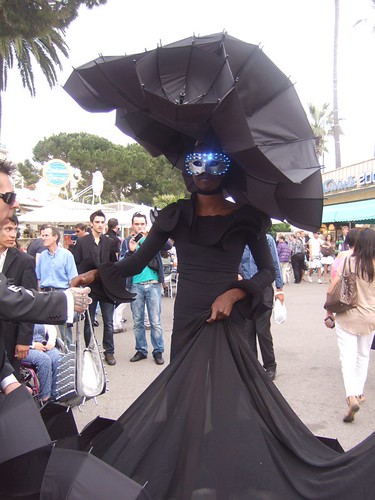
Not so Cannes. Particularly with its Official Selection, Cannes remains singularly focused on the cultural importance of large-screen cinema, a value it has steadfastly endorsed through its reassuring annual spectacle taking place in the bunker-like Palais. Photographers and locals line up literally days in advance to catch movie stars as they sashay up the red carpet to the evening premieres, while the audience, also in black tie and evening gowns (or, pictured, more avant-garde styles) strolls up that giant staircase right alongside them. Forget VOD day-and-date initiatives — a regular neck tie with a dark suit is enough to sour these carefully laid out proceedings. (Such a misstep will get you bounced out of line to a handy vendor willing to sell you a bow tie for 15 euros.) Despite — or perhaps because of — the sartorial hassle, as a night out at the movies it can’t be beat.
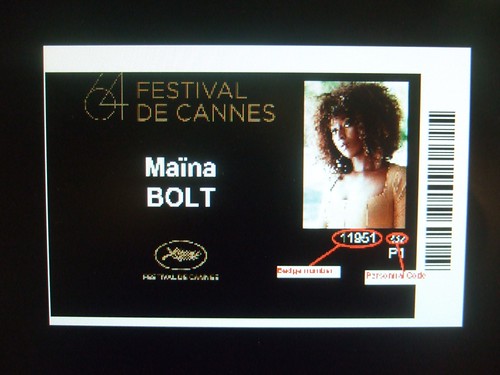 If you are looking for technological innovation at Cannes, you have to poke around the edges. This year at SXSW, “gameification” was the buzzword, but Cannes has been applying its own clever take on this idea for several years now with its ticketing system. You start the fest with a number of points (that number is dependent on the status of your credentials), and gain two more each hour you spend there. In the Palais are a bank of computer terminals, and when you use them to log-in, you ration your points to gain attendance to as many films as you can. (This year, fest-goers were welcomed by a home-screen graced by the quite glamorous, and entirely un-Google-able, Maina Bolt.) Score your tickets early and spend a lot of points. Wait until later, and spend less points… but take the chance that your screening will be sold out.
Digital technology at its most basic and the glitz of Cannes come together on the Croissette each night as those tuxedo’d moviegoers walk towards the Palais. Anyone looking tourist-y and needing to impress their date is descended upon by a clutch of photographers — including, I saw this year, one cyber-punkette straight out of a William Gibson novel — who convince them to stop for snaps. After posing in place while the crowds walk by, they are handed web addreses where their personal paparazzi shots can later be viewed and, for a price, downloaded.
 Leave it to the trades and panels, then, to opine on the way in which technology is changing the film industry. (Although I saw more than one person stand in front of the Screen International posters trying to figure out how to scan the barcode into their iPhones so as to access the mag’s Cannes coverage.) My panel at the American Pavilion was titled, “Indie Film Innovators: Keeping Up with New Thinking in Distribution,” and it divided between traditional film distributors (David Fenkel from Oscilloscope and Barry Meyerowitz from Phase Four) and those entering the film space from the new media or social networking worlds (Facebook’s Jon Fougner and PreScreen’s Shawn Bercuson). In the middle was Alamo’s Tim League (pictured after the panel with fellow Austin-ite, filmmaker Kyle Henry), whose work exhibiting genre titles at Austin’s Alamo Drafthouse is well known. But League has also been branching out into marketing partnerships as well as production, using Cannes to announce an anthology feature, The ABCs of Death. Twenty-six directors will each make a short depicting a specific death associated with one letter of the alphabet. League said the film will be a theatrical feature, but he also admitted that the episodic structure will allow complete segments to be used for marketing purposes online or even for foreign sale as individual shorts.
It’s hard to take notes on a panel when you’re moderating it, so I was happy when Elexa Dixon at Indiewire boiled down its “five smartest things.” She correctly points out the main topic of debate: the continuing value — or lack thereof — of release windows, a subject that, like it is dividing Hollywood and the exhibition community, split the panel. She writes, “While the panelists differed on their views of how to best use windows for a film’s release (theatrical and/or VOD), League pointed out that a film has one shot. That makes it important to push on all monetized platforms, including (but not limited to) a standard theatrical release, VOD, Amazon, iTunes and Hulu.” Indeed, exhibitor League, who said that he didn’t feel any of his playdates were hurt by day-and-date VOD exhibition, was the man in the middle where.
While admitting that they had experimented somewhat with new releasing strategies, Frenkel and Meyerowitz both argued that theatrical releases within defined windows were still necessary to create value and market identity for films. That philosophy is anathema to PreScreen’s Shawn Bercuson, whose business operates on an entirely different principle. Using a targeted email approach similar to GroupOn’s, PreScreen blasts fans with invites to watch films via secured streaming before their theatrical release. Then, says Bercuson, detailed information flows to the filmmakers regarding the demographics of the audience who responded to the invites. This information can help in the further crafting of marketing, or the digital release can simply generate good old word-of-mouth. PreScreen, which promises to bring you “one new movie a day,” expects to launch in a few weeks.
Data — as well as the ability to turn film viewing into a more communal experience — was at the heart of Jon Fougner’s comments. He said that analytics were able to determine that millions were added to the gross of films like The Dark Knight by virtue of their Facebook campaigns, and that online platforms offer the ability for fans to comment on movies in real time. (For more of Fougner’s thoughts on social media, audience building and movie marketing, check out his five-part series over at Ted Hope’s blog.)
As far as harnessing social networks for their own releases, both Frenkel and Meyerowitz said they are happy when filmmakers bring to the table existing online fan communities. Phase 4 picked up the doc Vidal Sassoon, which, in addition to having a brand-name subject, had 8,000 Facebook fans. Fenkel said robust fan bases are a consideration during acquisitions talks, but also cautioned that filmmakers can go too far. He cited one instance where the filmmaker had placed over 20 clips from his film online, a number that crossed the line between marketing and over saturation. Finally, Fenkel gave tips to companies looking to create Twitter identities. He said a couple of staffers are responsible for Oscilloscope’s Twitter feed, but that everyone in the company recommends worthy links. It’s important not to over promote, he said, and to supply fans with stuff they’ll like that’s not always about you.