Authors — Nicholas Rombes
-
The Invention of Paramount Pictures
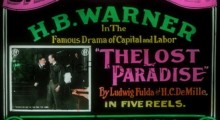
The Media History Digital Library is a goldmine of information about early cinema, the sorts of magazines, journals, and trade publications that, in the pre-digital era, had only been available to those able to travel to research libraries. At over 800,000 scanned pages and growing, the collection is daunting, and what I plan to do in Time Frames, a five-part series, is cull through and select a series of images and text from the collection to highlight key transformative moments in the film culture and industry, as well as other oddities and obscure artifacts. It’s perhaps impossible for us not […]
by Nicholas Rombes on Sep 5, 2013 -
Misremembering Only God Forgives
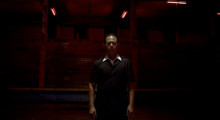
Of all the transformations cinema has undergone since the rise of affordable home viewing in the 1970s, perhaps the most ephemeral, difficult to quantify is this strange result: the difficulty of falsely remembering movies. Whether it was mixing up and remembering out of order a series of shots, or conflating scenes from different movies that happened to star the same actor, or simply forgetting portions of a film, it was difficult to recall a film correctly, accurately. Which isn’t the same thing as not recalling a film truthfully. This became apparent after watching Only God Forgives recently on the big […]
by Nicholas Rombes on Aug 12, 2013 -
The Camera as Narrator: V/H/S/2

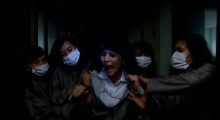
The new horror anthology film V/H/S/2–once you’ve shaken the blood from your hair–leaves behind some striking images and moments. Oh the lowly horror genre: the place where there is more cinematic risk-taking and experimentation happening than in the likes of “serious” films such as Paul Thomas Anderson’s The Master or Terrence Malick’s pulseless To the Wonder. There is, in particular, one short sequence in V/H/S/2 where the experiments with camera narration are revealing not only in terms of the potential uses of narrative point of view but also in terms of how we process visual information. It’s easier to think […]
by Nicholas Rombes on Jun 7, 2013 -
Zero Dark Thirty and the New History
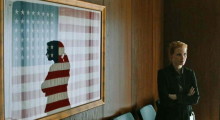
I saw Zero Dark Thirty twice. The first time, the auditorium was nearly full. The second, about a week later, there were only two other people. But both times, the auditorium felt empty, as if, in commanding the attention of its viewers, the film left no room for thought. Whether Zero Dark Thirty endorses torture or not has been much discussed elsewhere, and that discussion and debate has, in its own way, framed the very way we think about the movie. And yet there is another form of torture depicted in the film and that is the torture perpetrated by […]
by Nicholas Rombes on Jan 29, 2013 -
Overlooked: Director Rodney Ascher on His Documentary about Stanley Kubrick’s The Shining
NICHOLAS ROMBES checks in to Room 237 and the underground world of Kubrick obsessives with director RODNEY ASCHER.
by Nicholas Rombes on Jan 21, 2013 -
Watching Blue Velvet in the Land of Borges
In Jorge Luis Borges’s story “The South” the narrator notes that “every Argentine knows that the South begins at the other side of Rivadavia.” And this is where I found myself last month, in a city called Mar Del Plata, for the 27th Mar Del Plata Film Festival, hundreds of miles south of Buenos Aires, where I had been invited by Pablo Conde to attend the book launch of a Spanish translation of The Blue Velvet Project, which originally appeared here at Filmmaker from August 2011 to August 2012. Where I was, among generous, film-loving people, everything hovered on the […]
by Nicholas Rombes on Nov 29, 2012 -
The Blue Velvet Project, #152

Second #7144, 119:04 [Final post. Thank you to Scott Macaulay for taking a chance with this.] The blue curtain, creating the conditions for its own strange, vertical, blue-noise static. Remainders: 45,000 = total words in project 2 = frames that feature Dorothy, Jeffrey, and Sandy together 3 = frames including Aunt Barbara 17 = frames in which no human being appears 20 = frames featuring Jeffrey and Dorothy 23 = frames featuring Jeffrey and Sandy Robin Wood, from his classic 1979 essay “An Introduction to the American Horror Film”: Some version of the Other [include, simply] other people. It is […]
by Nicholas Rombes on Aug 17, 2012 -
The Blue Velvet Project, #151
Second #7097, 118:17 (Note: the final post in the project goes up Friday.) A confession, of a different sort, about how a movie saved a young man. Can a scene from a movie detour your life, turn you in a new direction? I think it can, in the same way that a book read and just the right age can, or a band can by the sheer force of its ideas turned sonic. (One of the self-imposed rules for this project was to avoid the personal, the anecdotal, but figuring this is the second-to-last post . . .) Blue Velvet […]
by Nicholas Rombes on Aug 15, 2012 -
The Blue Velvet Project, #150
Second #7050, #117:30 It’s as if the movie has gone back in time; Jeffrey and Sandy look so young. “I don’t see how they could do that,” Aunt Barbara (Frances Bay) says, looking at the robin on the windowsill with the live bug (perhaps one of the black beetles from the beginning of the film) in its beak, “I could never eat a bug.” She speaks these words just before inserting something black into her mouth. In The Plague of Fantasies, Slavoj Žižek suggests that fantasy does not simply realize a desire in a hallucinatory way: rather, its function is […]
by Nicholas Rombes on Aug 13, 2012 -
The Blue Velvet Project, #149
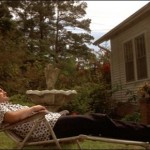
Second #7003, 116:43 The camera pulls back, low like in the beginning when it entered the lawn grass, to reveal Jeffrey, lounging, Sandy just having told him that “lunch is ready.” A concrete angel looks over him as he suns himself in his black pants and heavy black shoes. Order has been restored, but something has changed, something is different. You can feel it in the framing of the shot, in the oddly canted way that Sandy and the house bend inward, towards the center. In his recent book In the Dust of This Planet, Eugene Thacker questions the assumption […]
by Nicholas Rombes on Aug 10, 2012