Authors — Nicholas Rombes
-
The Blue Velvet Project, #129
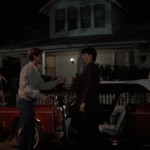
Second #6063, 101:03 Layered with unfolding narrative information, this frame depicts the brief confrontation with Mike, who threatens to kick Jeffrey’s ass “right in front of your own stupid house.” With the vintage cars, Mike’s friends looking on, the fight over the girl, and the classical-era wide framing, this could be a scene straight of Rebel Without a Cause. Except that there, having just emerged in the background and unnoticed by everyone at this point, is the completely naked and bruised Dorothy, who appears on Jeffrey’s porch just behind Mike’s friends. In a few seconds Mike will be the first […]
by Nicholas Rombes on Jun 22, 2012 -
The Blue Velvet Project, #’s 126, 127, 128
Second #5922, 98:42 Second # 5969, 99:29 Second # 6016, 100:16 In honor of Andrew Sarris, who passed away yesterday, three frames from Blue Velvet. Although Sarris’s essay “Notes on the Auteur Theory in 1962” (which appeared in the Winter 1962-63 issue of Film Culture) is best-known for its argument that “over a group of films, a director must exhibit certain recurring characteristics of style, which serve as his signature,” the essay also grapples with a more difficult, elusive, less discussed aspect of the auteur theory, what Sarris called a film’s “interior meaning”: The third and ultimate premise of the […]
by Nicholas Rombes on Jun 21, 2012 -
The Blue Velvet Project, #125

Second #5875, 97:55 André Bazin once wrote, in “The Life and Death of Superimposition” (1946), that the fantastic in the cinema is possible only because of the irresistible realism of the photographic image. It is the image that can bring us face to face with the unreal, that can introduce the unreal into the world of the visible. By this point in Blue Velvet, with only around 20 minutes left in the film, we might feel justified in thinking that we have figured out the geographic parameters of its narrative world. The hardware store. The hospital room. Jeffrey’s car. Jeffrey’s […]
by Nicholas Rombes on Jun 18, 2012 -
The Blue Velvet Project, #124
Second #5828, 97:08 At the basement party, Sandy has just assured her friends that it’s okay that she’s there with Jeffrey, not Mike. “It’s all taken care of,” she’ll tell Jeffrey in a few seconds, as “Mysteries of Love” is about to begin. They were asking a lot of money for the [“Song to the Siren” by This Mortal Coil] track, and we didn’t have any money. At one point Fred Caruso said, ‘David, you’re always writing little things. They could be called lyrics. Why don’t you write something and send it to Angelo and he will write you a […]
by Nicholas Rombes on Jun 15, 2012 -
The Blue Velvet Project, #123
Second #5781, 96:21 Sandy and Jeffrey, on their way to the dance in the basement of a house. Jeffrey tends to arrive and depart the Williams house at night. The car creaks as it moves. What space does the car drive though? The space of streets at night, the insides of stores illuminated like enormous aquariums behind Sandy. But also the space of a mind, the mind of the film, with its own series of codes that reference other films, other images. Carl Jung: The collective unconscious—so far as we can say anything about it at all—appears to consist of […]
by Nicholas Rombes on Jun 13, 2012 -
The Blue Velvet Project: A Pause
The project is on pause today, and will return on Wednesday with post #123 with a frame from second 5781. In the meantime, here is a peephole look into the frame: And here are some key words that will govern Wednesday’s post: night glass creaking collective unconscious rhizome Laura Mulvey escape Patricia Norris false selves Over the period of one full year — three days per week — The Blue Velvet Project will seize a frame every 47 seconds of David Lynch’s classic to explore. These posts will run until second 7,200 in August 2012. For a complete archive of […]
by Nicholas Rombes on Jun 11, 2012 -
The Blue Velvet Project, #122
Second #5734, 95:34 There is a look of pity on Detective Williams’s face as he delivers his warning to Jeffrey not to “blow it.” At this point, it’s not entirely clear whose side the Detective is on; is his Hollywood stock detective outfit for real, or is he—like the “well-dressed man”—wearing a disguise? His warning to Jeffrey, as he takes him by the arms and looks into his eyes, is like a secret communication, a signal to Jeffrey not to rush things, not dig too deeply because what he might find at the terrible, rotten core of things is not […]
by Nicholas Rombes on Jun 8, 2012 -
The Blue Velvet Project: Detour Into a Dissolve
A frame from between posts 120 and 121. By the 1830s, he [Henry Langdon Childe] had developed and perfected the [magic lantern] technique of ‘dissolving views,’ in which one picture faded out as the next one faded in. The images were aligned on the screen and the light remained a constant intensity, creating a smooth, gradual transition. This permitted a wide variety of effects that had not previously been possible. (From The Emergence of Cinema, by Charles Musser, University of California Press, 1990.) A dissolve is the superimposition of a fade-out onto a fade-in, achieved by reversing and them re-filming […]
by Nicholas Rombes on Jun 6, 2012 -
The Blue Velvet Project, #121
Second #5687, 94:47 Jeffrey approaches Sandy’s house, to pick her up for a date. He wears a black shirt and a white tie. Neither he nor the audience, at this point, know the meaning of the police car. The lens flare cuts the screen in half horizontally. In the fantasy, science fiction dimension of the film, the blue light is a laser beam, aimed at Jeffrey. The car is Detective Gordon’s, the Man in Yellow. He will enter the house, and will spook Jeffrey. In response, Detective Williams will take him by the shoulders and tell him: “Easy does it, […]
by Nicholas Rombes on Jun 4, 2012 -
The Blue Velvet Project, #120
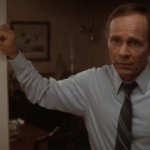
Second #5640, 94:00 The space behind Detective Williams — his accusatory gaze upon Sandy moments after Jeffrey has left — is unexplored in the film. He stands with his back to the darkness, his hand against the wall. There is the possibility of a fist. In a 2003 interview, filmmaker Chris Marker said that DVD technology is obviously superb, but it isn’t always cinema. Godard nailed it once and for all: at the cinema, you raise your eyes to the screen; in front of the television, you lower them. Then there is the role of the shutter. Out of the […]
by Nicholas Rombes on Jun 1, 2012