Authors — Vadim Rizov
-
“I Don’t Want to Make Audiovisual Historical Aids”: Kent Jones on Hitchcock/Truffaut
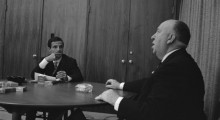
The formal title of Hitchcock/Truffaut (alternately Hitchcock and The Cinema According to Alfred Hitchcock) is a vexed question mooted by its famous title design: Hitchcock’s name on one side, François Truffaut’s on the other. First published in 1966 and revised before Truffaut’s death, it’s one of the most commonly name-checked starter texts for anyone looking to learn more about film. In a series of extensive, probing and relatively unguarded conversations, Truffaut guides Hitchcock through his work film-by-film. Illustrated by numerous stills (including one- and two-page layouts showing every shot choice from particularly famous/intense sequences, breaking them down in a lucid, teachable way), the book allows a director in total command […]
by Vadim Rizov on Dec 4, 2015 -
381 Minutes in 3,387 Words: Miguel Gomes’ Arabian Nights

I’ve come to the reluctant conclusion that there’s no way for me personally to really break down Miguel Gomes’ Arabian Nights trilogy without going through it segment by segment — “reluctant” because this could be too long, for both me and you, the reader, but it must be done. Gomes’ previous two features Our Beloved Month of August and Tabu are vital, terrific, and whatever other approbatory adjectives you want to throw at them; he is, no doubt, a major director, and will be so again. Arabian Nights is not a major movie, but rather a messy sketchbook stuffing disparate short- and medium-length films into an unwieldily […]
by Vadim Rizov on Dec 3, 2015 -
Watch: Charlie Lyne’s Copycat, A Short Film About the Proto-Scream
This short film by Charlie Lyne (whose zippy, highly enjoyable essay/compilation film about teen movies, Beyond Clueless, is still available on Netflix Instant) tells the story of Rolfe Kanofsky, a pioneer who maybe got scalped. Barely out of high school, Kanofsky made a meta-reflexive horror film, There’s Nothing Out There, that bears a suspicious relationship to Scream. Did Wes Craven’s son having seen it have anything to do with it? Whatever the case, Copycat is a fun watch; bonus points for making the whole thing plausibly seem as if it were being watched on a beaten-up VHS.
by Vadim Rizov on Nov 18, 2015 -
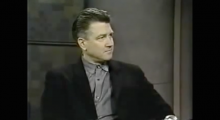
Watch: David Lynch Talks Saving Twin Peaks on Letterman, 1991
While Lynchians wait patiently for the 2017 return of Twin Peaks, a good way to pass the time might be with Dennis Lim’s new book on the director. Numerous extracts from David Lynch: The Man from Another Place have been shared online, and this part on Twin Peaks, recently published on Slate, is a fine place to start. As Lim writes: In what was widely seen as a bid to euthanize the show, ABC moved Twin Peaks to the television wasteland of Saturday night at the start of the second season. Ratings continued to decline, and in February 1991, the network put the show on hiatus, to the […]
by Vadim Rizov on Nov 16, 2015 -
Watch: An Andrew Bujalski Book Trailer for Karen Olsson’s All the Houses
We don’t normally post book trailers over here, because a) that’s not our remit b) they are, by and large, perfectly dreadful. This is a little different though, since it’s been made by Andrew Bujalski to help promote his wife Karen Olsson’s second novel All the Houses — as he wrote in an email, “I directed a ‘book trailer’ (not that anyone seems to know what a ‘book trailer’ is).” The novel concerns a family haunted by the father’s involvement in Iran-Contra. That makes for an excuse to playfully intercut between questions to Olsson (who sometimes cracks up at her inability to […]
by Vadim Rizov on Nov 10, 2015 -
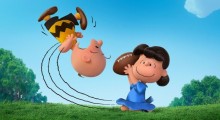
It’s an Ice Age-Flavored Dilution of Your Legacy, Charlie Brown: The Peanuts Movie
The two opening logos for The Peanuts Movie say pretty much everything about the two differing sensibilities birthing Charles Schulz’s characters into the 3D CGI 21st century. First there’s the 20th Century Fox logo, its familiar fanfare rearranged to accommodate Schroeder’s extra piano flourishes in front of the spotlight beams. Then emerges Skrat the squirrel, mascot of Blue Sky Studios, the animation studio whose signature product is the Ice Age franchise. In line with its competitors at DreamWorks and Universal Animation, Blue Sky specializes in a very particular kind of animated family product, one in which heavy-handed lessons are blended with admirably caricatured […]
by Vadim Rizov on Nov 4, 2015 -
Trailer Watch: Spike Lee’s Chi-Raq
The idea of a movie about gun violence in Chicago structured as an update of Lysistrata may not make intuitive sense, but the trailer for Spike Lee’s forthcoming Chi-Raq (and Amazon Studios’ first foray into theatrical distribution) makes it immediately clear what you’re going to see. It’s a Spike Lee movie: there will be didactic politics, a people-mover shot, and a definite can-this-actually-work? factor. For more information, read this excellent recent interview with Lee.
by Vadim Rizov on Nov 3, 2015 -
Night Vision: Some Questions Posed by Lois Patiño’s Negative Image Night Without Distance
One of the best films I saw during this year’s NYFF cost nothing to access. Paired with Calum Walter’s (very strong) Terrestrial as part of a free program running on a loop for a day during the Projections weekend, Lois Patiño’s Night Without Distance is a hypnotic 21-minute experiment that immediately gets your attention for a very simple reason: all the images have been negative reversed, creating a whole new patina for what could otherwise be an overfamiliar landscape. The festival film world has seen a surplus of post-Apichatpong forest reveries, to which Night Without Distance restores a sense of mystery: the grass is purple, […]
by Vadim Rizov on Nov 3, 2015 -
On Not Seeing The Martian, 3D Lens Misprojection and the Wretchedness of the Multiplex
In 2011, Ty Burr wrote an article on the most common scourge of multiplex projection: seeing a film projected that is obviously far darker than it should be because a 2D film is being projected through a 3D lens. This is still happening, and I want to use this website to yell about it a little bit: this is a common problem that simply should not exist at this late date. The rise of digital projection is a cost-friendly win for both studios who can save money on printing and shipping prints and movie theaters, which theoretically no longer have to […]
by Vadim Rizov on Nov 2, 2015 -
Watch: Arnaud Desplechin on Notting Hill’s Perfect Metaphor for Cinema
Director Arnaud Desplechin (A Christmas Tale, the excellent forthcoming My Golden Years) is a voraciously catholic viewer in his tastes; see, for example, this recent interview where he talks up the virtues of Superbad and Dazed and Confused relative to French coming-of-age films. So it’s not necessarily surprising that he’s a Notting Hill fan, but his explanation of how one scene uses Julia Roberts’ hidden nudity as a metaphor for cinema itself (!) will definitely throw you for an interpretive loop.
by Vadim Rizov on Oct 20, 2015