Filmmaker Videos
-
Watch: :kogonada on the Way of Ozu
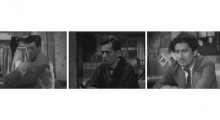
Filmmaker and video essayist :kogonada — one of Filmmaker‘s 25 New Faces of 2014 — has a new piece up that revisits one of his continuing inspirations: Yasujiro Ozu. As has been the case in previous pieces, Kogonada employs split screen to identify formal patterns and correspondences across Ozu’s work as well as to create a new work softly pulsing with allied rhythms and gentle background audio. By the way, Kogonada has a Tiny Letter — “Notes, inquiries, conversations, and projects in pursuit of Ozu, the aftertaste of time, the cinema of mu, and the somethingness of nothingness in this […]
-
Watch: Unmappable, by Diane Hodson and Jasmine Luoma
Premiering online on Vimeo is Unmappable, a short documentary by Diane Hodson and Jasmine Luoma that presents a complicated portrait of an artist and sex offender. Here’s Whitney Mallett writing about the film previously for Filmmaker at the Atlanta Film Festival. The short documentary Unmappable is a portrait of Denis Wood, whose poetic mapmaking challenges the distinction between art and cartography. He also had a sexual relationship with a 16-year-old boy — a friend of his son’s who began living with the family — for which he spent 26 months in prison. Both the story and tone directors Diane Hodson […]
-
Trailer Watch: K8 Hardy’s Outfitumentary

K8 Hardy does not want you to watch her debut feature, Outfitumentary. Or, at least, that’s her position expressed in the trailer above. If you choose to ignore her advice, the film has one more screening as part of MoMA’s Doc Fortnight series this Sunday. Also, check out Taylor Hess’s interview with Hardy here at Filmmaker.
-
Watch: Tony Zhou on the Coen Brothers’ Use of Shot/Reverse Shot
Tony Zhou covers a lot of ground in his latest video essay, which examines the Coen brothers’ use of shot/reverse shot. Noting that they prefer to film conversations from the middle rather than over the shoulder with a long lens, he finds an appropriate video interview with Roger Deakins that discusses his lens preference. Then it’s on to framing, how the characters are defined by their environments, and the emotional effect of these shot choices: both uncomfortable and funny, Zhou concludes.
-
Watch: Michael Mann Discusses His Entire Career
As part of their recent retrospective on Michael Mann, BAM had the man himself sit down for a 77-minute talk moderated by critic Bilge Ebiri. They begin, logically, at the beginning, with Mann discussing how growing up in Chicago shaped his visual sensibility, and go from there.
-
Watch: “Filmmaking is the Best Actor”
The latest video from the ever-productive Jacob T. Swinney isn’t as punchy as its title would suggest. “Filmmaking is the Best Actor” considers how cinematography, editing, production design et al. help enhance and support the performances of this year’s Oscar-nominated thespians.
-
Watch: Roger Deakins and Matthew Heineman Talk Shooting the Drug War
One fiction, one documentary, Sicario and Cartel Land were the year’s two most vivid cinematic vocations of violence surrounding the Mexican drug wars. Here, courtesy of VICE, is a great conversation between Sicario D.P. Roger Deakins and Cartel Land director and cinematographer Matthew Heineman. They get deep into their visual ideas for the film as well as the narrative and moral issues those ideas are designed to represent.
-
Trailer Watch: Stephen Elliott’s After Adderall
“What’s the difference between a memoir and life?” “I’m an agent, not a philosopher.” That’s writer/director/actor Stephen Elliott quizzing his agent, played by James Urbaniak, in After Adderall, the director’s feature-length, rapid-response to the strange experience of having his memoir turned into a movie starring James Franco. Elliott has assembled a great cast, including Michael C. Hall and Lili Taylor alongside numerous authors playing themselves (Jerry Stahl, Susan Orlean, Michael Cunningham). The film is currently being submitted to film festivals.
-
Trailer Watch: The Marijuana Journalism Documentary, Rolling Papers
The SXSW-premiering Rolling Papers, which opens in theaters today from Alchemy, finds a sharp angle to cover the rise of legal weed in the state of Colorado. Even before recreational marijuana use was legalized in Colorado, The Denver Post launched a department devoted to covering the pot beat, “The Cannabist.” It’s by focusing on editor Ricardo Baca and his team of journalists that producer/director Mitch Dickman tells a story that’s about changing cultural mores, the struggles of print journalism, and getting high in the Mile High State.
-
Trailer Watch: Tilda Swinton’s The Seasons in Quincy: Four Portraits of John Berger
Is there any contemporary filmmaker — or any artist invested in the creation of images — who hasn’t been influenced, at least on some level, by the British writer John Berger? His Ways of Seeing, a semiotics-tinged analysis of imagery ranging from European oil painting to 20th century advertising, is a seductive and accessible introduction to critical theory, feminist film criticism and Marxist cultural commentary. Premiering at the Berlin Film Festival is the anthology film, The Seasons in Quincy: Four Portraits of John Berger. Conceived of by Swinton and producer and literary critic Colin McCabe, the film captures the 89-year-old […]