Filmmaker Videos
-
Watch: Whiplash, The Short
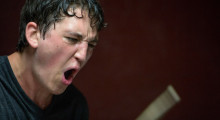
Initially unable to raise the $3 million budget for Whiplash, Damien Chazelle made a proof of concept, 18-minute short film that premiered at the 2013 Sundance Film Festival. Now available online, the short looks to be more or less an exact excerpt of the feature script, distilling Fletcher’s emotional manipulation, rage, and abuse into three consecutive scenes. The precise editing, gliding camerawork, and J.K. Simmons’ high octane performance are all on display, though the short — presumably for budgetary reasons — lacks the isolated, brooding mood and dark yellow color pallet of the feature version. Also notable is that Johnny Simmons was […]
-
Watch: Long Shots and Adrift Characters in the Films of Paul Thomas Anderson
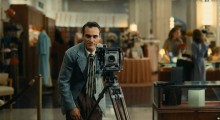
Not to go overboard with the Paul Thomas Anderson supercuts (but to go a little overboard with the Paul Thomas Anderson supercuts), here is a nice essay from Jacob T. Swinney that strings together a selection of long shots from the director’s first six films — a nice contrast to his application of close-ups in Boogie Nights. Emphasizing the unmoored nature of Anderson’s characters both psychologically and contextually, Swinney notes that “We are often presented with characters lost within the frame, and therefore have trouble connecting with said characters–we become isolated ourselves.”
-
Watch: “Red & Yellow: A Wes Anderson Supercut”

You can’t say that Rishi Kaneria doesn’t know what he’s interested in when he makes his supercuts. Following logically on the heels of “Stanley Kubrick: Red,” which looked at that director’s use of the color, now we have “Red & Yellow: A Wes Anderson Supercut.” Red’s on the left, yellow’s on the right, and there’s an oddly disproportionate emphasis on his 2007 short Hotel Chevalier.
-
Shaka King on Releasing His Sundance Short Mulignans Online
Newlyweeds filmmaker Shaka King made the slightly unorthodox decision to release his short film Mulignans online almost immediately following its Sundance premiere last month. Turns out, King never thought of Mulignans as a festival hopper, but a piece of work meant to be seen by “as wide an audience as possible as soon as possible.” Currently at 61,000 views and counting on Vimeo, I asked King to elaborate on his decision: We initially made Mulignans for the web, but a couple friends suggested I enter it into Sundance…and I’m glad I did. But the ultimate goal was always to get it out there […]
-
The Cooler Bandits Screening and Discussion at Columbia University on February 26
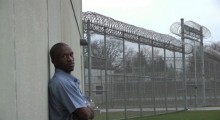
Followed by what promises to be an amazing discussion between filmmakers and subjects alike, John Lucas’s documentary The Cooler Bandits will be screened Thursday, February 26 in New York at Columbia University. The event is free and open to the public. For Filmmaker, Alix Lambert wrote about the film and talked to Lucas while The Cooler Bandits was in post-production. An excerpt: The Cooler Bandits is the film’s title as well as the crew consisting of Charlie, Donovan, Frankie, and Poochie, who were all teenagers in 1991 when they spent the better part of the year robbing restaurants. Collectively they […]
-
Watch: Objects and Close-Ups in Boogie Nights
This one’s zippy: a two-minute supercut of close-ups of objects and gestures in Boogie Nights, mostly the former. Taken out of context, a formidable amount of art direction and fetishistically shiny framing comes to the forefront. Entitled “Boogie Nights — Close-ups, Objects etc.,” this is the first video uploaded to the Vimeo channel of Justin Barham, who notes, plaintively, “If I knew people were going to actually see it I’d have given it a cool title.”
-
Watch: Why Gordon Willis’ Lighting in Interiors is Another Character Element
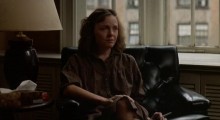
In conjunction with the Museum of Moving Image’s first ever cinematographer-centric retrospective, Reverse Shot has produced a small tribute to Gordon Willis’ work on Woody Allen’s Interiors. Staging their own recreations of the film’s many portraits, editors Michael Koresky and Jeff Reichert examine how Willis’ lighting contributes to the emotional interiority of Diane Keaton’s character, Renata. By casting her in shadows for the majority of the film, Willis reinforces her isolation. It’s an important consideration of how cinematography can not only set the external tone of a film, but also play a necessary role in the characterization of its inhabitants.
-
Watch: Buster Keaton’s Symmetrical Sense of Humor
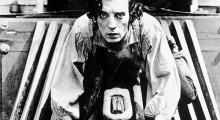
kogonada first caught our eye two years back with his exploration of symmetry in the works of Stanley Kubrick, followed by Wes Anderson a year later. But before both auteurs were associated with a centered, exacting aesthetic, Buster Keaton applied a looser construct of symmetry to his brand of physical comedy. The above video from Vince di Meglio looks at how the central framing of nearly 30 of Keaton’s films allows for head-to-toe humor in relation to both objects and space.
-
Watch: Michael Cimino’s 1967 United Airlines Commercial
In his first interview in 13 years, The Deer Hunter/Heaven’s Gate director Michael Cimino sounds off on the greatness of American Sniper and why Clint Eastwood should be president, writing novels published in France he’s afraid to have published in the US, and much more. It’s a good time to revisit the start of Cimino’s career, when he was a Madison Avenue commercial director, and a very successful one at that. This 1967 ad was part of a $1.7-million United Airlines campaign and it’s very of the period — literally colorful, musically brassy, casually sexist. More background on the commercial here.
-
“I Deliberately Cut an Unusual Rhythm”: Graeme Clifford On Editing Don’t Look Now
In this excerpt from the Criterion Collection’s supplements for their now-out edition of Nicolas Roeg’s 1973 Don’t Look Now, Graeme Clifford discusses the fine art of keeping people off-balance without being too obvious about it. “There is a comfortable way of editing, where people want to be unaware of cuts,” he explains. “In most movies, that’s generally the way you want to go. But in this movie, I deliberately cut an unusual rhythm. I would hold shots when there’d seem to be no reason to do so, or I would cut off them too quickly, or I would cut to things that were […]