Back to selection
Emergence
New work in new media by Deniz Tortum
The Screen in the Sky: Drone Shows as Cinema
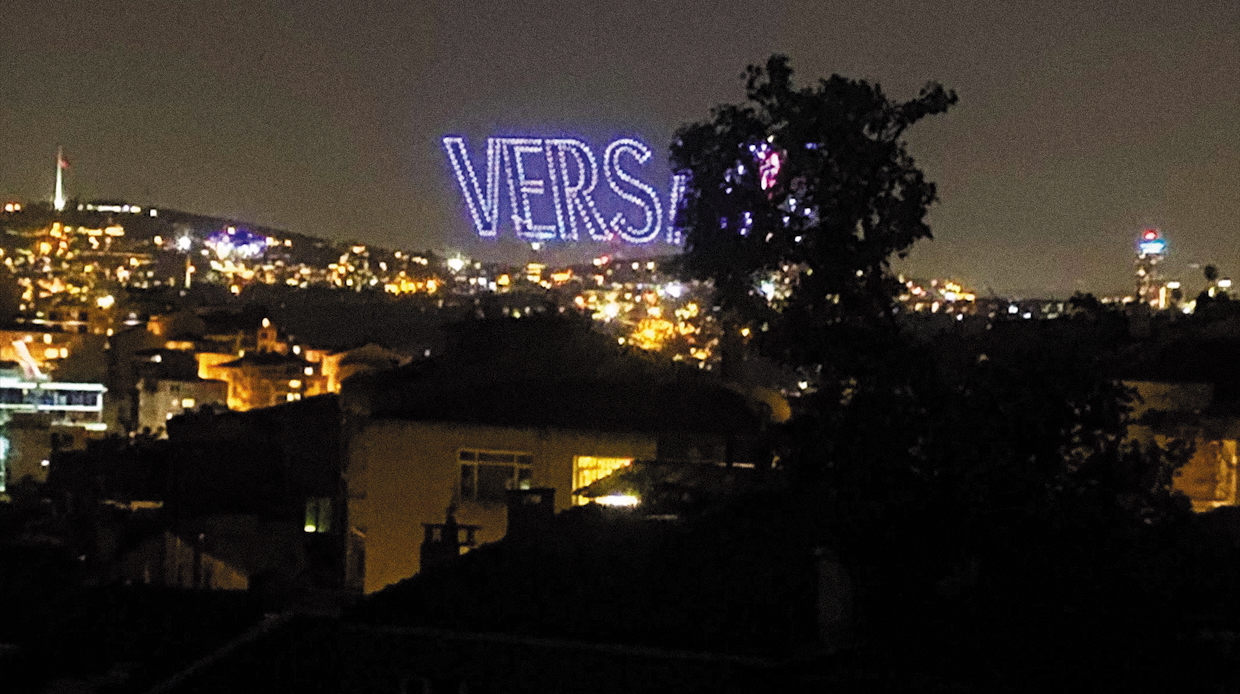
After I put my kid to sleep, I found myself standing by the window, looking out over the valley of apartment buildings. The house went quiet; the city softened into an arrangement of distant lights. As I stared into the sky, a bright purple word snapped into view over the horizon. At first, I thought there was something wrong with my eyes. Then, the letters sharpened: “VERSACE,” spelled out by hundreds of synchronized drones floating above Istanbul.
I had never seen an advertisement suspended in the sky before. Billboards, phone screens—the daily flood of images is, today, expected visual noise. But the night sky itself flashing a luxury logo felt like something else entirely, as though a private company had reached into one of the last remaining commons of the city and installed its own sign.
We live in an era of oversaturation and overproduction of images, created by humans, by algorithms, by artificial intelligence. Yet the sky still has the power to seize attention. The sky is an unsaturated screen, the last surface not everyone can create on.
A year before I saw my first skyvertisement, I witnessed another sky spectacle. Marking the hundredth anniversary of the Turkish Republic, 2,023 drones ascended above the Bosphorus, each one a voxel in a vast, floating image. From where I stood, near the official broadcast position, I could see the formations clearly: the outline of Turkey’s map, the flag, a soldier on horseback rising into the night.
It took me a moment to realize the show was not designed for everyone watching. It was crafted for a camera positioned at a specific angle. From that specific viewpoint, the image resolves cleanly. But from other locations, the drones skew into abstractions, glitches in the night. The event was a public celebration, but the public, depending on where they stood, received different images. What mattered was the televised version, the broadcast composite. Even sky spectacles are choreographed for screens.
My first encounter with drone art wasn’t an ad or a national celebration but something much quieter: artist Alan Kwan’s The Flying Umbrella Project (2016). Kwan had spent months trying to make an umbrella fly using a drone. From an engineering perspective, this was paradoxical because the umbrella blocked the air going to the propellers. The umbrellas drifted across the sky like jellyfish. They weren’t symbols or logos but rather strange creatures. I loved the performance’s modest design, its inefficiency, its feeling of impossibility and its stubborn refusal to scale.
There’s a lineage of artists drawn to the sky as medium. In the 1960s and ’70s, Otto Piene released enormous inflatable tubes and spheres into the atmosphere. He called this “Sky Art,” treating the sky as a canvas where objects could mingle with clouds, wind and weather.
In 2012, Marshmallow Laser Feast’s Meet Your Creator brought drones onto a stage: 16 quadrotors equipped with RGB LEDs flew in tightly choreographed formations. That same year, along the Danube in Linz, Ars Electronica Futurelab launched 49 illuminated drones in the first large-scale outdoor formation flight: a proposal for a “new kind of display in space.”
A year earlier, in 2011, Raffaello D’Andrea and architects Gramazio & Kohler had explored what drones themselves could build. In Flight Assembled Architecture, four quadrotors autonomously constructed a six-meter tower out of 1,500 foam modules. In a separate collaboration with Cirque du Soleil, quadcopters drifted around an actor inside lampshades, responding to gestures with uncanny, autonomous choreography.
All of these works treated the sky (or airspace) as a medium. What began as artistic exploration has since expanded into an industry that fills skylines around the world. To understand the shifting landscape, I spoke with Lucas van Oostrum, co-founder of Drone Stories, an artistic drone show studio that has created performances for Formula 1, Coachella and UNICEF.
In our talk, van Oostrum emphasized that their company grew from a creative background rather than an engineering one. His partner, Ralph Nauta, who also co-founded the art collective Studio Drift, had been imagining a drone-based bird-swarm performance since 2007, before the technology existed to realize it. Nauta was involved in the first drone show produced by Ars Electronica and eventually realized this vision with Franchise Freedom at Art Basel Miami in 2017.
Many drone shows today fall into what Lucas calls the “clip art” category: logos in the sky, municipal celebrations, corporate messages. He isn’t dismissive, noting simply that this has become the dominant aesthetic of a growing industry.
Drone Stories’s workflow is similar to filmmaking: build a storyboard, animate in 3D, compose a soundtrack, scout the site, determine the “show box” in the air, secure permits, ensure power access and upload the final choreography to the drones. One key design decision, Lucas said, is whether a show is built for a single vantage point (as most “clip art” shows are) or whether it holds from multiple angles. “Seeing something around you in the sky, it’s so big, so hard to comprehend,” he says. “Even today, when we do the shows, I still feel the awe.”
AI is now assisting with previsualization and will soon contribute directly to show design. As the hardware matures, content becomes the main differentiator. Integration matters, too. “It becomes much more interesting when drones are part of a larger system,” van Oostrum said. “Projection mapping, big screens, lights—with all these tools, you create a more interesting show. All the activators you have, triggering all the senses.”
“Creating a virtual world in reality” is how van Oostrum described the company’s work. The phrase stayed with me. Many aspects of our world are being virtualized. We live in constantly fluctuating layers of the physical and digital, and perhaps drone shows feel awe-inspiring (and uncanny) because they materialize that layering in the sky itself.
A few years ago, a friend of mine put out a Craigslist call for drone pilots to help with a short film. He expected one or two responses. Instead, dozens of men wrote back—hobbyists, tinkerers, guys who had fallen into the meditative loop of goggles and joysticks. Instead of picking one, my friend invited them all. So, on a Sunday morning, 10 men gathered in a field to fly their drones simultaneously.
The scene they’d come to shoot quickly dissolved. Instead, the men filmed one another’s drones. Tiny machines flying through the air, a swarm of amateur cinematographers chasing one another. In their goggles, the landscape pixelated into a first-person simulation. The sky became their video game. Most of them talked about the flow state they entered while flying. It struck me later: FPV pilots create their own virtual skies. Reality becomes virtualized. If drone shows create a virtuality from above, hobbyists do it from below: intimate and embodied, two different ways of turning the sky into a medium and reality into virtual space.
The world record for the number of drones in a show is now around 11,000. That many drones can create an image with a resolution of roughly 100×110 pixels. For comparison, when it was released in 1977, the Atari 2600 had the analog equivalent of about 160×192. One would need approximately 30,000 drones to reach that. How long until the sky has the resolution of early computers?
People generally applaud drone shows because, compared to fireworks, they’re silent and produce less waste. More municipalities in the United States are now seeking drone shows as a replacement for fireworks. But the bad things about fireworks might actually be a kind of “good inefficiency”: they burn out quickly, and their noise and waste limit how often we use them. Drone shows, on the other hand, may have a “bad efficiency.” They can scale easily, last longer and potentially spread across many skies far more often.
What happens if a clear, empty night becomes a luxury? If a skyline without logos, animations or aerial signage feels rare? The sky is an unsaturated screen, for now, but screens never stay empty for long. Like most emerging technologies, drone shows sit in that uneasy space between wonder and unease. As more of the world becomes virtualized, the sky is beginning to follow suit: a layer of reality that can be programmed, turning the atmosphere itself into a kind of augmented reality.