Back to selection
“I Hope They Boo”: Tim Heidecker and Eric Wareheim Take Cannes
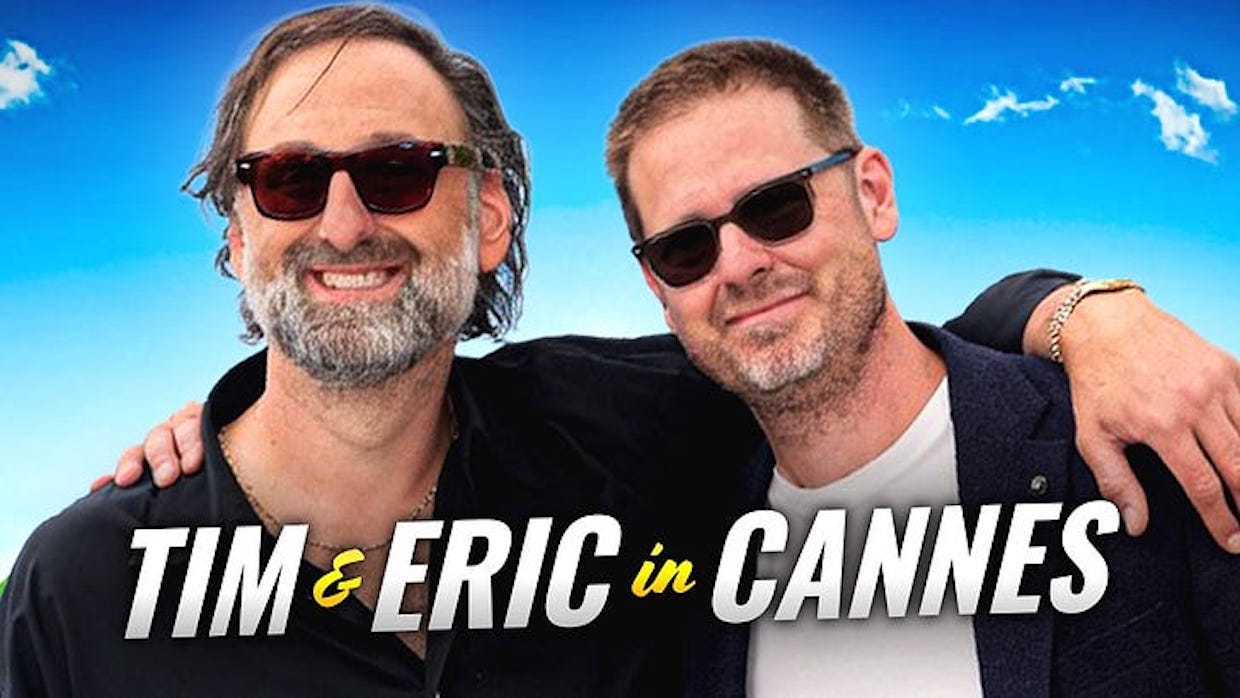 "Tim & Eric Made It 2 Cannes"
 Laurel and Hardy, Martin and Lewis, Nichols and May… Tim and Eric. A double-act for the ages, Tim Heidecker and Eric Wareheim first teamed up as students at Temple University in Philadelphia, and secured comedy-legend status with their chaotic-good surrealist sketch show Tim and Eric Awesome Show, Great Job! (2007–2010), produced for Adult Swim. Like public-access TV beamed through a cracked funhouse mirror—this nineties kid recalls how much those first viewings felt like some kind of illicit initiation rite—Tim and Eric managed to remake internet culture, and maybe even American humor, in its own, gleefully psychoactive image.
In the intervening 15-odd years, Heidecker and Wareheim have embarked on diverse solo ventures. Together with Gregg Turkington, Heidecker has forged another gonzo comedy universe in the multimedia psychodrama On Cinema at the Cinema (2011–) and has also toured behind six very fine rock albums. In April, he was announced as the new creative director of InfoWars, as The Onion draws closer to wresting Alex Jones’s propaganda empire from his supplement-enhanced grip. Wareheim, meanwhile, has pursued the path of the bon vivant as a cookbook author and winemaker, and has recently turned over a new leaf as a garden-plant guru.
It’s a delight to see the Beaver Boys reunited in Quentin Dupieux’s Full Phil —alongside Vertiginous, one of two films by the prolific French filmmaker to debut at this year’s Cannes. A vulgar surrealist and multi-hyphenate—he also makes music under the name Mr. Oizo—Dupieux specializes in an offbeat kind of existential meta-comedy that has obvious points of crossover with Tim and Eric’s—and indeed, Wareheim has appeared in two of his previous films, Wrong Cops (2013) and Reality (2014).
Described by the director as “Emily in Paris in hell,” Full Phil concerns an ill-fated attempt by a wealthy man (Woody Harrelson) to reconnect with his daughter (Kristen Stewart) via a luxurious jaunt to the French capital. Rather than indulge her father, Stewart’s character prefers to indulge herself: she stuffs her face with all manner of tender meats and cream-piled sweets, her gaze happily fixed on the black-and-white horror movie she’s watching on a clunky portable DVD player. Heidecker and Wareheim star in this film-within-the-film as screwy scientists in the Victor Frankenstein mold, expertly chewing the scenery while pursuing a Creature from the Black Lagoon–esque reptilian, who in turn chews the heads of his cartoonishly terrified victims.
Ahead of Full Phil’s midnight premiere, I met Heidecker and Wareheim at a disarmingly swanky hotel restaurant for a free-range discussion—and some light people-watching. Heidecker was fresh from an IndieWire keynote on the “Future of Filmmaking” at the festival’s American Pavilion, during which he and Wareheim—whose mutual commitment to independence goes back to the 2007 founding of their production company, Abso Lutely—were praised as “progenitors of the creator economy.” In our conversation, the maverick duo expressed both awe of and healthy suspicion toward the gilded tumult of the world’s most famous festival.
Keva York: What are your impressions of Cannes so far? Do you have a to-do list beyond the premiere?
Eric Wareheim: I came in so thrilled to do this. I have zero plans, which is a new technique I’m trying. If I get 20 minutes to walk around, I’ll be very happy. We grew up wanting to do this festival.
Tim Heidecker: I was boarding the plane and met Woody Harrelson—he’s very nice. And another guy was there, and he was like, “Oh, is this your first time at Cannes?” “Yes.” “Oh man, I remember my first time, I was with Quentin Tarantino, we had just made Reservoir Dogs”—and it was Lawrence Bender, who was the producer of all the early Tarantino movies! So for me it’s very surreal, like Eric said—growing up, thinking that you would be here…
But then you get here and it’s like, if you’re familiar with a place in Glendale called The Grove—this place is like The Grove if it was the size of Disney World. And the people are absurd, they’re wearing these evening gowns… Who the hell knows who they are, but it seems like a lot of people without the best intentions. And it seems really silly that you would wear a tuxedo to go see a movie.
Wareheim: I do like the formality of it, because we’re so accustomed to watching everything at home in, like, our night clothes.
York: You’re going to be in a 2,300-seater theater.
Wareheim: It’s that many people? Wow. Quentin says it’s fun; it’s raucous.
Heidecker: I hope they boo.
York: Let’s talk about the film—I really enjoyed it.
Wareheim: You saw it already?
Heidecker: We haven’t.
York: So I’ve got the edge on you guys there. Eric, you’ve worked with Quentin a couple times. How did you meet?
Wareheim: I was into Quentin’s music, and he was fascinated with Tim and Eric, finding his comedy chops and making cool shit. And the way he worked was similar to Tim and I: very fast, he did everything, shot, edited. I became close with him. We took some holiday trips here, in Corsica, and he showed me a cool side of the country—music and art; all kinds of good stuff. We kind of have a little brotherhood, we call each other “beards.”
York: How did Full Phil come about? Tim, it sounds like you hadn’t met Quentin before.
Heidecker: No. I got some email, and Eric said, “This thing’s out there for us.” We just went over to Paris and shot for four days, something like that. It was wonderful. Long lunches, short days. Quentin’s shooting everything. We’re intentionally bad in the movie, doing some big, ridiculous theatrical acting.
York: You’re in this film within a film, which riffs on classic Universal horror titles like Creature from the Black Lagoon [1954] and Frankenstein [1931]; Tim, you mentioned Vincent Price this morning. Were you taking specific cues from that canon?
Heidecker: He gave us a couple references—James Whale?
York: He did Frankenstein and Bride of Frankenstein [1935], yeah.
Heidecker: We looked at that for a little bit and I was like, “I’ll do that big mid-Atlantic accent,” and he was very happy with it. I didn’t think about it too much beyond that.
York: I know that you guys leave a lot of room for improvisation with your own stuff, but here you’re part of someone else’s project: how much was on the page versus hashed out in the moment?
Heidecker: It’s meant to feel very scripted. He was like, “Can you guys just please learn your lines?” I like being told that; then I know how to prepare. So we pretty much did. It took us a minute, but…
Wareheim: He also had these old-fashioned camera moves that he was doing.
Heidecker: This wheelchair dolly kind of thing…
Wareheim: He would sync those moves up with the lines. But also, he writes in French, and then he just puts it into a translator. Ten years ago, when I shot with him, I was like, “This is not in English.” But I was so bad as an actor, it worked. It’s a weird, cool universe he creates—but it’s harder, because you can’t lean on the skills you have with the English language. It makes everyone odd.
York: Did you get the whole script, or just the sides?
Heidecker: I don’t think we ever got the whole script.
Wareheim: I think he purposely didn’t give it to us. It was like, this is the film that you’re doing.
Heidecker: Truly the last thing in the world I ever want to do is read a script.
Wareheim: [Laughs.]
Heidecker: It’s the biggest drag.
Wareheim: Have you done any script-to-audio stuff?
Heidecker: No.
Wareheim: I’m a slow reader. I’m in this other film called Onslaught that’s coming out—it’s a juicy character, but I was like, “Fuck, I can’t read this whole thing.” So I made it into an audio file and it was so nice, I would drive around listening to it.
York: Can you share more about Onslaught?
Wareheim: It’s this guy Adam Wingard, who made You’re Next [2011]—legend. Then he instantly became a huge mega-director; he did the last King Kong [Godzilla x Kong: The New Empire, 2024], for like, $200-something million.
Onslaught is harkening back to his early indie horror stuff—it’s not a cheap movie, but it’s not massive. I was nervous because I’ve never worked with all real actors before, but he told me, “Just let go. You’re not the director”—and that was the best [advice]. It was so fun, I didn’t look at the monitor—some actors never wanna look at the monitor on a shoot, and I was like, “Oh, I get it.”
Heidecker: Be on time. Be polite, helpful, respectful. I always feel, that way, I can fail in other ways and I won’t disappoint. “Well, at least he was nice, even though he messed up his lines 25 times.”
Wareheim: I did mess up my lines in the hugest production value shot. I probably can’t say exactly what was in it, but there were explosions, all kinds of shit.
Heidecker: I did that in this movie, Atropia [2025]. I did one really good day with Chloë Sevigny; we were doing these little scenes and just kind of improvising. But then I was brought back to do this walk-and-talk with a Steadicam—I’m this military guy, and I’m like, [staccato] “Da da da da, da da da”—and I kept fucking it up. Then there were these planes overhead… I was like, “You can cut together a couple of those, right?” “Well, no, it’s one take.”
Wareheim: Just cut to a shot of the planes. [Makes plane sounds.]
Heidecker: [Laughs.]
York: It sounds like you both came to Full Phil prepared to put yourselves in Quentin’s hands, at least.
Wareheim: That was the first thing I told Tim: “You can trust Quentin.” He’s cut from the same cloth [as us] in some ways—the French version of it; a luxurious, cashmere version. And he’s always wanted to work with Tim. Tim is a real actor…
Heidecker: [Laughs.]
Wareheim: I don’t do something unless I know it’s going to be a really good time. But once Onslaught comes out… you’re won’t even be able to get a hold of me.
York: You’ve been collaborating since your college days. Do you feel like your process has been consistent over the decades?
Heidecker: We don’t work together as much anymore—obviously, we had a big, white-hot period of time where that’s all we were doing. But today, as soon as we got together, we were shooting stuff. [Laughs.]
Wareheim: What I have on here [brandishing phone] is so good.
Heidecker: It’s just us goofing around about being in this insane place and making fun of ourselves because nobody knows who we are—which is funny to us because, in some sense, we are extremely influential [laughs]. I was saying to Eric, I don’t really care, but what’s the difference between us and Emma Mackey, who seems like a very nice person and has done some interesting things, but the press goes “Oooh, Emma! Emma!” and we’re like, “Tim and Eric changed the course of American comedy, and nobody is interested.”
Wareheim: I agree, but this is an isolated place. We’ve been offered shows in Paris—there is a weird subset that’s interested.
Heidecker: [Cannes is] very celebrity-driven in a way that I don’t really understand.
Wareheim: I work in a different industry now, plants, but I still always have the craving to make funny videos. Sometimes early in the morning, I make them for my crew, who are younger people—only a few know me from comedy, which is really weird, but I love it; I know they’re real—but only like, half of them think they’re sort of funny. So it’s my mission now to make them laugh.
Heidecker: Whoa, look at this guy. [A tall, hat-and-leather-clad man has entered the restaurant.] By the way, half of our lives is us going, “Whoa, look at that guy.”
York: And look, there’s a princess. [Outside, by the pool, a woman in a Barbie-cake style dress is posing for photographs.]
Heidecker: I know, I keep looking at that princess. Like, what is the point? It’s ultimately for a picture that will just be not looked at. But see that guy there with the cowboy hat?
Wareheim: So much shiny leather and sparkles.
York: In the talk you gave this morning, Tim, you spoke about how both of you had stepped away from Abso Lutely. What led to that decision?
Heidecker: Abso Lutely started as the way we would make our stuff—we had to have a company to do that at some point, it was just a lot easier. And then, to keep everybody working, we started producing other people’s stuff, and that worked out really well. But then, with COVID, the way these networks made deals with production companies really changed. A lot of stuff started happening in-house. There was a pretty big monthly nut to keep an office, keep people staffed and all that stuff, so we looked for a way out: we sold it to Jimmy Miller’s company, he’s a Hollywood guy—he bought the UCB Theatre brand, and then he brought in Abso Lutely for development.
We still have some kind of ownership, and I know that they’re producing a lot of stuff—they’re focusing on stand-up specials. But it seems like it’s hard to get the good stuff made right now, the weird stuff.
York: That leads us to Infowars—it sounds like your intention is for it to become an incubator in the way that Abso Lutely was. And maybe the HEI Network, the site you built to host On Cinema, is a blueprint for this kind of “direct-to-consumer” model…
Heidecker: That’s what I pitched to The Onion, and they were all about it. If you’ve got people that know how to build websites and you have an audience, you can make stuff and have them pay for it. We would probably prefer to have big fat deals with studios where they give us too much money, but this is a good way to make the pure stuff—and with Infowars, there’s actual money to make stuff the right way. We’re not going to parody the Infowars universe for very long. We have an arc that we’re going to extend for a little while and then we’ll kill it, but we’re going to continue to make stuff. It’s a proof-of-concept sort of thing, so we’ll see what happens over the next year or two.
Wareheim: Who do I contact to get a meeting?
Heidecker: You can just reach out to me directly. I mean, we have such a long relationship.
Wareheim: Tim and I have made a great body of work, and we reached the next level—larger studios, bigger budgets—and we were tied up for years in that process, and it was not that fun. Obviously, it’s very fun to make TV in the Adult Swim universe where we had no rules, but we also know how to make TV that’s “responsible” for HBO.
Heidecker: We were in development hell with this one show at FX. It was like we were in a grad student program, all these questions and second-guessing. “What’s going to happen at the end of the show?” “Let us make it. We’ll figure it out.”
Wareheim: [The situation has been] pushing both of us—you developed your own TV network and now you’re starting another one, and I’m fully in another career. I’m only gonna do my own thing because it’s the only way that we can survive in this landscape and know that the amount of work we put into it will be represented on the screen. We’re hashtag-blessed that people let us do anything, but at this stage we don’t want to do things that aren’t going to get made.
York: I’m keen to hear about your green thumb, Eric.
Wareheim: I take really interesting plants and put them in really interesting vessels—that’s the easy way to describe it. I used to live my life loving restaurants but it was very expensive and just not fulfilling anymore. I went through some personal things that pushed me toward the beautiful art of studying bonsai.
I kind of took the energy that Tim and I started with—we will work 24-7, anything to make the thing funny or beautiful or whatever—I did that with this. I didn’t even want it to be a business; I just had to pay back some of the intense bills I was [racking up]. I have three shipping containers from France on the water—that’s my new life. I’m an importer, I love it. I was just in New York and I went to two botanical gardens instead of 100 restaurants—I’m in a post-food world. It’s a healthy switch, but I don’t know what’s happening.
York: Well, food and gardening are both about the fruits of the earth.
Wareheim: I really feel like comedy and winemaking and even plant stuff is about giving someone this beautiful feeling. And it’s better than selling crack.
My obsession is a shipping container from Australia filled with fucking trees. Tim, have you ever seen an Australian grasstree?
Heidecker: [Sarcastic] Of course!
Wareheim: Australian grasstrees look like Joshua trees but burnt. They’ve been in these brush fires year after year and have evolutionarily kept the black skin; it protects them from future brush fires. They’re stunning.
Heidecker: I’m checked out.
Wareheim: Have you gotten a big spike since all the Infowars stuff?
Heidecker: Yeah, a little bit. But, God, [Alex Jones] talking about our work; we haven’t really talked about that. That was unreal. I’m sorry you got dragged into that, Eric. Because Steve Mahanahan’s like, on every front page. He was like, [Jones voice] “Look at these people, this is who we’re dealing with, these are demonic pedophiles, killing children.”
Wareheim: The stuff that you sent me, I couldn’t believe. It’s so good.
Heidecker: It’s so funny. They can’t wrap their heads around what this is.