Filmmaker Videos
-
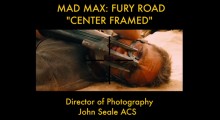
Watch: Crosshair Framing in Mad Max: Fury Road

Sometimes it’s good to state the seemingly obvious, so Vashi Nedomansky has performed a public service in assembling this brief video showing how centered and symmetrical framing helps guide viewers’ eyes through the many cuts of Mad Max: Fury Road. Audio of John Seale discussing director George Miller’s constant instructions as to where to keep the camera’s crosshairs in each shot clarifies the point being made visually. Read more at Nedomansky’s site; thanks to The Playlist for the heads-up.
-
Watch: Tony Zhou In Praise of Chairs
Video essayist Tony Zhou recently griped about the preponderance of Fincher, Scorsese, Anderson, Nolan, etc. dissections, and has since turned his efforts to more unusual facets in film history. His latest video, for instance, explores the role of the chair — or, an extension of the production designer — in storytelling. With a wide range of clips, he interrogates the furniture as a conduit for a person, a situation, and the filmic context.
-
Trailer Watch: James Ponsoldt’s The End of the Tour
Here’s the first trailer for James Ponsoldt’s David Foster Wallace biopic, The End of the Tour, which picked up several nice notices out of Sundance, if not from his family and literary estate. Starring Jason Segel as Wallace and Jesse Eisenberg as the Rolling Stone reporter David Lipsky, the two-hander winds through a leg of the former’s book tour for Infinite Jest. A24 will release the film on July 31.
-
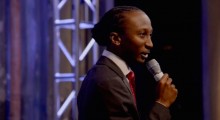
Artel Great Launches Project Catalyst at Cinema Research Institute Event
Project Catalyst, an “innovative transmedia initiative that fuses creative community building with cinema, art, music, and technology” and is aimed at multicultural communities was pitched at an NYU Cinema Research Institute event last month, hosted at AOL Build. In the video above, learn how Great intends this smartphone app to connect audiences with filmmakers in original ways and in order to support diverse content.
-
Watch: A Brief History of Motion Capture’s Past and Present
With Robert Zemeckis back in the live-action world and James Cameron taking his time to gear up Avatars 2-4, there’s not been much discussion lately of motion capture. That doesn’t mean it’s gone away, and this video from Vice’s The Creator Project is a nicely succinct overview of what motion capture’s evolved from and where it’s going next; the participation of the technicians behind the technology is a big plus. The baby project described and shown at the end may just be the one that crosses the uncanny valley.
-
Watch: Wes Anderson and Noah Baumbach Fundraise for Orson Welles’ Final Film
You’ve probably heard about the latest push to finally produce a finished, edited version of Orson Welles’ uncompleted final film, The Other Side of the Wind. In support of an Indiegogo campaign to raise funds, Wes Anderson and Noah Baumbach have taped a video message urging you to just contribute already. Unusually for the famously controlling Anderson, he appears to have shot the video handheld selfie style.
-
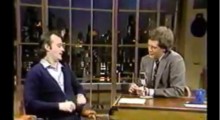
Watch: Bill Murray on David Letterman’s First NBC Show, 1982
Given the overwhelming surplus of articles about David Letterman’s retirement, career and final show tonight, there barely needs to be anything said here. Bill Murray was the guest on last night’s penultimate show, which is fitting, as he was the first guest on Letterman’s first NBC show in 1982. They antagonized each other, watched a panda video and then Murray performed Olivia Newton-John’s “Physical,” which is basically everything you need for good television.
-
“Olivia Can Fly”: Oscar Sharp on The Kármán Line
A BAFTA nominee, Oscar Sharp’s The Kármán Line tells the unusual tale of Sarah (Olivia Colman), who inexplicably begins to levitate in her living room, showing no signs of slowing down, not even as she breaches the atmosphere above her very roof. A rich tonal brew, the film is also a showcase for some seamless visual effects as Sarah moves through floors and the sky alike. Since The Kármán Line premiered at SXSW, Sharp signed with Tobey Maguire’s Mental Pictures and is in development on a sci-fi feature. You can watch the short, now streaming in The New Yorker‘s Screening Room, above, and hear from […]
-
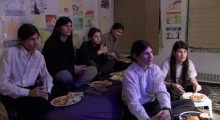
Trailer Watch: Crystal Moselle’s The Wolfpack
In our current print issue, Approaching the Elephant director Amanda Wilder interviews Crystal Moselle about her Sundance Grand Jury Prize winner The Wolfpack, and how she went about navigating the reclusive existence of the Lower East Side Angulo brothers. You can check out the first trailer, which displays a head-scratching R rating from the MPAA, above. Magnolia Pictures will release the film on June 12.
-
Trailer Watch: Arabian Nights, The Three-Part, Six-Hour Follow-Up to Tabu
Miguel Gomes — the wildly talented director of Tabu and Our Beloved Month of August — will be premiering his new film at Cannes. Technically, Arabian Nights might be considered three separate films, since it’s six hours long and in three volumes. As The New York Times‘ Rachel Donadio explained in a fine profile last year, the film examines the Portuguese recession and its fallout on citizens through a dozen stories. The trailer is lively.