Back to selection
Production Gear: A Primer on How Tariffs Inflate Costs and Erode Choice, and Why Costs Will Never Come Back Down
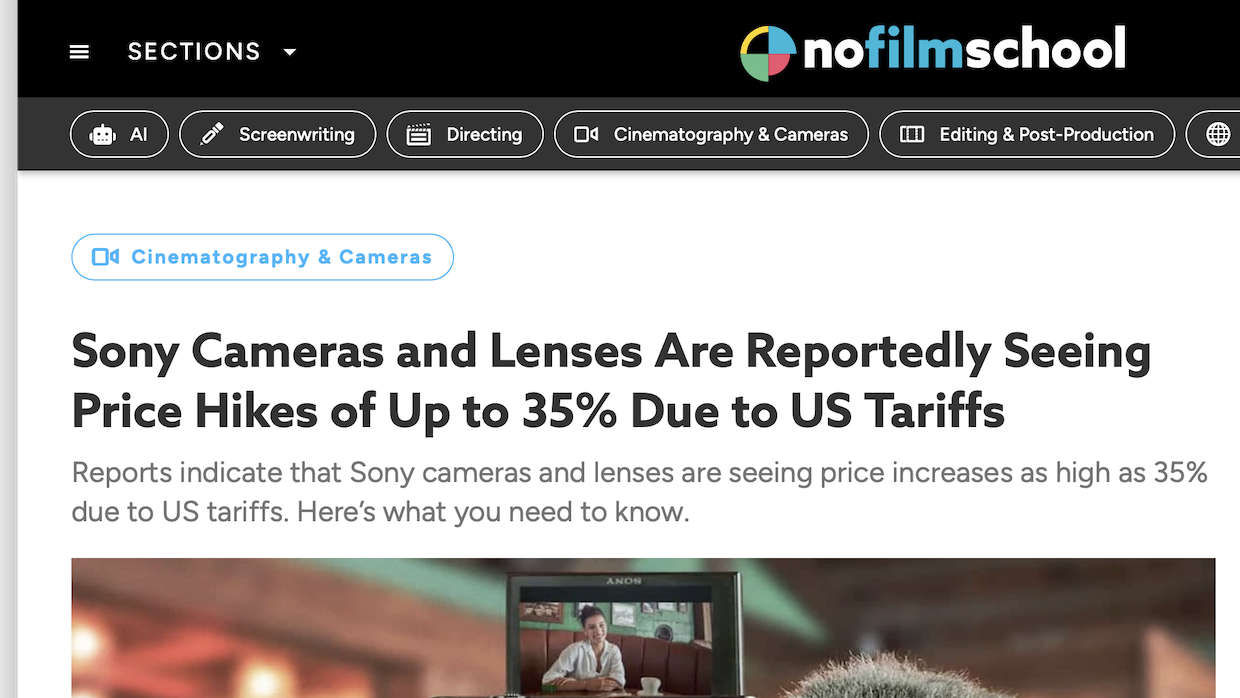 An anxious headline from July 3. Tariff price hikes on Sony products range from 7% to 34%.
 L.A. film and TV production, recovering in the long wake of the global pandemic, has been beset by strikes, streaming wars, a generational turn from legacy media, and now AI anxiety. Resulting historic lows in production have meant that industry freelancers are widely out of work. It’s a safe bet that the last thing the industry wants is another round of whiplash.
Enter broad tariffs. A blast from the past, last signed into law by Herbert Hoover in the Smoot-Hawley Tariff Act of 1930. I think we know how that turned out.
The current American President, seizing questionable executive powers to declare a nonexistent national economic emergency, enjoys brandishing tariffs as a political and economic weapon to goad and alienate our closest neighbors, Canada (10%-50%, depending on product) and Mexico (25%-50%, not all goods), as well as our traditional European Union allies (15%).
Meanwhile, our true geopolitical and trade rival, China, enjoys a “tariff truce.” An August 12th executive order caps tariffs at 30% on Chinese imports until November 10, reportedly to prevent economic disruption during the upcoming holiday season. After November 10, tariffs on Chinese goods could skyrocket again. Sky’s the limit.
I began writing this piece in early May, out of concern that nosebleed tariffs on Asian products and disruption of Asian supply chains would harm film and TV production in countless unforeseen ways. I had just returned from the National Association of Broadcasters (NAB) equipment show in Las Vegas, where I had gotten a foretaste of what might be in store.
Since that time, however, the roll out of Trump’s tariffs has been so shambolic, such a moving target, that it’s been a challenge to draw a clear bead on it. Broad tariffs aimed at individual countries have been threatened, raised, lowered, delayed—seemingly at a whim or out of pique. Twice I rewrote, twice I set aside, this article.
My consternation in keeping up with tariff policy-making, however, is nothing compared to the plight of an Asian manufacturer facing American tariffs, trying to plan ahead for the next several quarters, confronting tariff-induced supply chain uncertainties, no longer able to project costs or labor needs, fearing the real prospect of their products getting priced out of the largest market in the world.
But—back to NAB, our industry’s flagship trade show, in its 102nd year. NAB this year took place April 5 – 9 and drew 55,000 attendees and 1,100 exhibitors from 160 countries. (Last year’s draw was 70,000 attendees and 1,300 exhibitors.)
You’ll no doubt recall “Liberation Day,” a/k/a “Reciprocal Tariff Day.” It landed at NAB’s doorstep on April 2.
“Tariffs were on everyone’s mind,” wrote Caleb Hammond in his Filmmaker review of NAB 2025.
Why were tariffs on everyone’s mind at NAB? On the very first day of NAB, April 5th, Trump’s inaugural 10% tariff kicked in. This tariff targeted all imports from all countries except China. Chinese goods were instead levied with a punishing 54%.
On the last day of NAB, April 9th, Trump escalated, declaring a 125% tariff on Chinese imports. And the following day, April 10th, a White House official clarified that 125% had actually meant 145%, because Trump’s crack economics team had neglected to factor in Trump’s prior 20% “fentanyl tariffs.” Also clarified was that 145% was a floor, not a ceiling.
In other words, that affordable DJI drone at B&H you’d had your eye on, the one listed for $1,300—this purchase would now ding your bank account $3,185, and that’s before applying state & local sales tax to the tariff sticker price. (Taxation on taxation?)
In his NAB review, Caleb Hammond devotes an entire paragraph to the latest upgrade to Blackmagic Design’s impressively affordable Cintel film scanner. He notes that the scanner lists for $32,045. But on NAB’s last day, April 9th, in response to American tariffs, Blackmagic raised prices on all products including their popular cameras. The price of their Cintel scanner jumped to $35,255—only a 10% increase, because Blackmagic manufactures in Singapore, not China.
As of this writing, Blackmagic’s Cintel scanner still lists at $35,255. To further use the Cintel as an example: if the threatened Chinese 145% tariff were applicable, the scanner’s price would have topped $78, 510!
If you follow the news, you’ll recall that back on May 12, after initial talks with Chinese representatives, Trump paused his 145% tariff for 90 days in favor of an interim 30% tariff. That’s still hair-on-fire steep! That Cintel scanner, if instead subject to a 30% tariff, would now cost $9,614 more than it did on the first day of NAB—again, before taxes.
As it happens, the current 90-day reprieve on maximal Chinese tariffs, the one that expires on November 10, is Trump’s second delay. Why is China receiving special treatment?
Blackmagic’s scanner may contain some Chinese-made components. I don’t know whether it does or not, but in 2025 almost every technologically advanced product, electronic or automotive, does. This would include “Made in America” products from American manufacturers, as well as products mostly assembled here, in Mexico or in Canada. Incorporating Chinese-made components could subject a finished product to the full tariff rate on Chinese goods! Which is why American car makers have been quaking in their boots. (They’ve obtained a two-year auto-parts tariffs reprieve, but still face 50% duties on parts that contain imported aluminum or steel.)
And then there are the countless products made and assembled in China—70% to 80% of all smart phones, computer displays, LEDs, solar panels, electric bikes, home appliances, tools, consumer electronics, anything made of plastic—that are exported directly from China. These include—vital to our industry—virtually all camera drones and stabilized gimbals for cameras, advanced 6-color LED lighting, compact video field monitors, wireless audio and video systems, and, increasingly, affordable cine lenses. Plus a million bits and pieces of grip gear and camera kit.
Wait for the howls from individuals directly ordering these bits and pieces from China when they discover their costs multiplying due to Trump’s elimination of the 90-year-old de minimis exception. Historically low costs for mailed goods are fast receding in the rear view mirror.
That China has no peer when it comes to manufacturing is no accident. For the last 45 years, China has methodically set up and nurtured so-called Special Economic Zones to welcome foreign businesses and build international trade. These are capitalist sanctuaries where market forces are permitted to prevail over politics (in theory, at least).
There are now upwards of 40 such SEZs, the most famous being the very first, Shenzhen, sandwiched in the Pearl River Delta between Guangzhou and Hong Kong. Initiated as an SEZ in the early 1980s, Shenzhen has mushroomed into an advanced hi-tech manufacturing powerhouse, China’s Silicon Valley. It’s also China’s third largest city and the world’s fourth busiest container port.
In his Filmmaker NAB review, Caleb Hammond notes that “Many of the companies present at the show are based in China; a cursory scroll through the show directory, for example, found 17 companies listed with a company name that began with “Shenzhen.” One of these would be the world’s leader in drone technology, DJI.
Ask yourself: What company is the American equivalent of DJI?
Nor is China is resting on laurels. At a time when Trump defunds university research and undercuts EV adoption, The New York Times reports that “China has close to 50 graduate programs that focus on either battery chemistry or the closely related subject of battery metallurgy. By contrast, only a handful of professors in the United States are working on batteries.” Also, “One force propelling China’s E.V. revolution… is the torrent of mechanical engineers graduating from universities—10 times as many as in the United States.”
Now, extrapolate this surfeit of young, ambitious chemical and mechanical engineers to electronics, robotics, optics, imaging, solar, avionics, aerospace…
I’ve attended every NAB since 1992, and each year I give an annual talk to the New York section of the Society of Motion Picture and Television Engineers (SMPTE) on my take-away from NAB. I’ve made it a point in recent years to highlight the growing number of Chinese booths at NAB. Ten years ago I might have noted that Chinese grip gear, camera support, or lighting were copycat and insufficiently robust. This year I reported that Chinese cine lenses including anamorphic are not only optically superb but brimming with novel designs, and that Chinese lighting firms like Aputure and Nanlux are competing to become the DJI of cinema lighting.
In fact, not a week goes by that I don’t learn of some new low-cost Chinese cine lens design or new cine lens manufacturer I’ve never heard of before. The field of Western cine lens manufacturing has long been chummy if not closed, limited mainly to a handful of seasoned British, French, and German companies, with the occasional American or Canadian. Geared cine primes have long cost five figures and up, with full sets at six figures. Often with long waits for delivery. Not anymore, if you buy Chinese.
Enterprise like this not only demonstrates the growing sophistication and prowess of Chinese manufacturing, it is also emblematic of the creative drive of the latest generation of Chinese, who came of age in the PC and mobile phone era and spend a part of their day online, like their peers around the world.
As usual at NAB, I chatted with people at various Chinese booths. Some of the nicest people ever. Mostly young, smart, eager to engage with the world. And loving being part of the motion picture industry. (They all speak English.) When I queried their views on the impact of tariffs, they looked bewildered. As bewildered as I looked asking the question.
For there is one poorly understood dynamic of “China the World’s Factory” that makes the marketing of Chinese goods particularly vulnerable to the vicissitudes of tariffs. With so much design and engineering talent, with central and local governments extending subsidies and loans, with dense webs of local supply chains that provide cheap materials and components, with an excess of workers and low wages, almost any manufacturing startup can readily succeed at first. Which means that often too many businesses spring up to manufacture the same item. Which leads to excessive competition and price cutting in order to come out on top. Which shrinks margins to almost nothing. This comes about easily when there are often no stockholders to answer to.
The Chinese have an English word for such excessive, cutthroat competition, “involution.” It should be self-evident that manufacturers with razor-thin profits, if any, are in no position to absorb the blunt trauma of steep foreign tariffs by cutting already basement prices. If they happen to manufacture components for American companies, perhaps those American companies might absorb part of the consequent price increase by reducing margins on their finished products. In the case of Chinese finished products, perhaps tariff price hikes could be absorbed by American middlemen like wholesalers, or warehouse outlets like Costco.
Nah, that won’t happen for long. Why else do why American companies, who do often have stockholders to answer to, have MBAs, if not to protect their inviolable margins? Tariffs, after all, are import taxes, and over time they become just another manufacturing or distribution cost. Which inevitably gets passed on to the consumer like all other underlying costs.
The calamity here is that Trump and Luddite economists like Peter Navarro have willfully got it entirely wrong. This is the Information Age. Manufacturing does not need to come back to the U.S. The U.S. economy has already transitioned beyond the manufacturing phase, as it did the agricultural.
As Fareed Zakaria has written lately, “The most advanced economies in the world are dominated by services… In the U.S., services account for more than 80 percent of all non-farm jobs. Manufacturing is less than 10 percent. America’s distinctive exports to the world are software and software services, entertainment, financial services, and other such intangible things—and in these, the U.S. runs not a trade deficit but a surplus with the rest of the world.”
Economists will tell you that there are two ways to put prosperity in people’s pockets. Substantially raise wages or substantially lower costs, so that current wages buy more. By jacking up the price of every item that consumers will buy at Walmart and Home Depot, Trump causes not only inflation but pocketbook stress, as those of us in the lower 99% effectively get poorer. You don’t have to have an economics degree to figure this out.
Needless to say, as tariffs plow through the economy, low-budget filmmakers and their shoe-string productions will be particularly impacted. Their hard-raised funding will not go as far—crew and post will need higher rates—and budgets will adjust upwards to compensate.
It gets worse. Higher prices will be here to stay, even if tariffs do eventually go away.
This is a movie I’ve seen before. In 1980 a couple of Texan speculators, the Hunt brothers, attempted to corner the market on silver. They succeeded briefly, and the price of silver, a key ingredient in the light-sensitive emulsions of Kodak’s color and b&w films, shot up from $6 an ounce to $50 an ounce. Kodak promptly hiked prices on its motion picture film products by 25%. Within a couple of months, however, the hapless Hunts had lost their grip on the silver market, and raw silver plummeted in price down to its previous low.
Did Kodak subsequently ever lower their prices on 16mm and 35mm film?
They did not. Ever.
Perhaps Congress can someday rid us of these troublesome tariffs. After all, it alone possesses the Constitutional authority to enact or remove tariffs, not the President. At the moment, regrettably, Trump’s political party is securely in his pocket. Ditto the Supreme Court. But what’s past, Shakespeare reminds us, is prologue. The Gilded Age gave way to the Progressive Era.
So while our Preston Sturges national satire plays out on an international stage—“Sturges repeatedly suggested that the lowliest boob could rise to the top with the right degree of luck, bluff, and fraud,” wrote film critic Andrew Sarris—what’s a low-budget filmmaker to do?
Buy any gear you’ve had your eye on ASAP, before pre-tariff inventories run out.
Then buckle up. To paraphrase Bette, it’s going to be a bumpy ride.
Postscript: On August 29th, a federal appeals court upheld a lower court ruling from last May that Trump did not have the authority under the 1977 International Emergency Economic Powers Act to impose import taxes. Next stop, the Supreme Court, which in November will give thumbs up or down on Trump’s authority to tariff at will. Don’t hold your breath. So far the current Roberts Court has rubber-stamped every single Executive Branch power grab.
Senior Contributing Editor David Leitner is a filmmaker and a Fellow of the SMPTE.