Back to selection
“I Find the Truth of the Scene in the Moment”: Fatih Akın on Amrum
 Amrum
Amrum Fatih Akın had reservations going into Amrum, a soulfully classical coming-of-age tale set on the eponymous German island in the waning days of WWII. The story was by and about Akın’s friend and frequent collaborator Hark Bohm, a veteran of the German New Wave alongside Rainer Werner Fassbinder. Initially, Akın was only set to produce, but when Bohm fell ill and asked Akın to take over directing duties, the Turkish German filmmaker behind deeply personal films like Head-On and In the Fade had to find a way into Bohm’s personal recollections of life during wartime. (Bohm ultimately passed away in November 2025, after Amrum’s Cannes premiere last spring.)
About 12-year-old Nanning (newcomer Jasper Billerbeck), a lonely kid raised by a Nazi mother suffering from postpartum depression and confronted by their Hitler-hating neighbor Tessa (Akın mainstay Diane Kruger), Amrum follows its young protagonist as he tries to procure modest ingredients like eggs and flour to feed his unwell mother. His purpose sends him off to a fable-like journey across the North Sea island, underscoring Nanning’s strengthening moral compass along the way.
“In the beginning, I didn’t immediately say ‘yes,’” remembers Akın in a recent Zoom conversation with Filmmaker. “I was like, ‘What do I have to do with Nazis, Germans, and this time period?’” But he changed his mind during a trip to Cannes two years before shooting Amrum. “I was at this lunch with some French filmmakers, and rosé was flowing. I said, ‘Guys, I have this problem. What should I do?’ And they said, ‘You should do the film. You will find your connection along the way.’”
Find his connection director and co-writer Akın did, pulling both from his own immigrant family’s experiences and his love of Italian Neorealism. In the conversation below, Akın tells us about Amrum’s themes and beginnings, his visual aesthetics and references, and marrying his European filmmaking sensibilities with his DP’s Hollywood roots.
Filmmaker: Amrum feels like a departure for you, both thematically and stylistically. What’s the full story behind you taking over from Bohm?
Fatih Akın: I have this tiny film production company called Bombero, founded to produce my own films. And Hark is a close friend; we worked on several projects together. He wanted to direct another film, a screenplay that he wrote about the Third Reich. It had nothing to do with what ended up in Amrum—it was about a judge who was in the SS, kind of like “the good Nazi.” When he asked me to produce that, I really didn’t want to go for it. I didn’t feel comfortable with its political approach. I helped him anyway, but the project was passed by all the institutions [we approached]. There was one final meeting in Germany and [they] kicked us out of the office. “Good Nazis? Are you joking? Get out of here!”
Hark was really destroyed. So I asked him, “Why do you want to do this film?” And then he told me about his parents who were Nazis. His father was arrested by the British on Amrum. And I was like, “Tell me more about what he did.” That was the time when filmmakers were doing personal films. Alfonso Cuarón had Roma, Steven Spielberg made The Fabelmans, so I was like, “You should do that. You have something to tell.” I convinced him to write the screenplay. It was planned that he directs and I produce, but then there was COVID [and he was getting older]. He was sick and it was clear that he couldn’t do the film, so he asked me if I could direct.
Filmmaker: What was it like for you to direct something you didn’t have a personal connection to?
Akın: The point was to start this whole film as a director. A director is something other than a filmmaker—the filmmaker is the auteur. And the director is someone like John Ford, or the Turkish director Atıf Yılmaz. I once met and had a conversation with Yılmaz when I was on my peak as an auteur. And he had a huge influence on me—he has done more than 100 films as a director, but always found something personal in the material. And I asked myself, “Can I be a director?” My approach was the films I know, like Roberto Rossellini’s Germany, Year Zero, or Vittorio De Sica’s Bicycle Thieves. These were the films that influenced me when I was younger.
Personally, [directing] this film was like being an outsider, coming from the mainland to the island [as] an immigrant. Of course, this is an experience that I know. Having very different political views than your parents is also something I know very well. My father and I were completely different politically. We loved each other but we couldn’t speak about politics for 10 seconds, so this is something that I know: There’s the parent you love, but you hate their political point of view. Of course, there was also this romantic idea to finish the body of work of someone else. You don’t do a film for friendship, because film is too big for that. But one day, when I’m too old to finish my film, maybe someone who’s younger than me will finish my work.
Filmmaker: I’m really glad you brought up Bicycle Thieves. I was actively thinking of it, especially during the scene when Nanning’s mom stole the food she couldn’t afford and got shamed in front of her son.
Akın: Yes, when the mother is caught, the shot’s on the boy. When you re-watch Bicycle Thieves, you’ll see that the way we shot that scene is pretty similar to when the father is caught. I re-watched Bicycle Thieves, particularly that scene, the night before we were shooting.
But there were also some other personal elements. At first, I didn’t want to do Amrum because it felt dusty, like something of the past. But then I realized this film is very much about today’s Germany—or today’s Europe, or America. We forget what it means to grow up after the war. But we’re dealing with it right now, particularly in Germany. We have the rise of the far right and they’re not [on the] outside. They have to be some people you know, because there are so many of them. They might be your friend, or the mailman, or your tax consultant. They’re getting closer and closer. And that’s what the film is also about.
Filmmaker: Another urgent connection to today is the way in which war impacts children in particular. It was so interesting to see your movie and The President’s Cake on the same day in Cannes. Both movies send their child protagonists on a quest to supply basics like milk, eggs, flour…
Akın: Yeah, when I saw The President’s Cake, I was like, “Oh wow.” The two films are like brother and sister. I think we have the same influences, going back to Italian Neorealism. That movement has been the strongest influence on my work. Generally, I tried to experiment with the camera, angles, and movement a lot; I tried to be modern or fancy. But the older I get, the more films I make, I realize the most effective way of handling a scene and a screenplay is simplicity. Simplicity has the strongest impact for the audience, and the power of these pictures comes from their simplicity.
Filmmaker: I would think embracing that simplicity demands more from your actors in a sense. How did young Jasper Billerbeck fit into that sparse style? He’s so terrific that it’s hard to believe this is his first acting job. It’s an experience to follow his quiet presence, as Nanning finds and leans into his own moral compass.
Akın: Jasper has such a strong face. You know this experiment with a face and film editing? For example, you can have a funny moment like someone slipping on a banana peel. You [show] the face, and its reaction looks like enjoyment [or amusement], even though it’s not reacting. If you have a very tragic moment, you cut again to the same face and you’d think it has sadness or shock. I think Jasper’s face has that ability. It’s like a pure mirror, reflecting whatever the audience experiences in any scene. You know the scene in Scarface, when Pacino’s in the shower and they use this chainsaw to torture him? You don’t see how the chainsaw gets into the flesh. You just see the blood. But in your imagination, through Pacino’s face, you think you have seen that. The same tactics work with Jasper in a way. I was looking for a face not commenting, but reflecting.
Jasper was a very unique kid, so easy to guide after the first two days when he was shy and nervous. He was a real partner and understood whatever he acted. Maybe because his mother is a history teacher, he knew what was going around. The kids of today are pretty smart. You can’t fool them and you have to treat them as an equal. You don’t talk to them like a kid. I don’t do that; I use a lot of bad words when I’m shooting. [Laughs] We could only shoot three hours per day with Jasper. It’s the rule here when you have kids of that age, so I hired two young female actors as stand-ins; these tiny 18-year-old adults [for rehearsals]. I could really put the camera in the right position, as the idea was to always stay in the eyeline of the kid. I rehearsed everything with them. When the light was right, I got the kids and did everything we were prepared to do with the camera. That was a beautiful way to shoot—not that stressful. We could do the shot list on set with the stand-ins.
Filmmaker: One quiet moment I particularly love is when he takes all the goose eggs, but then hesitates and puts one back.
Akın: That scene was not in the script. That happened in the moment. I think we had shot one take, and him taking all the eggs was how it was written. My DP, Walter Lindenlaub, was speaking to himself like, “Wow, he’s taking all the eggs.” Then I was like, “He should put one egg back.” I work like that a lot. I’m not the kind of director who knows everything up front. I wish I could be like Hitchcock—you come and you know everything. I find the truth of the scene in the moment when I shoot the scene, in front of the camera. If there’s something that’s happening around me, I put it in the film.
Filmmaker: I must commend the goose as well. She gives a real performance in that standoff.
Akın: That goose was a professional, like a method actor. [Laughs] She did everything that we asked for. There were a lot of animals in the film—some trained, some not. You know that owl at night? She was also a trained animal, but had a lot of caprice. She was not doing what we wanted, so we used some effects with the owl. But the goose was fantastic, we used no effects with her.
Filmmaker: The owl reminds me of the film’s gorgeous nighttime scenes. Did you shoot day for night? They are truly poetic and embrace this geography and landscape in a unique way.
Akın: All the nighttime scenes were day for night. That was because it is not allowed to shoot with kids after 10 p.m. We were shooting this on the island in May and June and in the northern part of Germany, it becomes dark pretty late that time of the year. It was not planned to shoot day for night originally, but sometimes outside [obstacles] help the film.
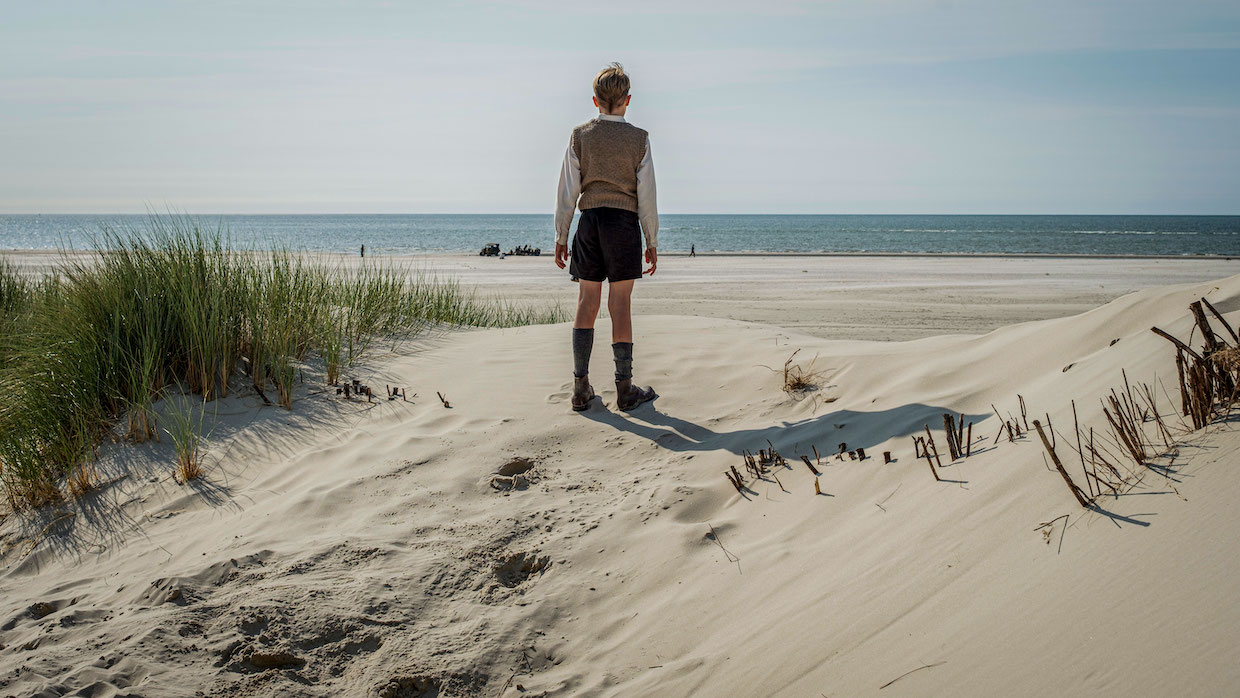
Also, working with nature was something really new for me. I am a big city person. I like streets and rooftops and all that. There is a German painter from the 19th century, the Romantic period, called Caspar David Friedrich. There was an exhibition of that painter a year or so before the shoot. I already had him in mind, as he painted a lot with nature, so I went to this exhibition with my DP. We got a catalogue of the exhibition as a reference, as a blueprint. His paintings inspired me to make this film in 1:85 instead of scope. My DP wanted Scope first, and I said, “Look, we will lose a lot of sky if we go for Scope.” I think the most impressive thing on that island is the sky. And it’s difficult to shoot kids on Scope. So those paintings and a lot of Nordic art were the influence on the shapes and colors. And because Jasper was very disciplined, we could do long shots.
Filmmaker: What was the specific camera and lenses that you used to attain this classic cinematic quality?
Akın: We shot with ARRI ALEXA 35. That’s a pretty expensive modern camera, but because they knew Lindenlaub, they gave it to us with special conditions. We tested a lot of lenses, and in the end, we used Signature Prime. They had this very clean and clear aesthetic, very sharp. I tried to convince him to shoot the film on one lens, like Polish filmmaking or Rossellini, whom I adore, but Lindenlaub is a Hollywood DP even though he was born and raised in Germany. He is used to working with coverage and a lot of lenses, so it was very interesting to work with him because I am a European filmmaker, a German filmmaker. We don’t have the budgets of American films. We are forced to tell our stories differently. We shoot much faster, we light differently, and we don’t have studios telling us to cover everything, so that was a different experience for Lindenlaub. That was a beautiful thing: To work with a Hollywood DP and make him shoot a European film.
At the same time, I learned a lot about lighting from him. I shot eight or nine films with Rainer Klausmann, who lights differently [with not as many sources]. Lindenlaub is into the science of light. The interior locations were done in a studio,and those were the first things we shot. I was sometimes teasing him, “I can see two shadows.” Or, “I can see where the light is coming from.” I wasn’t used to so much light all over the place. Then we found a middle ground and when I saw the rushes later on, I started to trust him. We found our way. It was the beginning of a beautiful friendship.