Back to selection
Live From Cine Gear Expo 2026
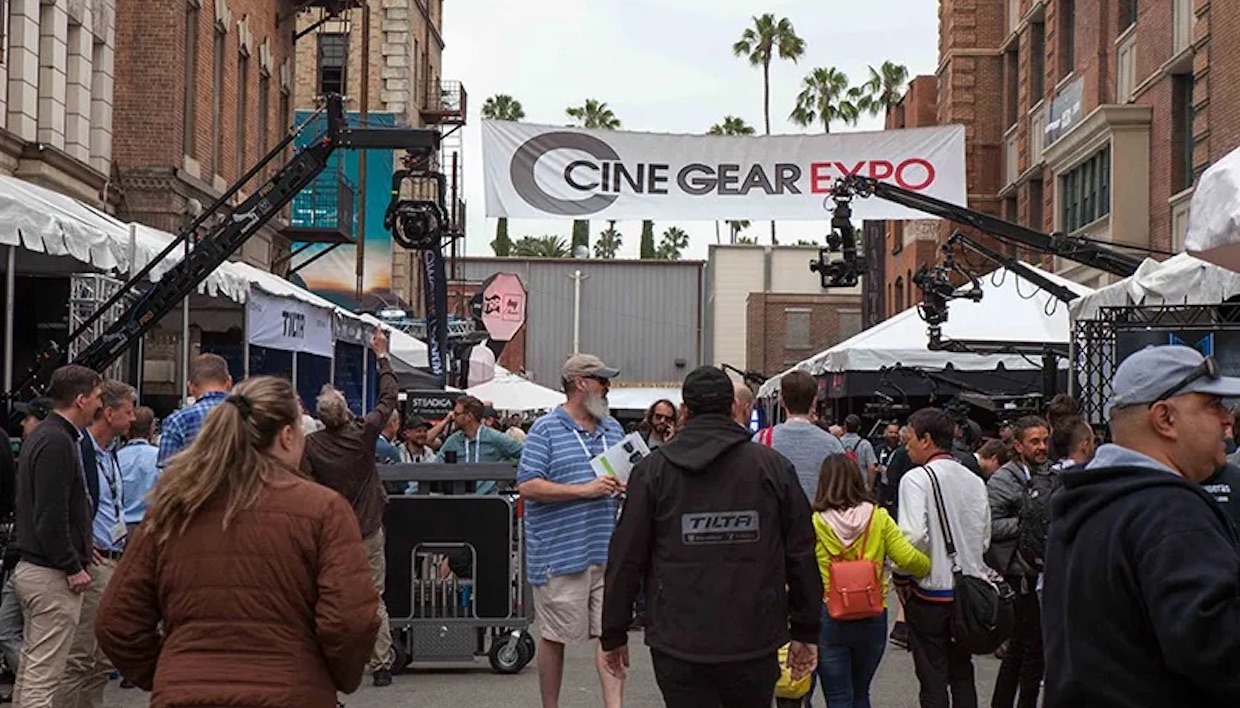 Cine Gear Expo
 If NAB Show seems to inspire a mini–existential crisis in me each year, as I am forced to reckon with cinema’s diminishing relevance amidst other growth arenas in video, Cine Gear Expo invites more optimistic vibes with its film focus and Hollywood backlot setting. Cine Gear acts as a two-day gathering of Los Angeles cinematographers, gaffers, and lighting technicians to check out the latest gear and see what everyone has been up to over a beer and maybe a hot dog, if one is lucky enough to get invited to an offsite barbecue.
I made plans to meet up with Alec Moeller (New Faces class of 2022), who—while very knowledgeable about vintage lenses—didn’t strike me as the gearhead type. He confirmed as much via voice memo as I drove to the Universal Studios Lot: “As an independent filmmaker who’s mostly disinterested in the latest and greatest lighting, stabilization, digital cameras—who prefers to continue shooting on film and using naturalistic lighting, to keep it simple—I’m here in more of an ethnographic sense,” he explained. The preponderance of young people among the attendees on that Friday morning was immediately noticeable to Moeller, who saw a kid in an Obsession shirt. “In the wake of the Obsession and Backrooms success, it feels like there’s that kind of energy in the air,” he said. Some of this had to do with it being a Friday. Los Angeles cultivates a demographic of the forever-unemployed, freelance variety (myself included), so I wasn’t surprised this early crowd skewed film school undergrad–adjacent, and expected Saturday to attract a more workaday, union card–carrying set.
Cine Gear was previously held on the Warner Bros. lot, where one could imagine oneself as Christian Bale in Knight of Cups (2015). At Universal, the layout was a bit frustrating. Attending buzzy panels featuring cinematographers like Ed Lachman meant queuing up early in direct sunlight. The backlot area, where most vendors were housed under tents, was a full shuttle away from the seminar area, making any back and forth between the two cumbersome. The experience recalled being at a film festival, more Sundance than Telluride. Also festival-like was the ample free swag that attendees eagerly gobbled up. The comically large, bright yellow Insta360 totes were perfect for stowing other giveaways (namely, smaller totes).
My second day at Cine Gear began with the annual American Society of Cinematographers panel, featuring a whopping 15 ASC members, including Jeff Cronenweth (The Girl with the Dragon Tattoo, 2011), Rachel Morrison (Black Panther, 2018), Karl Walter Lindenlaub (Independence Day, 1996), Natasha Braier (I Love Boosters, 2026). The panel began with a montage of work by ASC members over the Society’s 100-plus years. I was pleased to catch a fleeting glimpse of John Toll’s Oscar-nominated work in The Thin Red Line (1998). The quantity of panelists meant no cinematographer had enough mic time to delve deep into process, but their sound bites were nonetheless illuminating. “I believe in body consciousness,” Steven Fierberg (Secretary, 2002) said. “When you’re standing on the set, where does your body want to go with that camera? Often you don’t know why.” Braier said that being the child of psychoanalysts has helped her tap into the unconscious, and that her work is informed by growing up under a military dictatorship in Argentina, where everything was shrouded in subtext.
Post-panel, I met up with Local 728 gaffers Drew Moe and Jeffrey Taylor, who run the boutique rental house Canary Yellow alongside Ryan Oppedisano. We ventured to Stage 17, which housed some lighting and lighting-adjacent vendors, as well as Blackmagic Design. “We’re here to talk to the vendors, hear their elevator pitches for the new products they’re trying to get out into the world, to see what we want to add to the fleet,” Moe says of their Cine Gear goals. Rapid advancements in LED lighting technology mean keeping up in the field is more important than it used to be. “Most of Hollywood’s history has just been tungsten, then HMIs, then fluorescent,” Moe explains. “That was a pretty slow timeline compared to what we have now. Every year they’re updating LED units with new chipsets or attachments. It’s an exciting time.” Moe likes what Aputure has been up to, singling out their proprietary Blair CG color engine, which I covered out of NAB Show in Las Vegas earlier this year.
I tagged along as Ian Peterson walked Moe and Taylor through V3, the latest update to Blackout Lighting Console, which adds visual control components to processes that have been primarily based on numerical values. The optionality was overwhelming, but the iPad control over these lighting commands felt fluid and intuitive. More than a minor software update, V3 could separate Blackout from its competition in the lighting control space when it comes out this year.
From there I went to the outdoor backlot area where I talked with Caz Voorhees, chief engineer of the Cinelux Sixteen, a 16mm camera from Cinelux Cinema Tools, a prototype of which was on display at the booth of the CSLA rental house. The camera is the first new film camera to be developed in years, and is “the only camera designed to shoot film and digital simultaneously,” recording to an SD card at 3.2k resolution. The digital footage will include proxies as well as a file with a film-emulation LUT applied, to approximate the film footage itself. Voorhees described the development as the small team’s “personal project” for the past two and a half years. This camera could help assuage producer fears when their director expresses a desire to shoot on film and expedite the processing of dailies.
The Cinelux Sixteen prototype present at Cine Gear is their third, and Voorhees estimates they are probably two more versions away “before we’re actually happy with everything and can give it to people,” which they hope will be in mid-2027. As for developing a camera from scratch, Voorhees says the digital capture element was the easy part. “There’s all kinds of information out there now on how to make a sensor work with a computer,” he said. By utilizing a Sony sensor, they didn’t have to develop that element from scratch, either. The difficulty has been the film magazine. “The magazine is really fucking difficult, because you have to move it from one side to the other side, all within an inch or two of space and with zero friction—it has to not touch anything,” Voorhees said. “So I’ve been struggling a lot with the magazine, but everything else has kind of just come together.” There is also an open-source element to the entire project. “We want to make it so that the magazine stuff is all online,” Voorhees said, “so you can download it and 3D-print a magazine if you’re in a pinch or something. I want [our users] to own the camera.”
Nearby, I recognize Zero Optik as the company responsible for rehousing a set of vintage Canon FD lenses from the 1980s I used on a film shoot earlier this year. Zero Optik began their rehousing services almost a decade ago with a set of Bausch & Lomb Ultra Baltar lenses from the late 1930s to early ’40s. Because these photography lenses don’t work with film cameras with a mirror shutter, “they were relegated to attics and basements for years,” says Zero Optik operations manager Alex Baxter. But “with digital cinema, all of a sudden you had all these new options.” These particular Bausch & Lomb lenses are a favorite of Lachman, who shot both El Conde (2023) and Maria (2024) with them. Zero Optik also rehouses new photography glass. Whether they be Leica Olympus, or Nikon, Zero Optik will “turn them into proper cinema lenses,” Baxter says. Their clients include DPs, rental houses, and even the ASC, who commissioned them to restore a set of Todd-AO 65mm prime lenses from the 1950s they discovered sitting in their archive. These iconic lenses were used on Hollywood classics such as Oklahoma! (1955) and The Sound of Music (1965). Zero Optik worked with cinematographer Greig Fraser (Dune 2, 2024; Project Hail Mary, 2026), who helped them “try to get as consistent of a look across the set as possible,” per Baxter. These lenses are available to rent exclusively through Keslow Camera.
Elsewhere in the lens department, Atlas Lens Co. has a unique origin story. Cofounder Dan Kanes worked first as a lighting technician, then as a DIT, and eventually as a cinematographer. When the first wave of digital cinematography took center stage, Kanes saw a market need for wireless HD video transmitters, which he developed from scratch in his garage as Paralinx, a company he eventually sold to Vitec Group and Teradek.
Instead of “buying a Porsche or Ferrari” with the windfall from the sale, Kanes put the cash into his real passion: anamorphic lenses. Kanes and the newly formed Atlas Lens Co. presented their first anamorphic lens prototype at NAB Show in 2017, and in the ensuing nine years their lenses have been used on some of the biggest Hollywood productions, including Project Hail Mary (2026), Babylon (2022), and the forthcoming Dune: Part Three (2026). Atlas now offers three anamorphic lens lines: Orion, Mercury, and the newly announced Kaizen series. That flagship Orion line carries a “vintage look that’s reminiscent of lenses from the 1970s and 1980s,” but Kanes adds that they have “unique characteristics [counter] to what you might think an anamorphic lens can do, in that you’re able to hold people in focus across the frame.” The “high field curvature” present in many vintage anamorphic lenses is traded for a “quite parallel field curvature,” he explains, which allows for a two- or even a four-shot of faces across the frame “and the focus doesn’t fall off too much from left to right.”
The Kaizen Series Anamorphic lenses are designed for large sensor cameras like the Fujifilm GFX Eterna 55, the Arri Alexa 265 or the Blackmagic Design Ursa Cine 17K, but Kanes notes that these lenses still look great on Super 35 or full-frame sensors. Announced at NAB Show earlier this year, they have now begun shipping.
I met cinematographer Chapin Hall at the Cinelux booth, where he tells me that although he is no longer based in Los Angeles, he makes a point to come out for Cine Gear as it is his favorite trade show: “It’s the most fun. The community’s great. Sometimes I can’t make it around the corner for two hours because I keep running into friends.”
I wrap up Cine Gear 2026 with a seminar featuring M. David Mullen, presented by Red Digital Cinema. Mullen is a generous contributor to cinematography.com forums, and possesses a unique pedagogic ability. At one point, he walked the audience through a complicated tracking shot from the third season of The Marvelous Mrs. Maisel (2019), explaining where each of the four cameras was at any given time. After that talk, I zoomed over to the ASC Clubhouse in Hollywood for their annual barbecue. After a hectic but rewarding two days of rushing around the massive lot, it was nice to end the event seated outside in good company, chowing down on a spread of hot dogs, potato and pasta salad, barbecue chicken, and ribs. It brought into focus the community and camaraderie that draws attendees to the Expo each year.