Back to selection
Learning By Doing: Producing My First Feature
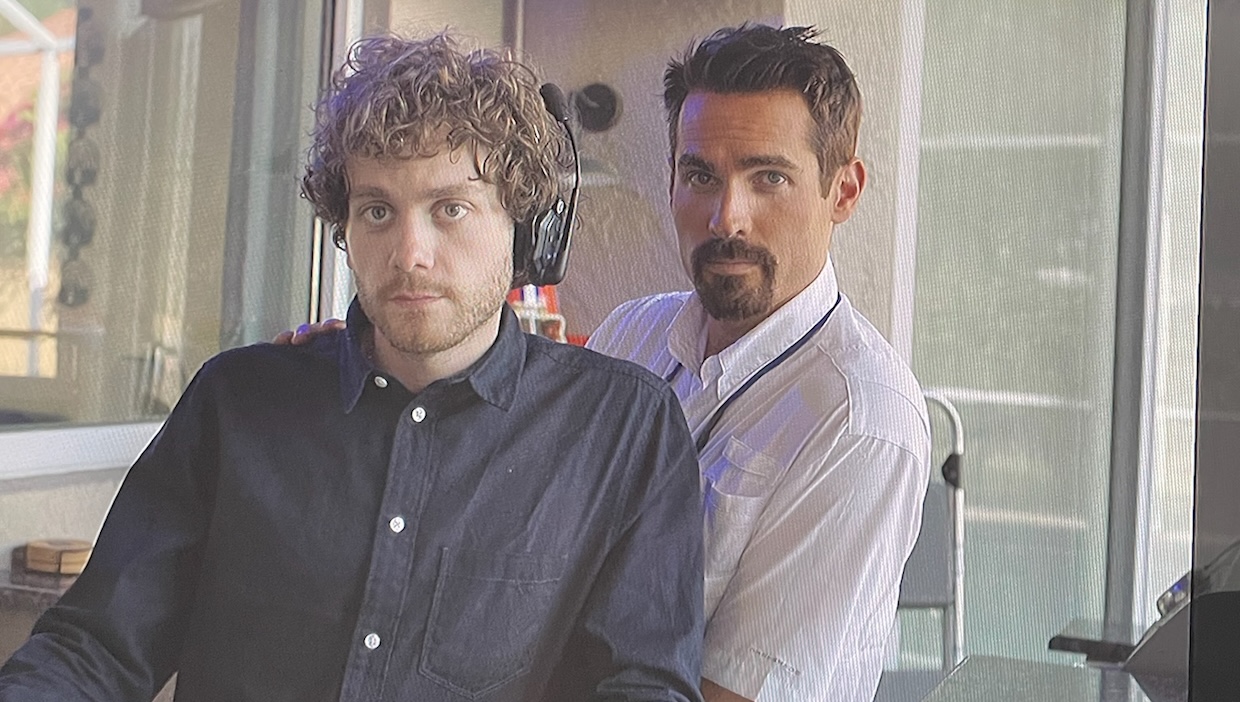 Stephen Musumeci and Jim Cummings on the set of The Big Game
 At nearly 6:00 a.m. on a Wednesday in late March, the sun began to rise in Tampa, Florida, and Stephen Musumeci called cut on The Big Game’s martini shot. The crew clapped and hugged, and Musumeci, who wrote and directed the feature, gave a short, dizzy speech that was interrupted by a producer pouring a large bucket of water (for lack of Gatorade) on his head.
When I joined the film as a producer 14 months earlier, I firmly envisioned reaching this point, even though I had never produced a feature before. After reading the script, I’d immediately fallen in love with it—it was funny, strange and culturally specific, with a naturally propulsive premise, and felt like a movie that should, and would exist. Even though, in truth, my enthusiasm was greater than my know-how, I had faith that with enough passion and hard work we’d find the money to make it. I just didn’t have a clue where exactly that money would come from.
It was February 2024, and Musumeci and producer Raymond Knudsen had been trying to get the film off the ground for more than a year. They’d accomplished a lot in that time—putting together a rough budget, assembling much of the crew, beginning the long process of casting and raising $50,000—but there was still a lot of money to be raised and the bulk of the cast to be filled out. They were determined to shoot that year—ideally, in June—so there was no time to waste. For me, what followed was a crash course in independent film producing.
Lab origins
The project first came together in director Jim Cummings and producer Benjamin Wiessner’s Short to Feature Lab. Cummings’s second feature, 2018’s Thunder Road, was a modest independent success story, winning the Grand Jury Award for Best Narrative Feature at SXSW and, through a self-distributed release supported by Sundance’s Creative Distribution Initiative, more than doubling its $200,000 budget in theatrical revenue.
Musumeci grew up in a family of sports obsessives and went into the Lab intending to make a film about fandom. He originally conceived it as a series of vignettes, in the style of Jim Jarmusch’s Night on Earth or the Coen brothers’ The Ballad of Buster Scruggs, but in the Lab, Cummings and various fellows encouraged him to tease out one story in particular—a dark comedy about a college football obsessive who, the morning of the big game against the rival team, discovers that his wife has died. His friends are about to arrive at his house for a watch party, and rather than call the police and risk missing the game, the man pretends his wife is sick in the other room and goes on with the party, leading to the tensest viewing experience of his life.
Cummings was won over by the simplicity of the setup and absurdity of the premise. “When Musumeci pitched it to me, I was like, ‘Oh, it could just be centered around a bunch of people watching TV! That’s one of the funniest, most American things,’” Cummings says. “We talked and agreed this could be an incredibly funny, graphic, Napoleon Dynamite-in-Florida type of film that’s shot like Roy Andersson. It would be this bizarre art piece about modern times and sports addiction.”
In addition to the creative workshopping, the Lab brought in an array of industry professionals, such as Sarah Winshall (producer of Strawberry Mansion and We’re All Going to the World’s Fair) and Ron Najor (producer of Short Term 12), as guest speakers. Across the board, they all stressed one thing: No one is going to show up and just want to fund your movie; you have to make it happen. Practically speaking, that meant writing something that could be made inexpensively and finding ways to fundraise yourself.
Motivated by Cummings’s encouragement, Musumeci hunkered down and wrote the script in a frenzy. Though there was plenty of rewriting to be done, it was a strong first draft—and equally important, it was fundamentally makeable. Most of the movie took place in a single location, the main character’s Florida home, and it wouldn’t require expensive special effects or production design. The biggest costs would come from paying the 10-person ensemble cast, getting everyone to Florida and feeding and lodging them. Cummings agreed to executive produce the film (as well as act in it), and he believed that people who’d invested in his prior work might invest in The Big Game, too. “It felt like there was potential for a fast track to making it at that point,” Musumeci says. “But you learn over and over again that there isn’t.”
WeFunder and online fundraising
As it turned out, most of Cummings’s connections were not looking to invest in movies at that time, so Musumeci and Knudsen turned to the crowdfunding site WeFunder. Cummings found success fundraising for his Thunder Road followup, The Wolf of Snow Hollow, on the platform, as had several other Lab fellows, but by the time they set up their WeFunder in May 2023, it felt like film investment was cooling on the platform—too many people had been burned, and then the writers’ strike put a pause on everything. “I find right now the things that are doing well [on WeFunder] are faith-based movies that come in already having a following,” Musumeci says.
Initially, Musumeci and Knudsen had set a goal of raising a mid-six-figure budget on WeFunder. They didn’t get there, but the effort wasn’t a total bust. After unsuccessfully advertising the campaign with targeted Facebook ads, Musumeci and Knudsen made an extensive spreadsheet with names and contact information of prominent WeFunder investors, college football boosters and supporters of the arts in Tampa. There was a period when they almost treated cold-emailing potential investors as a full-time job, bringing in about $2,000 a week. It wasn’t nothing, but at that rate it would take years to raise enough money. It became clear that the only way the movie was going to happen was with a few big investments. But how to find the person willing to throw a year—or better yet, four years—of college tuition at a stranger’s movie?
Honing the pitch and courting talent
Often, smaller movies from upstart filmmakers find investment from wealthy family or family friends. As with everything in life, the rich have a leg up, but no one like that jumped to mind for our team. On the other hand, we believed that, if executed correctly, this was the rare small indie that could be profitable. The script was funny, suspenseful and captured a colorful suburban Florida world, and there was some baked-in IP to boot: a prominent college football team. Sports movies tend to perform well, yet there aren’t that many of them. If we could appeal to even a small fraction of the team’s fans—not to mention college football fans more broadly—it seemed like an investor would have a good shot of making their money back. And if the movie happened to hit big? Its investors would receive a fairly traditional 120 percent ROI (return on investment) following distribution, and then as much as 50 percent of net profits in perpetuity.
Our pitch was compelling to various investors, but it was missing one crucial component: talent. In theory, if you can attach some recognizable actors to your project, you’ll have an easier time courting investors. The problem, though, is that while every financier’s first question is “Who’s in it?”, every agent begins the conversation by asking, “What’s the budget?” and “Are you financed?” And, of course, if you say that the budget is small and you’re not financed, good luck getting anyone to read the script.
To navigate this catch-22, we met with a few different established producers and asked them for advice. Emily Korteweg (The Climb) suggested hiring a scrappy casting director who believes in the film. That person would have relationships with actors’ reps and be better positioned to convince them to give the script its due. Graham Mason (Good One) advised building the cast beginning with actors you have some connection to and then citing those actors’ involvement to lend legitimacy to the project. Ted Schaefer (The Adults) helped us with our language. Rather than mention the precise budget figure, he recommended quoting the SAG budget tier the actors would be working under. And writer-director Devyn Waitt told us that offering a great experience—a rental car, a nice Airbnb—could help make a low offer more appealing for a name actor.
Most of this advice turned out to be helpful. But, as we began contacting our list of targets for each role, we found that the most important tactics were simple: casting a wide net and being persistent. Actors’ reps’ receptivity to the project varied wildly— and not just according to their clients’ stature. By pressing for follow-up calls after certain rejections, we learned that a “no” might turn to a “yes” if we fit the project into a very specific window of availability or if we made changes to one small portion of the script.
Getting the train rolling
When Musumeci and Knudsen told me they wanted to shoot in June 2024, I was initially dubious. Given our lack of financing and cast, that timeline seemed overly ambitious. They’d chosen that window with the hope of meeting Sundance’s September submission deadline, but applicants have a better shot at getting into Harvard than Sundance. Wouldn’t it be better to give ourselves a little more time, make the film the best version of itself and try to get into Sundance the following year? Why rush?
I soon learned why at a release party for Sean Price Williams’s book, 1000 Movies, held at New York’s Metrograph. An experienced filmmaker told me that established actors are more likely to agree to be in a small indie if it’s happening soon. For one thing, a fast-approaching date signals that the project is actually happening; for another, it doesn’t require them to lose out on other opportunities that may arise down the line. Really, for everyone—whether it’s cast, crew or investors—you want to project a sense that the train is rolling and everyone needs to be ready to get on board. So, we met somewhere in the middle, telling actors’ reps that we would be shooting sometime between June and October, depending on actor availability.
We’d briefly put financing on the back burner while we focused on casting, but then something crazy happened. A pair of investors had gotten word about the movie from a filmmaker friend of Musumeci’s who met them at the Gasparilla Film Festival. They loved the concept, and each wanted to put in half the remaining budget. We considered celebrating but opted to hold off until the money was in the bank.
A few days later, still riding high, I ran into Filmmaker editor-in-chief Scott Macaulay, who has produced movies like The Assistant and Julien Donkey-Boy, on the subway. He told me a few stories about his own dealings with flaky private equity financiers and gave me a piece of advice he’d received from former Focus Features co-president James Schamus: “Get them to say ‘no’ and move on.” In other words, you want to have the hard conversations early on to test the investor’s seriousness and avoid someone stringing you along.
And wouldn’t you know it: Macaulay’s advice turned out to be all-too-prescient. A few days later, these financiers who’d been so eager to say “yes” got cold feet. One exited the project; the other paused the conversation, only to come back a week later and rejoin. Talks with him continued, off and on, for a couple months. At certain points, he seemed quite keen to foot the whole bill. But we had reservations: He wanted to be creatively involved and would call and text the director often, and some of his suggestions gave the impression that his vision for the movie was different from our own. Still, it’s hard to say no to money and easy to convince yourself that you can overcome an imperfect marriage.
That is, until the right partner comes along—which, for us, happened unexpectedly.
Enter Bronxburgh
At the end of May, director Lance Oppenheim—who was aware of my film journalism—invited me to a premiere party for Ren Faire, his three-part HBO documentary about the Texas Renaissance Festival. The party began at HBO headquarters, then we moved to a nearby bar for the after-party. As I was getting ready to leave, I said hello to Dad & Step-Dad executive producer Richie Doyle, who I knew through a friend. With Dear Mama associate producer Conor Hannon, Doyle runs Bronxburgh, the burgeoning production company that was most recently a part of Mary Bronstein’s Sundance-premiering If I Had Legs, I’d Kick You. He asked what I was working on, and I told him about Musumeci’s movie. He seemed interested and asked to read the script. Not long after that, we met him for lunch, and he told us that he loved the script and wanted to help us make the film. As we talked, it became clear that he understood and genuinely wanted to support Musumeci’s vision.
At first, we tried to bring in Bronxburgh as the primary investor without entirely casting out the financier we’d been in talks with. That’s because, around that same time, a line producer friend looked over our budget and told us it was unrealistically low. We thought we could raise our budget number by combining funds from the original primary investor and Bronxburgh. But the first financier was uncomfortable holding less power, so we moved forward solely with Bronxburgh and a few of Musumeci’s original WeFunder investors. Bronxburgh took the rising budget in stride and agreed to come in for more money, an early sign that they wanted the film to achieve its maximum potential. It wasn’t quite everything we needed, but it was enough to feel good about moving decisively toward production.
By this point, it was already June, and we’d been disabused of any notion we were going to shoot in time to meet the Sundance deadline. We considered aiming for a window in the fall, but holidays and family commitments got in the way. Instead, we decided on a period from late February through late March of 2025. In part, this specific window was selected to accommodate the schedule of Joel Murray (Mad Men), who agreed to star in the film. But postponing the shoot wound up being one of the best decisions we made. It allowed us to flee New York during the brutal winter months for sunny Florida while also giving us needed additional final script development and soft prep time. Musumeci and I spent much of the summer and fall discussing and reworking the script, being hypercritical of everything. We made sure that every scene was not only as strong and tight as it could be, but that it was contributing to what this film was at its core. Musumeci simultaneously had similar conversations with the cinematographer, Chris Violette, about the film’s visual language. They considered many different versions of the film, with a focus on the resources we had access to and the effect and meaning of different choices.
In the early winter, we also ramped up our casting efforts, bringing on Skyler Zurn as our casting director. She created a list of established actors who might be good targets and sourced audition tapes from a broad array of local and non-local talent. We wound up casting a nice mix of superlative character actors, local gems and exciting discoveries. What we looked for in each role was different, but our guiding philosophy throughout casting was simple: Choose the people who spark passion. If we found ourselves rewatching someone’s audition tape a lot, that was a good sign. It’s often tempting to cast the person who most closely resembles your initial conception of the character, but I came to believe that, as much as possible, you’ve got to abandon those notions and select actors who bring the character to life in exciting ways. Time after time, the actors we selected vindicated that approach.
As for locations, the plan was to shoot the film primarily in Musumeci’s parents’ house in suburban Tampa. Lucky for us, there was a large house just a couple doors down that had been sitting on the market. We arranged to rent the house for a couple months and use it as a holding area for actors, a site for HMU and wardrobe and a production office. Having access to that house and the picture house throughout pre-production was a tremendous gift. Musumeci and Violette were able to do a lot of on-site testing, and our art team had a healthy amount of time to design each set. During production, Musumeci and Violette lived in the picture house. While that had its challenges, sleeping there allowed them to adjust their plan as we went. Most nights, after we wrapped, the two of them stayed up late to tweak the following day’s shotlist.
The shoot went about as well as it could’ve. Of course, it was hard and stressful, and there were plenty of hiccups along the way, but we got everything we needed to get, we stayed on budget, the vibe among the crew and cast never soured and there were several scenes where it felt like something extraordinary was happening. I learned so much about on-set producing, but my biggest takeaway is that by the time you get to the shoot you essentially become a party host. The job is to keep everyone happy and support them in doing their best work, all the while managing the various obstacles and constraints to the best of your abilities.
In addition to their help with financing, Doyle and Hannon became hands-on producers as well, and in both capacities they were excellent partners. They were great at taking a bird’s-eye view of the production and knowing when, where and how to step in and give it a shot in the arm.
As we went through the process, Doyle, who is astrologically minded, would sometimes talk about fate: “It’ll happen if it’s meant to happen.” Looking back, the process of getting a movie off the ground is such a nebulous one that his outlook has resonated with me. You hustle as hard as you can, knocking on doors and gathering fellow believers, attempting to build enough momentum to carry the film to the finish line. Beyond that? Well, hopefully, it’s written in the stars.