Back to selection
Shutter Angles
Conversations with DPs, directors and below-the-line crew by Matt Mulcahey
DP Drew Daniels on “Anora”
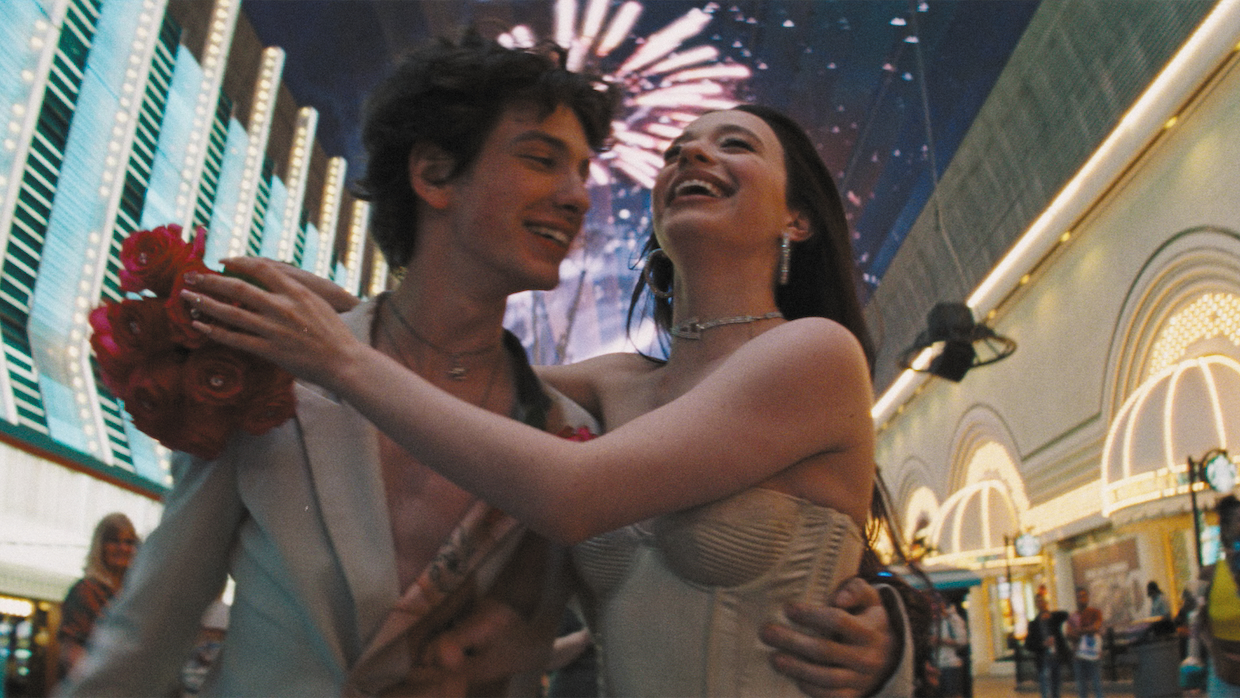 Mark Eydelshteyn and Mikey Madison in Anora
 In Anora, a stripper (Mikey Madison) at a Manhattan club marries the irresponsible 21-year-old son of a Russian oligarch after a whirlwind romance, only for his family to quickly attempt to get the union annulled.
In an ode to the “Russian-ness” of the story, cinematographer Drew Daniels paired 35mm film with the flavorful Soviet-era Lomo anamorphic lenses. For further inspiration, Daniels and writer/director Sean Baker turned to the New York City movies of the 1970s.
“Some of my favorite films are New York films. The city gives you such a unique canvas,” said Daniels. “I feel like every cinematographer has to try to make their great New York City film at some point and this was my opportunity to do that and shoot it in a way that felt like an homage to my favorite movies while also staying true to the story and Sean’s vision.”
Daniels broke down the creation of his “great New York City film”—and Oscar winner for Best Picture—for Filmmaker.
Filmmaker: Let’s start with the lenses you used for Anora—the vintage Russian anamorphic Lomos.
Daniels: From the beginning, Sean wanted to use Lomos. There’s so much Russian-ness about the film, so Lomos were kind of a given. There’s lots of different Lomos. There’s the square fronts and round fronts, there’s good ones and bad ones. They’ve been rehoused by everybody under the sun. I found this super cool Lomo 40-120mm zoom that was absolutely amazing, the most gorgeous zoom lens I’ve ever shot. It looks as good, if not better, than most anamorphic primes. The distortion, the bokeh, everything is just beautiful. It turns everything kind of green so you have to time that out, but it has this milkiness to it. It’s just a lovely lens.
We were testing that zoom with another set of Lomos in L.A. and it started getting dark during our test. It was a rainy day in L.A. and we had the big bay doors open. We had Mikey [Madison] there with her red scarf and a fur coat. I didn’t compensate on the lens as it got darker and for that part of the test I ended up underexposing the image quite a bit, just by accident. When we got the tests back, that zoom lens with that amount of underexposure just felt like “it.” That was the [look of the] movie. [In addition to that zoom] we found a set of Lomo round fronts in New York that were rehoused by Hawk and I just loved them. I had a 35mm, 75mm and 100mm. I mostly used the 35, 75 and the zoom. We probably shot half the movie on the 35. It had such a unique look. I also used Orion anamorphic lenses every now and then for low light.
Filmmaker: I read that you had to shoot that zoom at a 5.6. What could you shoot the prime Lomos at before they fell apart?
Daniels: I would shoot them usually at a 2.8 ½ for my interior stop or nighttime stop and then my [day] exteriors would be like a 4 ½.
Filmmaker: What’s the difference between the square and round front Lomos?
Daniels: Honestly, I don’t think the look is drastically different. The square fronts usually aren’t rehoused well or at all and oftentimes the marks are in meters and they have really bad close focus, like five or six feet. With the Lomo round fronts, they’re a little bit more modern, but they’re still from the 1970s. They just look amazing. They have this velvet finish that they put on the image. It’s beautiful. I tested one set of Lomo square fronts, and they were just such a pain in the ass that we decided that round fronts were going to be way better.
Filmmaker: Tell me about using the Arri VariCon filter. What look were you trying to get with that tool?
Daniels: I tried to approach it how they might have approached it in the 1970s. On something like The Taking of Pelham One Two Three they did all these things—pushing and flashing—basically just to get an image on the negative. They did it completely out of necessity, but it also gave it a really unique look. I was also trying to do some of these things out of necessity as well. So, if I felt like I needed that little boost in the shadows, I would throw the VariCon on. It affects the shadows more than anything. It’s supposed to not really affect the highlights or midtones. I used it for some things on the streets at night and inside the club when we were following her around on long lenses as she’s hustling and finding dudes to dance with.
You could also probably cite Altman’s films, like The Long Goodbye or something in that vein. Those are references that for me will always be references in everything that I shoot. It’s hard to not have those films that I love so much not affect my work. They just do. Buffalo ’66 or The Long Goodbye, films like that will never really escape me.
Filmmaker: I haven’t read in a long time about anyone actually preflashing the negative. Cinematographers say they are going for that look, but nobody actually does it anymore. Is it just too risky that you’re going to ruin a day’s work if you don’t do it right?
Daniels: I think there’s that. It’d probably be hard to get a bond company to be okay with that. It’s also just very expensive because you have to take all of your film negative, run it through this machine and then recan it all. So, there’s a lot of things that can go wrong, but also it’s just expensive. We looked into it, priced it out and it was over the top. There were a couple ideas that came and went like that. At one point we talked about whether we should shoot this on reversal and process it as reversal film. Then we were thinking, “What if we shot it with lower speed film stocks and then lit it with only tungsten light, so it would really have this 60s or 70s classic feel?” All that stuff was just going to get in the way of how we wanted to work on set, the speed at which we wanted to shoot and the ability to use natural light. We tested some of those things here and there, but ultimately if we’d done them we would have been waiting on me every single day, which I hate. I wanted to have more time for more takes or trying new things and experimenting on set.
Filmmaker: Let’s get into some specific scenes, starting with the opening shot where you have this parallel tracking shot along the booths at Anora’s club in slow motion. Then you zoom in when you get to Ani’s booth. So, you’re in low light. You’re shooting in slow motion. You’re on a very slow lens. Oh, and it’s at a practical location.
Daniels: We went to the club one night when it was open during prep and we’re walking around and kicking around ideas. We walked into that hallway, which is exactly how it is in the film. It is a hallway with lap dances happening in it with little partitions in between each one.
Filmmaker: Those partitions are awkwardly close.
Daniels: They’re very close. The curtains are almost like blinders. You can see the other dancer, but you can’t see the other guy’s face. I remember we walked in there and I literally saw a dude sleeping while getting a lap dance. I saw dudes getting their feet rubbed. It was just like crazy lap dances happening and as you walk down the hallway you’re naturally tracking as you’re looking at these people trying not to make eye contact with them. [laughs]
Filmmaker: I’m just picturing you guys with a viewfinder with a big old lens on it walking through this lap dance area with all these random dudes.
Daniels: Oh my god. I don’t think we actually brought the phone out once. It’s also very dark in there too, but I remember scouting it and pitching the shot to Sean and being like, “We can put a dolly track here and track from one end to the other. This has to be in the movie.” Then Sean wanted to do it on that zoom lens, which I was like, “I don’t know, man. We’re going to need a lot of light to get it on that zoom lens.”
Filmmaker: And in slow motion, so you need even more light.
Daniels: Yeah, so it was basically three stops more down than I would’ve normally shot it if I had shot it regular speed on a prime. We fell in love with that shot. It became one of these iconic images in our heads as we were approaching the film. It felt like the coolest way to get into the story and on set we found how you could come off of the tinsel and reveal the dancers. Originally, it was just going to start with the dancers, but we found that red tinsel and I had the art department put it up in front of the lens. There were probably only a couple of inches of space in front of the lens between the tinsel and the glass, but it was just enough. I was under the camera sort of tickling the tinsel with my fingers to give it like a little bit of movement as we’re tracking. (laughs) I tried to light that space as naturally as possible. I just put a bunch of tubes above them and made it blue. We found during testing that blue was really beautiful and sexy. It looked better than red in a lot of ways because the red became too soft-looking. You lose the texture, and the focus doesn’t really grab onto things. Red is a tough color. That shot just became one of those iconic shots that we obsessed over, that and the shot of Ani gagged on the couch when we hard cut to that close-up of her.
Filmmaker: That gag close-up reminds me of the shot at the end of the film when she sort of sees Igor for the first time. It’s like that Jonathan Demme eyeline where it’s almost down the barrel.
Daniels: They were actually looking right at the lens for that. That was Sean’s idea. I remember we were lining up the eyeline. I had the frame up and we were trying to find it and I was like, “Should it be here, or should it be here? It should be really tight.” And he’s like, “Well, let’s just have her look in the lens,” and as soon as she did it, we’re like, “Oh shit. That’s really powerful.” A lot of things happened like that. We would get the ingredients in the right places and then just try things and find the images that were the simplest and the most powerful.
Filmmaker: For the club sequences, were you able to use some of the club’s existing lights or did you have to bring in mainly your own units?
Daniels: I had to start from scratch in there, which was a real pain in the ass because usually in a space like that I would love to use at least some of the lights that they have. I did use their chandeliers, which were all on a dimmer, so those ended up in the movie, but besides that, everything else was from scratch. It was really tough because we had to load in and load out every single time we shot there. We couldn’t shoot six consecutive days.
Filmmaker: You had to re-rig every time?
Daniels: Yes, so it was very annoying for the grip and electric department and for everyone essentially loading in and loading out six times. It ate into our shooting time a lot. Those were really hard days.
Filmmaker: Another dolly shot I really liked was the proposal scene in the Vegas hotel, where the camera circles around and you get this beautiful blue bokeh out the window.
Daniels: That shot was 100 percent Sean’s idea and I don’t even think he told me about how he wanted to shoot it until literally we were there on the day. It was a very long scene, and he rehearsed it with the actors privately. We don’t really do a whole lot of rehearsals where we show the crew and do this big elaborate blocking rehearsal. I’ll have the actors just walk through [the space]. I never have them do a full rehearsal. I like to just know where they’re going to be. I like it to be very spontaneous. I want there to be some room for catching something late or framing something in a weird way because I didn’t know it was going to happen. There are always some fun surprises that happen when we do it that way, especially handheld. With handheld, I don’t do rehearsals really. I like handheld to be totally intuitive in terms of the way that you respond to what the actors are doing. I like for the first time I see it to be the first time I’m shooting it with the camera. It’s like a documentary feeling to it because you’re just there with them and acting with them, responding to them without the pre-knowledge or prejudice.
Filmmaker: Did you scout that? Because really the best frame of that shot to me is when you get to the profile, and you see out that window.
Daniels: Sean pitched doing it as a oner, which was great because it was like four pages of dialogue or something and I was like, “This is going to take forever to shoot this scene [with traditional coverage].” Sean was like, “I think we should just rotate around them,” because the bed was circular. And I was like, “That’s brilliant. That’s absolutely what we should do,” but I didn’t have any curved track. It was just me, a dolly grip/key grip—my friend Steve Forbes—and my gaffer. We set the dolly up in a way where Steve was pulling it, I was pushing it and we did the move right on the carpet. Not even floor—carpet. I’m also operating the fluid head while pushing this 400-pound dolly. So, it had to be this dance between the two of us timing it to where we got all the way around and then reveal the lights of the city behind her. I really love that scene.
I laid dolly track only a few times on this whole movie; I could count on one hand how many times. It was mostly pushing right on the floor and that was to achieve a certain aesthetic. I love watching older movies and seeing the camera have bumps, like Otto Preminger movies with these big, long tracking shots and the camera hits a bump. It just doesn’t matter. It still works. Even like the opening of Touch of Evil. The camera’s all over and it’s bumping. In There Will Be Blood, there’s all kinds of bumps, and also in Magnolia. I love that stuff, and it gives this human touch and takes a little bit of that robotic feel out of it, which works for some filmmakers. I really can appreciate a little bit of imperfection or a wabi-sabi texture to it.
Filmmaker: Let’s talk about the house location. From a technical challenge standpoint, it’s all windows. You’re shooting there for over 10 days. You’re doing some day for night. Just the continuity and all the pieces that you have to put together to make that work, walk me through how you were able to pull that off.
Daniels: There are two shots that I can tell you that are definitely shot day-for-night. One is a shot on Toros when he’s laying it out for her. He’s like, “You’re going to get your $10,000,” and it pushes into him while she’s in the foreground. I had to note spot readings for the walls, for the windows outside, how many stops above my exposure was the sky because then once it got to a certain point, it looks too dark in relationship to the interior, and you have to start opening up the lens and taking down all your lights inside to keep that balance. So, we’re doing that constantly all day long and relying on my notes, partially at least, to light the scenes for night. Also, I’m just using every light I have on the truck, essentially, and pushing it through diffusion through those windows. There’s also this shot where Garnik goes and gets the frozen dumplings out of the fridge—this wide shot of him walking and holding them on his head—and that was shot at night as well. Then maybe a few close-ups here and there. Most likely, if you’re not seeing windows in that scene, it was shot at night.
You also had to sort of choose where you wanted continuity to be because [the initial scene what Toros arrives at the house] is in real time. It all happens over 30 minutes. I wanted it to feel colder and more grey, but we definitely got sun. There are some moments where you see sun, but usually it’s hitting the floor, never hitting the actors. I also couldn’t entirely just hold up the schedule if you were seeing a little sun hitting the background. It’s just knowing what you can get away with and what you can’t. Also, the really challenging part for me was every day I had to be the one walking around with the meter and being like, “Okay, now we can shoot. We have enough stop.” Conversely, I had to be the one to call it and be like, “Okay, we can’t shoot this shot anymore. We’re done. If you want to shoot this again, if you need more takes, then we’re going to have to come back tomorrow.” Sean would always push it, and I’d be very uncomfortably shooting something that was way too dark. There’s definitely a shot like that where she comes downstairs out of the elevator at the end with her suitcases and then she looks at Igor and it pushes into him. It was so dark. I’m wide open. It’s dusk outside and somehow we were able to grade that and make it all balance out, but there were some uncomfortable moments for me for sure.
Filmmaker: You did a lot of free driving in the movie. Are there camera mounts in the car or is any of that handheld?
Daniels: No, we’re never handheld. We’re always on a tripod or a head inside of a car.
Filmmaker: Did you put some small little LED panels somewhere in there?
Daniels: Yeah, a very minimal amount. I lit them with little light pads that my gaffer Chris Hill made. I think he actually made them for me on Waves. They’re pads of various sizes, and I would hide them and diffuse them down. They were RGB so you can dial them in. We usually made them sort of a coolish bluish/greenish color, so it felt like dash light or whatever instrument lights would be in the car. I played all of the dash light like three stops under, sometimes more, because I wanted it to feel more lit from outside. If you passed a street light, a food truck or the storefronts on Brighton Boulevard, those are lighting them. Even taillights and headlights. That was my goal. It’s something you can get away with easily with digital, but I also wanted to do it here with film. I didn’t mind it being dark, and there is something that feels more real when you’re just letting the actual lights light them from outside, instead of rigging all these lights and have this car with lights all over it.
I was also trying to keep the camera in the car with them. It feels more like you’re with them as opposed to mounts [on the outside of the vehicle], but sometimes you needed to see the full entourage from the front, which really plays well especially for the vomit scene. One of my favorite shots in the movie is actually Igor and Garnik in the car that drives all the way up to the house. When you cut to that shot, it feels like an entirely different movie. It feels like some Russian mobster film all of a sudden. It’s just a whole different vibe and I fucking love it. But, yeah, it was almost all live driving. I think we might’ve had a process trailer for one or two shots. Sean was so annoyed by the whole process trailer aspect of it that we just never used it again.
Filmmaker: I think the part I laughed at the hardest in the movie is when Toros answers the phone at the christening, and he keeps getting texts. To me, that was the line of demarcation in the tone.
Daniels: Oh yeah. There are some great moments in that. The Armenian church was one of the first days of shooting.
Filmmaker: I’m trying to remember when this shot comes, but another shot that I wrote down that I really liked is—I think it’s the morning she has to leave after she’s sort of up bonding with Igor and it’s snowing. It’s from behind. That’s a beautiful frame.
Daniels: Yeah, that was the 35mm. I think we’re just kind of pushing into her and or maybe it’s still by that moment, I can’t remember which take they used. That’s one of the shots when you’re scouting—much like the dolly shot—and you’re like, “We have to get this.” There’s something very melancholy about that shot. It’s the last time she’s going to be in that room ever. There’s a moment earlier in the film where she also looks out the window and she comments on how nice the place is. It just felt like a full circle. We had guys on the roof with snow [pushing it into the frame]. There’s a couple of those images that we had in our heads that were these key images: The wide shot outside the house with the Volvo and the snow coming down, Ani coming through the gate and walking up to this giant house. I feel like we could almost distill the whole film down into these five or ten images and it would really tell the story.
Filmmaker: Another shot I like is all four of them in a wide shot in profile as they’re going by The Cyclone at Coney Island.
Daniels: Yeah, that’s a great one. Also, the low angle shot of them walking through the courthouse and it’s like a whole entourage on a super wide lens and you can see the ceiling. We’re just rolling the dolly right on the floor, like how we always do on a 25mm anamorphic looking up at the ceiling. My gaffer was rolling along a big light on a rolling stand because how else am I going to light this giant space? We’re shooting wide open and praying that it’s all going to be there. That’s the thing, too, about shooting on film. I feel like sometimes you have to do so little because film just looks so beautiful. I really appreciate how film can elevate something and give it a level of sophistication or importance. There’s just something magical about when you get it back and see it for the first time. You’re like, “Man, this is so much better than I could have ever pictured it.”
Filmmaker: What is this helicopter zoom shot I’ve read about? Is this when they’re kissing on the balcony?
Daniels: It’s part of this montage where they’ve gotten married, and they’re basically just in love. They’re going and trying on the fur coat and getting the ring and getting this and that and then there’s this shot of them kissing on the balcony. It’s framed in profile and the sun is behind their lips. Then it jumps from the camera on the balcony to the reverse angle of that, which is like a full shot which then zooms out and pulls back and reveals Manhattan in the background so you can actually see where the house is in relationship to Manhattan.
Filmmaker: So, it maybe could’ve been a drone, but Sean really wanted the handheld zoom.
Daniels: And to his credit—even though sometimes you’re like, “You want to do it the most difficult, pain in the ass way possible?”—he’s always right. He has this innate ability to know what’s right for the film. It was not the easiest way to do it. It was not the cheapest way to do it. It was funny because the guy who operated the helicopter kept on telling us, “It’s not going to work. It’s going to look like shit.” He had this stabilizer thing and then on the day the stabilizer that he promised me would work wasn’t going to work with the camera. Sean was like, “Let’s just do it handheld.” When it comes time to shoot, it’s so loud and chaotic. We’re on walkie with Alex Coco, our producer, who’s in the helicopter. Coco is screaming at us. We can barely hear him. We’ve got a guy with a giant Lomo zoom that he’s hand holding. He was up there changing mags. He was also a 1st AC, so he’s literally, with the helicopter door open, changing the mag and reloading the film. We basically shot it at like a T16 or something [with focus at] 40 or 50 feet, so it was all in focus. It was just utter chaos for like 15 or 20 minutes, then we got kicked out by airport security or airport aviation or whatever. They’re like, “You guys can’t be in that area. You’re too close to the airport.” We did a couple takes and none of them looked that great to us. We’re like, “Fuck we didn’t get it.” It was one of the worst days on set, actually, because we just felt so down after that. It was like, “I don’t think we got the shot. What a waste. I guess maybe we’ll do it with the drone or maybe we just don’t have that shot in the movie.” Then we got the shot the next day or so and I sent it to my colorist, Alastor Arnold, and he did a light stabilization, and we were like, “Holy crap, this is going to work.” Even with that stabilization, it still felt handheld and that was the whole point. We wanted you to notice that it’s handheld because nobody in 2024 is shooting handheld helicopter shots on film. Sean kept on talking about Dirty Harry as a reference. That sort of approach is the same reason we’re dollying on the floor or using the flasher or pushing two stops. We’re trying to treat it as if we had the same sort of tool sets that they would have had in the 1970s in a way without being overly dogmatic about it. I’m excited to keep working with Sean. I really love his style, his voice and the films he makes. This film just feels like we’ve combined our styles and approaches in a really easy way. Us working together has been a great match.