Back to selection
Northern Exposure: Chandler Levack and Sophy Romvari Chat Mile End Kicks and Blue Heron
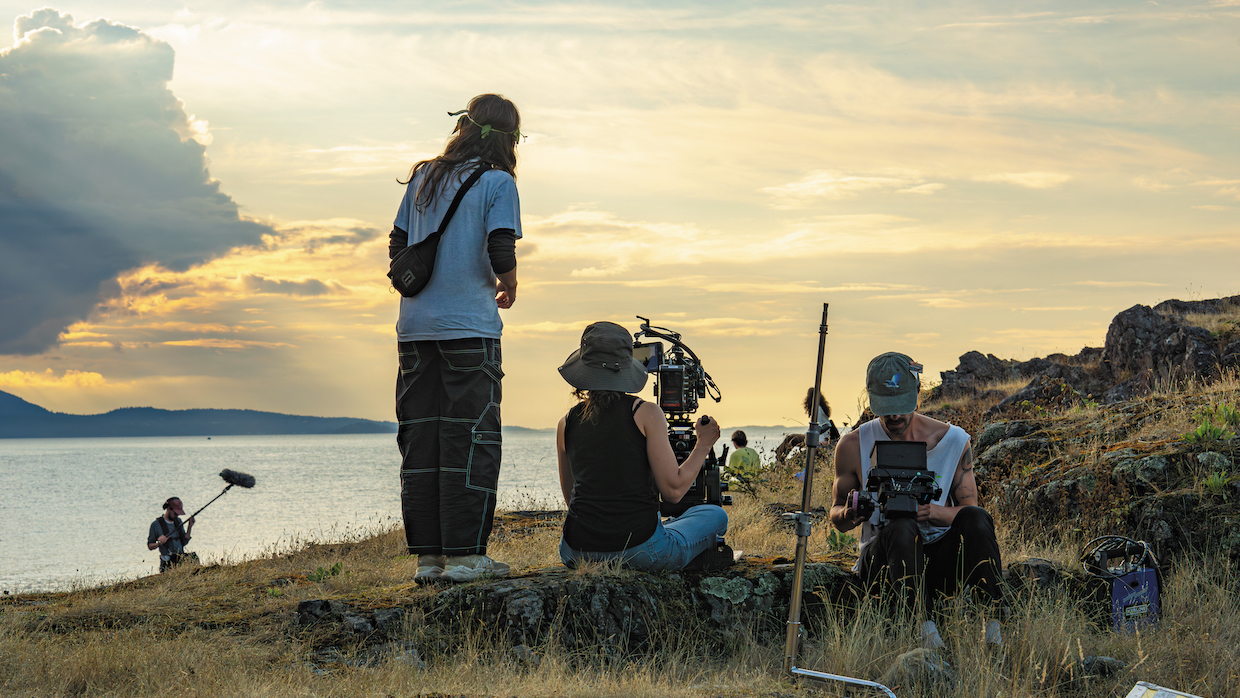 Photo by Robb McCaghren
 Chandler Levack’s Mile End Kicks and Sophy Romvari’s Blue Heron make time travel feel possible. Levack retreats into the beer-drenched, laissez-faire vibe of Montreal’s indie rock scene circa 2011; Romvari reflects on her Hungarian immigrant family’s domestic struggles on Vancouver Island in the late 1990s.
In Mile End Kicks (Sumerian Pictures), 23-year-old Grace (Barbie Ferreira) is an avatar for Levack, a music critic at a Toronto alt-weekly who leaves her bro-dominated publication for a creative summer in Montreal. She’s supposed to write a short book for the 33 ⅓ series about Alanis Morissette’s Jagged Little Pill. Instead, Grace loses herself in a love triangle with the frontman (Stanley Simons) and lead guitarist (Devon Bostick) of wannabe rockers Bone Patrol. Work is replaced by neverending loft parties, where iPhones appear in single-digit release versions and American Apparel garments are worn by all.
In Blue Heron (Janus Films), Romvari’s stand-in is Sasha (Eylul Guven), an 8-year-old girl whose home life becomes strained by her teenage stepbrother Jeremy’s (Edik Beddoes) mental health issues. Sasha spends her days playing in sprinklers, sculpting pierogis with her mom, and quietly observing, but not really understanding, Jeremy’s struggle. In the third act, the film takes an experimental turn that finds older and younger versions of Romvari connecting amid the chaos.
Levack and Romvari are both comfortable creatively mining the experiences of their younger selves. Levack’s 2022 feature debut, I Like Movies, stars Isaiah Lehtinen as a teen version of the filmmaker back when she worked as a video store clerk. Romvari has long looked to her family for filmic fodder, most notably with her 2020 documentary short Still Processing, also about her brother. Their latest projects are honed by years of personal reflection, capturing moments in time that are intimate yet definitive.
Blue Heron premiered in Locarno this past summer before screening at TIFF in September, where Levack’s film also appropriately bowed. In a remarkable collision of release dates, both films hit U.S. theaters on April 17, the same day Levack’s new comedy Roommates, produced by Adam Sandler’s Happy Madison Productions and starring a slew of familiar comedians, debuts on Netflix. You could feel the anticipation in the air when the pair spoke in March. —Natalia Keogan
Levack: How are you after all of your incredible success releasing your first movie into the world? What’s going on with your brain right now?
Romvari: I’m actually in the middle of troubleshooting DCP exports, so I’m not done with the movie—I don’t think anyone ever is. Our post house is in Hungary, and we had to add new titles, and we’re trying to deliver the film to Janus right now, so it literally feels like I’m doing post all over again. But it’s exciting. This will be the version that gets seen in theaters. I’m trying to take a break in March, especially from travel. The fall was a lot. I think the travel that comes with festival stuff is so exciting and fun, but also so exhausting and lonely. I don’t know if that was your experience.
Levack: With Mile End Kicks, I’ve hardly traveled at all. I went to one festival. With I Like Movies, it was like, “OK, I guess I’m in Norway for three days, then France, then Taiwan.” It’s wonderful—it’s the main exciting perk of making a movie, beyond just the making. Getting to engage with all these different filmmaking communities around the world, meeting other filmmakers, talking to them about how they make their work. And then, showing your film to different audiences—you realize your job as a filmmaker is to find out what audiences around the world think of it.
Romvari: Totally. To see different cultural reactions in real time is such a gift. I haven’t done the theatrical run yet, so I don’t know what that experience is going to be—it’ll be more of a general audience than I’ve ever experienced because I’ve only played film festivals. A festival goer already has an adventurous spirit, maybe a little more risk-taking when they watch films. My film isn’t difficult, but it’s a little unconventional, and even a little bit can be difficult for certain audiences. I’m curious how the theatrical will go.
The main thing I learned, or re-learned, on the festival circuit was how lucky we are to live in Canada—how privileged we actually are to have access to grants and a government that isn’t actively trying to kill us: Things you can become entitled to, or just unaware of, if you don’t travel. When you do travel, you realize we’re living in an almost utopian filmmaking environment. To be able to make a film, specifically with [Telefilm Canada’s] Talent to Watch Program, you have all the creative freedom in the world, and no one’s really telling you what to do. As challenging as our first films are, it’s an insane privilege to get that amount of money and freedom. Everyone else I met on the festival circuit was borderline selling organs to make their movies.
Levack: When I went to Argentina, their economy is so volatile that every week your movie would cost a different amount. You couldn’t actually budget your film because the peso would be worth three times as much one day and three times less a week later. People there are making movies for $20,000 on average. It’s a culture of extremely low-budget filmmaking.
Romvari: You can’t really make money as a filmmaker in Canada, but at least you can make the work you want to make, for the most part. That’s more than a lot of people get [laughs].
Levack: Both Mile End Kicks and Blue Heron are semi-autobiographical—personal excavations of things that have happened to us. I’ve often found that being a female director on stage at a Q&A, those sessions can be a little invasive. I feel a need to protect myself in that experience. Having done it for almost eight months now, has it gotten any easier for you to embody your movie? When releasing I Like Movies, I didn’t realize I had to be good at public speaking and be a charming, articulate person. It always feels like after you show a movie, you’re kind of naked in front of everybody.
Romvari: You’re right. You have to be many things at the same time—very articulate, confident about your art, polite. Someone will ask you an aggressive, assertive question about your personal life, and you have to navigate that in front of an audience of 500 people. In Greece, I had a question translated to me by the interpreter, and they just asked, “So, how did your brother really die?” In front of a huge audience. Of course, I expect those questions when I make a film like this, but I had to quickly figure out how to answer without shutting it down entirely. I think I said something like, “The film is autobiographical, but I wrote it as a fictional script, and I included what I wanted to include.” Just a way of subtly signaling that the things they want answers to are not in the film for a reason. People can’t really parse documentary from fiction when something is autobiographical. And I think especially if you’re a woman—people assume everything is personal. Men don’t make personal movies, apparently.
Levack: Or, if they do, they get the largest pat on the back that’s ever existed.
Romvari: True. Do you feel like people assume you are one-to-one with Grace, your main character?
Levack: There’s part of me that wants to say, yes, I was, I am—but there’s also a part of me that’s like, “Don’t even look at me!” and hates being perceived. We bear a pretty heavy physical resemblance, at least to my 24-year-old self. She’s wearing some of my old clothes from my twenties. But at a certain point, you have to give your actor the agency to create an actual character. I can’t imagine how stifling it would be to have the director watching from the monitor going, “Actually, it wasn’t like that—can you be more like me?” There’s some stuff that’s so personal that every time I watch the movie it’s agonizing. It feels really raw. But it’s not my job to tell audiences what to think of something I’ve created.
Romvari: You have to give it over to the audience. That’s been the most liberating part of this experience—it’s no longer my job to articulate what the movie is doing. I did that with the movie itself. People have their own experience. Sometimes, I’ll get these really beautiful emails from people about watching the film, and I have this desire to respond with just as much intensity. But then I realize I already said my piece by making the movie. This is their response to it. You can’t give as much as they’re giving you because you already spent five years with your response. Your side of the conversation is already spoken into the film.
Levack: What makes you want to make movies? I make films, I guess, to be understood, or to understand something that’s happened to me. I need the physical object that other people can see—it’s almost like my way of giving testimony. People talk about films as therapy, but there’s something about the cinematic object, even when it’s heavily fictionalized, that makes something more true.
Romvari: I’ll say it’s risky to make a film to be understood by other people. People are going to misunderstand not only you but [also] your intentions artistically. Everything is going to be perceived in a million different ways. What it can do, on a private level, is help you understand yourself more. But I don’t rely on the work for other people to get me—a movie shows just such a tip of the iceberg of a person. That’s actually what I learned making this film. I wanted to make a movie about growing up with my brother, and by the end of it, it’s clear that the making of the movie doesn’t even begin to understand who he was. The process of making a film is a very flawed way of trying to recreate a person. There’s just a tiny microcosm of that person in the film, and it’s not possible to do more. That’s part of the acceptance of grief in the movie—you can’t access that anymore. You can try, but you’re not going to achieve anything close to reanimating the person. That’s the morbid reality of making films about someone who’s deceased. You think you have control as a filmmaker, but you really don’t. That was the lesson. I didn’t know that’s what I was going to learn when I started.
Levack: There’s a moment in your film where [Sasha] comes back to do the clinical report of the family, sits down with all the kids, and sits next to her younger self. What would you see if you could perceive yourself as a child? The empathy she feels for that person, while still maintaining this objective documentary approach—reporting the facts, trying to be clear-eyed about it? Nobody is objective about their own grief.
Romvari: What you’d want, if you actually had that opportunity to go back—like Nirvanna the Band the Show the Movie [laughs]—is to change the outcome of the scenario you’re reliving, but I really wanted to show a situation where the character has access to that and yet can’t change anything. There’s no rescue of the past. The making of the film is reckoning with that. I can make a film about it, but it’s not going to change the reality. That’s what the time-travel device was trying to communicate artistically: we have these tools as filmmakers to travel through time, but it doesn’t actually impact reality. It can only create temporary moments of relief or catharsis. And then, by the end, you’re by yourself at the top of a mountain.
I spent not just four or five years making this feature, but 10 years before that making iterations of it through my shorts. I didn’t even know until I looked back at them how similar they all were—how many were just doing the same thing. They say every filmmaker remakes the same film again and again, but it wasn’t until recently, when I watched a retrospective of my work in Spain, that I saw them all together and was horrified by how vulnerable they were. It gave me that naked feeling. I had never seen them all in sequence, and then I watched the feature right after, and I could clearly see how I’d been trying to figure out how to make the feature before I’d even started making it. Trying to build a language for reckoning with the past and with memory, with my dad’s photography and his filming—all of that is wrapped into my shorts. I just didn’t have the construct yet that I had for the feature. I guess I had to spend 15 years making this film.
I know you wrote Mile End Kicks before I Like Movies. Do you feel like making I Like Movies lent itself to making Mile End Kicks a more complex film?
Levack: Definitely. I wrote the first draft in 2015, almost as an exercise. I’d only written one other screenplay before. I had a month in October where I’d moved to Montreal, and I decided, for the first time in my life, I’m not going to write film or music criticism. I’m just going to focus on writing a screenplay. I love romantic comedies. I think my sensibility then was a little more commercial. I spent the month extrapolating these memories I had, fictionalizing things, figuring out this story and character. Then, Matt Miller, who also produced Nirvanna the Band the Show the Movie and BlackBerry, came on board, and by 2018, we were really gung ho about making it. But the financing felt impossible. Nobody wanted to give me the money. I couldn’t get actors to read the script. Producers were suggesting, “Well, maybe you should shoot it all in Hamilton for tax credits, then do two days of exteriors in Montreal.” And I was like—that’s not what this movie is. It’s a love letter to a place. You’d spend your entire budget recreating one street corner, and none of the extras would have French Canadian accents.
I was really depressed and discouraged and angry. And Matt Miller said, “You should make another movie first, through Talent to Watch. If that film is successful, it’ll be a calling card, and we can get back to financing this one.” At the time, I was devastated—I’d been rewriting this script for three years, literally 35 drafts, and now I had to completely start over. But it was the best advice anyone could have ever given me. It empowered me to think more creatively and be less beholden to this one project. And then, when I wrote I Like Movies, I’d matured. My sensibility had changed. The more I rewrote it, I realized I had other stories to tell, and making it really helped develop my process as a filmmaker. My whole life I’d been a critic, directing music videos for bands, making things for other people. There was this huge part of me that I was ignoring and repressing—I really wanted to be a filmmaker, and I’d been burying it. That first film was a kind of coming out, as an identity. And then, when I went back to Mile End Kicks, I could think more ambitiously about it.
Romvari: By doing that, you already had a script waiting by the time you finished your first feature—and I think that’s the big trick to pull off in Canada. You and I have both seen a million people make their first feature and then just absolutely disappear. It’s so difficult to combat. I’m pretty terrified in this moment, actually. What am I going to do next? I’m trying to ignore that pressure, but I don’t have a script waiting for me. The fact that you did it this way was very smart—it kept you going strategically.
Chandler: There’s no linear path.
Romvari: It’s very hard to give advice to younger filmmakers or students because you can’t recreate a path. You can only tell people what yours was. For me, it was work at movie theaters through your entire twenties and thirties, make short films for no money. I spent so long making short films, hustling on very little money, no financial stability, just freelance gigs and the movie theater. I love the movie theater. But I would not wholeheartedly recommend the financial reality of it.
Levack: Same. For my personal films, not only was I often not paid for them—I put my own savings into them. There were so many times, especially with I Like Movies, where I was just like, “I’m never going to finish this. I need to do one more pickup, one more reshoot,” and it feels like it’s never going to happen. Being back at Value Village with my dad waiting in the parking lot, scrounging for props. Going through our basement for set dressing. But there’s a very DIY sensibility to all of that, which I also learned from doing music videos. If you push yourself to the absolute limit to secure the things you really need to tell your story, then at least the movie could be good because you put all of yourself into it.
Romvari: I agree. And no one will ever care about the movie as much as you do—but a big part of the process is finding collaborators who care about their own roles as much as you care about yours. I did that with Blue Heron, and I’m eternally grateful for having taken my time finding the right people for every role. It was quite a utopic shoot. Everyone had just enough resources to do their job properly, and there was a very warm atmosphere on set. I was expecting total meltdowns every day, and instead I was just like, “Wow, we got through another day without a crisis. What is happening?” A big part of that was shooting with [cinematographer] Maya [Bankovic], who is a consummate professional but also hilarious and warm. She brings so much atmosphere and experience to any set she’s on. I’m sure it was the same with Jeremy [Cox, Levack’s cinematographer].
Levack: Jeremy is just an incredible collaborator. And my costume designer, Courtney Mitchell—I worked with her on both projects. She’s so talented and creative, cares absolutely so much, wants everything to be perfect, is obsessed with details in the same way that I am. And I had a wonderful production designer on both films, Jess Hart in Montreal. She worked very tirelessly. I think the production design is really great in that movie. But that’s the weird thing about being the director, right? I feel like I never have enough words to express how grateful I am to everyone who worked with me. It’s not just you at the end of the day. And it’s strange that you then become the face of it. It is your film, but it also is not—the actors are really the authors in a lot of ways. So many people’s gaze and time and energy went into it. During the shoot, you’re the focal point of that. But it’s also everybody.
Romvari: You’re the one keeping it in some sort of container, with your vision. But the parts that are shaping it are equally important. And something I’ve really loved is the number of reviews that call out each individual department—the sound design, the cinematography, the editing, performances, production design, costume. People have mentioned all of the specific elements, not just the film emotionally or just what’s on the surface. It makes me very proud.
Levack: When you want something to feel like a memory, you need all of those pieces—production design, costuming—to make it feel true to you. I just selfishly wanted to have those tactile experiences again—the feeling of a plasticky DVD in my hand, putting it on the shelf, wheeling the cart down the carpet, pressing down on those really hard VHS players. Those were tactile experiences from my youth that I missed. So, I had to recreate them in a film. And then, for Mile End Kicks, there’s a moment when we found the 2011 white MacBook and the old iPhones. Just seeing Barbie shoot herself in Photo Booth and the Notes app. And you get those phones back in your hands, and you’re like, “Oh my God, I can’t even type on this thing. My thumbs don’t fit anymore.” And there’s a playlist on her iTunes that says, “If I ever have sex.” That was very fun to remember—those weird personal little playlists that were almost like mini memoirs unto themselves.
Romvari: Did you find there were things you thought you were writing fictionally, but then you realized later were actually autobiographical? I’m thinking of things I wrote in my film that I fully thought I was inventing, and then speaking with my parents after, they were able to fill in the blanks. And it went both ways: there were things I didn’t remember that I put in the film, and my parents would say, “Oh, it was actually much more extreme in real life.” For example, Jeremy on the roof was based on a real event where my brother did something like that. And it wasn’t a suicide attempt, he was just mocking my parents from the top of the roof. His behavior in general was much more chaotic and bizarre than Jeremy is in the film. And that was partly because Jeremy, as an actor, was street cast. He had this really beautiful presence, this evocative, deep sense of pain. But he didn’t have the chaotic qualities that my brother had. I wasn’t going to force this non-actor to behave that way—it would have completely ruined the film. What was beautiful about him was his natural presence. So, the film became different because of him.
Levack: I think the most emotional shot for me in Mile End Kicks is actually a two-shot where Isaiah is sitting next to Grace on the ground. It was really interesting to see the star of my first film and the star of my second film side by side.
Romvari: It’s almost like the shot in Blue Heron—the younger and older self next to each other.
Levack: I think Lawrence is some weird subconscious version of my ego. When I was thinking about who would play that part, I never could have even dreamed Isaiah into existence. When he auditioned, I was like, “Of course it’s him.” We’d done a casting search across all of Canada; [more than] 500 people had auditioned for that role. But he did capture this element of me that is maybe my most shameful, embarrassing part. And Barbie is sort of the 24-year-old version—a little more poised, obviously feminine, but still with that aching and yearning and this weird combative, avoidant tendency. When you’re casting people who embody someone from your real life or history and you’re looking for something true, you don’t want the exact person; you want the movie star version. You want the person whose face you want to gaze at for the next year and a half as you cut and finish your film. It’s got to be somebody so special and charismatic that you just want to keep watching them.
Romvari: I agree. You need to find the balance between what’s important to you and what’s actually going to be interesting to an audience. If you go too far in the other direction, you risk isolating people from your own experience because then you’re prioritizing your memory over what you put on screen. And I am not interested in making something that’s only interesting to me.
Levack: We make personal films, but they still have to be pieces of entertainment. When you’re excavating your own history and thinking, “Is that anything?” I feel like you just kind of know it when you’re writing. You know what’s going to make a scene interesting or pivotal.
Are you nervous about the theatrical release? Do you feel any pressure about it needing to do well or make its money back?
Romvari: I mean, we made the movie for very little money. With distribution, they pay you the minimum guarantee, but then you have to make that back before you see anything else. The main thing I’m excited about with Janus is that they really care about theatrical exhibition. They care about the materials—the trailer, the poster—and they’re so collaborative. They care about how I want the film to be represented. It was beyond a dream. They weren’t even on my list of potential distributors. I didn’t think it was in the realm of possibility. When they reached out during TIFF, there’s a picture of me reading the email looking genuinely shocked. But it’s such a gift because they’re going to take such good care of the film. Regardless of the box office, I know it will be well taken care of. I know they care about it, and they understand it.
Levack: With I Like Movies, I was going to see another movie with my mom and just walked into a screening, and I was so surprised it was packed on a random Wednesday at the Carlton, maybe a month and a half after release. It’s really fun to secretly watch a group of people from the back of the theater.