Back to selection
“This Rupture of Utopian Horizons”: Irati Gorostidi Agirretxe on Aro berria
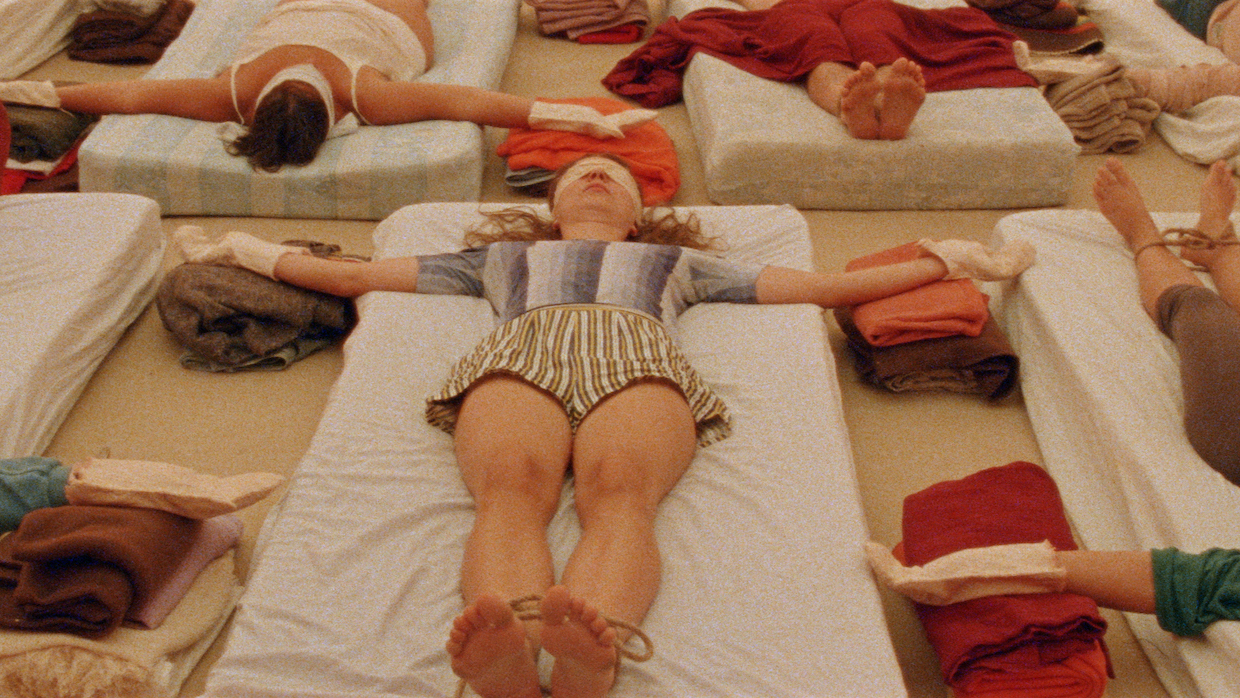 Aro berria
 Aro berria, the first feature from Spanish Basque filmmaker Irati Gorostidi Agirretxe, is focused on the revolutionary potential of two spaces: a factory floor and a tent. In the former space, Gorostidi restages the working-class unrest of the late 1970s during Spain’s transition to democracy, opening the film with workers in a San Sebastian water meter plant forming a human snake, their comrades silently putting their tools down and joining in a collective mass. When the more radical workers—many of them young people—fail to sway the plant towards continued action, a number of them leave San Sebastian for the Arco Iris (Spanish for “Rainbow”) commune in rural Navarre.
In the early ’80s, Gorostidi’s parents lived on this new age commune, which she says was a time of ambivalence for them—it was a spiritually fulfilling experience, but the community was ultimately mired by organizational challenges and internal disagreements. It’s a moment that the filmmaker has been obsessed with for years, having made prelude films exploring that transitional moment in Spain’s history, like the documentary San Simón 62 investigating the memories of the commune and its problematic sexual politics, or the short fiction film Contadores, similarly about radical factory workers dissatisfied with the contracts they’re bargaining. Gorostidi’s short Unicornio is the most influential on Aro berria, following a woman, inspired by Gorostidi’s mother, taking refuge in an abandoned house. This is also a character that Gorostidi would place at the center of her latest feature as Eme (Maite Mugerza Ronse), who goes to Arco Iris to partake in the tantric workshops that made the commune notorious in Spain.
Aro berria (Basque for “New Age”) falls in with a remarkable tradition of films exploring the utopian aspirations of communes, like Robert Kramer and John Douglas’s portrait of the American left in-flux in the ’70s, Milestones, or Ben Russell and Guillaume Cailleau’s more recent and quietly polemical documentary DIRECT ACTION, but what makes Gorostidi’s film stand out is her emphasis on spiritualism. No doubt, the long, visceral sequences of how these rituals unfolded—the breathing, the body movements, the screams, the cries, the laughter, the joy all housed in a big red tent—will imprint on many after viewing Aro berria. What’s extraordinary about these scenes is the way Gorostidi is able to pull the audience into the rituals, not to sensationalize them, but to invite viewers to take them and their effects seriously. These scenes play in between more seemingly banal ones, filled with conversations about the operations of the commune, or contrasting official rhetoric by its guru (a brief, potent performance from Óliver Laxe) with how people actually discuss issues of sex, abortion, and relationships. Eme lives in these contradictions at the heart of Arco Iris, herself disillusioned from her radical labor struggles and finding a more personal, spiritual fulfillment through the workshops, yet at the same time remains skeptical of the commune’s project and its contradictions.
Ahead of the film’s screening at New Directors/New Films, I got together with Gorostidi over Zoom to talk about Aro berria.
Filmmaker: To start off, I wanted to ask you about your personal relationship with these communes. I understand that your parents lived on one for a time.
Irati Gorostidi Agirretxe: I started the project by asking them about this community I knew they were living in before I was born. My dad gave me this book that was printed in the community. These photographs were very striking, very moving to me. After I saw those photos, I went to my mom’s and I took my sound recorder with me. I remember that already being kind of a statement: Not just asking her, but taking the recorder with me to record that conversation. I already had the intuition that I was going to develop some sort of project from it.
Filmmaker: You’ve developed a couple projects from it. The documentary San Simón 62 is also exploring that commune.
Gorostidi: Yes, I developed another two, even three films—Unicornio is somehow also related to the project. When I was writing and producing Unicornio I was thinking about [Aro berria]. Actually, the main character [in both films] has the same name. Somehow it was very natural to, instead of writing or researching from a more theoretical perspective, materialize in a filmic way with smaller projects.
Filmmaker: In Aro berria you have a pretty large cast, and also you construct the space of the commune itself. That tent space where they do the tantric rituals, how did you go about filming that?
Gorostidi: The work to make the film is very much based in working with an archive and reenacting different materials and testimonies of people. In the process, we were establishing a dialogue—not just me, but all the cast and crew, creating a collective reflection on this archival material and its meanings, what was moving to us as the generation that came after this historical moment.
The community became super famous because of these workshops they were offering. Hundreds of thousands of people went to the community. It was in major TV news and press in Spain. We started working with this therapist group that are mainly in front of the camera, but some are behind the camera as well, to think about how we could—based on these techniques they were using in the community—recreate something. Of course, it’s this space in between the actual therapeutic or cathartic techniques and working with performers that are coming from theater, dance and other disciplines related to the body. There are these two layers of actually going through the experience, which is very intense, and the real activation of the body with all these techniques that are related to movement and breathing.
The way we were recording it, we would never interrupt the action. It’s more like how you would do it in a documentary. It could take one hour or two, depending on the technique, but they were very long sessions with a very small crew. It was four or five of us, depending on if we were using a traveling camera or not. And the first two weeks of the shoot was the tent.
Filmmaker: That’s a pretty intense way to start.
Gorostidi: It was super intense, but bonding for the cast and crew, so it was a good idea. Also, it was very challenging for the crew to understand how it was going to work. To me, it was the most important part of the film, but it was hard to imagine [based on how it was written in the script] for most of the people. We were working in a way that is not conventional for a feature narrative film, so it took a lot of effort and of resources. We had therapists, an intimacy coordinator, and everybody had to figure out their methodology for working on this film. We didn’t really have a formula or anything, so it was very challenging.
Filmmaker: You mentioned a kind of in-betweenness earlier. I feel like the whole film has this very in-between quality, where a lot of the characters are disillusioned with the labor movement and the left and go out seeking this personal fulfillment through the commune and the workshops, but there also seems to be some limits to that.
Gorostidi: In what sense, limits?
Filmmaker: Especially through the character of Eme, she’s very skeptical of the possibility of the project. I think about the scene after she gets the new name and Tintxo is like, “What does it mean?” and she says, “I have no idea.”
Gorostidi: I see what you mean. To me, the most challenging part was finding a place from which to represent this community. My parents themselves were super critical about how it worked. Not about principles, not about the project itself—that of course really attracted them a lot. They were living there for quite a long time, they were participating in many workshops, and I think it was a very important part of their life. But what I heard about the community from my parents was super critical. So I have a critical opinion about how the community worked. On the other hand, I felt like it had a lot of potential. It’s not just this community, [but the countercultural movements all over the world in the ’70s. We all know about what went wrong [after].
To me, it was very important to make a film that was not just critical about it or that would somehow reinforce all the prejudices people have about these sorts of communities. I think that’s super common nowadays, to look at hippie communes and just talk about them from even a mocking view. I had to find this place where even people that had these caricaturesque views would have a few characters that they could relate to. It was very important [in the film] to be really engaged in the project, but also be critical about it, because I could relate to that very much. The character of Eme was very much inspired by my mom. She was super critical and very politically engaged, and I feel like she was in this constant process of seeking. I feel like that moment of the ’80s is this rupture of utopian horizons globally, so I think it is important to show that somehow, to be realistic. The starting point of any conversation or reflection about that historical moment nowadays should start from there, from knowing that it was a moment of deception.
Filmmaker: It’s interesting how even though this utopian project exists in parallel to society, so many societal problems still creep in. There’s the great sequence in the middle, where they’re talking about the planning of the community, and the men keep interrupting the women.
Gorostidi: That was also super surprising to me to find out when I was researching the archival material. For instance, the sequence in the beginning where they are talking about sexual liberation, how sex lives should change according to the new times. What Eme is reading is an actual magazine that was printed back then. It’s shocking how contemporary it feels. These sorts of conversations are very similar to the ones we have nowadays.
It’s very easy for me to explain it from the Spanish perspective: after 40 years of dictatorship and repression, there is this will of breaking with everything. Not just the political, economic, or social systems of the dictatorship, but also relationships, sex, intimacy, family, and spirituality—all those things young people just know that they want to do differently to how their parents did or were forced to do. That happens in all western cultures, where we know those traditional ways of doing [things] are not what we want anymore. The only alternative that is offered to us is just a neoliberal, capitalist, and really alienating way of making things. We are still trying to figure out how to substitute these ways of organizing community. We don’t want to live as our grandparents did, but then how do we do it? We know that we still want to feel connected and think about community, spirituality, and all those things that are so necessary to live in a happy way.
Filmmaker: The discussions are still ongoing. Even though the commune tries to separate itself from society, it is still partially reliant on it. They talk about how if they actually want to buy property and be totally nondependent, they first have to keep making money off of their workshops.
Gorostidi: That’s a conversation that I could imagine was happening. I know that there were all these debates in the community about being a co-operative. All these material aspects are affecting the possibilities of the commune and the organization. My main source of research were the publications printed in the community, and they never talk about these things. It all just feels so perfect and so utopian. They just talk about spirituality, basically. But then when you talk to people that were part of it, it’s interesting to ask, “How were paying rent? Where was the income coming from? What sort of debates and conflicts did you have around this?” because I feel like it’s inevitable.
In the worker’s movement, they are talking about how to go through things in a very communist perspective. In the community, everything is about inner and spiritual work. The workshops are also interesting in that sense: they were the source of income, they had to keep making them and attracting people to the community. Even the printed material, its main purpose was to announce the workshops, so it was kind of the propaganda from the community. Everything is somehow structured around that.
Filmmaker: I think it’s great how you use the guru character played by Óliver Laxe. He’s such a magnetic figure, but he factors so little into the daily lives of the people on the commune. Someone from the outside might think that he’s the voice of the whole movement and everything circles around him, but in reality he’s this a side part of their day-to-day lives.
Gorostidi: It was a very difficult character to approach, because that is one of the aspects of the community that is more uncomfortable for me. Not the fact of having a leader itself, but how the leader was. The Arco Iris community was very much inspired by Osho. These sorts of leaders create such a strong reaction in society, so it was tricky. It’s true that he was a very charismatic leader that attracted many people. But it’s also true that he was very much detached from the community. He already was not living there [when Aro berria is set]. I decided to show him a bit to establish that there is a leader, but this movie is not about him.
He gives these lectures, so it is obvious that he is somehow the official voice of the community. I think that is very important to understand the official discourse: it is actually original texts that Óliver reads about tantra. Sexual liberation works in different moments in the film to talk about different things. In this case, it is contrasting all the conversations we see around abortion or intimacy with his official way of talking about it that is very different. He is also giving new names to the people that have done the workshops. Those two things are very symbolic. With Óliver, the casting there was very important, because I feel like he has a presence that makes it very easy to understand that he is a leader, you know?
Filmmaker: Can you tell me about casting for Eme? Maite’s performance is so central to the film, even just the way we see her face react to everyone and everything around her.
Gorostidi: It’s a bit of a long story, but I think it’s worth telling. I’ve known Maite for a long time. We met in art school. She’s part of a theater company called Tripak. Their work is super inspiring, and several members of the group are also in the film. One of them, Marina [Suárez], was also one of the casting directors, so they were very involved in the process from early on.
I first thought of working with [Tripak] while I was making my short film Contadores, which is a prequel to Aro berria. I hadn’t seen them in years, but I went to see one of their performances and immediately remembered them from our time at university, especially from the student assemblies we were part of in the 2010s, during the protests against the privatization of the university system. I really liked their presence and attitude, and I wanted something like that for the film. On top of that, it was essential for me that the cast would be involved in the research process, engaging both with the archival material and with the methodologies we were developing. I knew they would be open to that way of working, and that’s how the collaboration started and continued all the way into the feature.
Maite was already playing a version of Eme in Contadores, so her casting for Aro berria happened very organically. The character evolved with her in mind. It’s hard to explain, but there is also something more intuitive or personal in it. The character of Eme is partly inspired by my mother, who passed away almost five years ago, and there was something in Maite—not physically, but in her attitude—that reminded me of her.
Filmmaker: I’m glad that you brought up Osho, because actually I grew up in Portland, Oregon, which is very close to where the Rajneeshees were. Even in my childhood, that still sort of loomed over the culture. Some of their tantric rituals were secretly recorded and distributed as these kinds of shock films used to upset the conservative ethos of the time, like, “Look at what these hippies are doing out there; we have to shut them down.” When you film these rituals, you force the audience to take it very seriously.
Gorostidi: To me, it was also a bit of an experiment. I knew I wanted to portray these rituals or in a way that was not related to the narrative of the film. I wanted it to be very observational. I wanted to take the techniques they were using as a starting point. I knew that it had to be a very long sequence where we are seeing what is going on with this group of young people with historical, political, and social context—these are people that were born and raised under the dictatorship.
We can relate these images and what’s happening to everything we’ve been hearing: all the conversations about sexual liberation, about abortion and pregnancy, about tantra. This is having an effect on us emotionally, even unconsciously. Then we are having a moment to just relate to these images. The film doesn’t give us any clue of how we have to feel about it, we just have to be there and see what’s happening from a very observational point of view. I’ve been surprised by how strong they are for people, because I felt like they were quite soft. But the images still create such an intense reaction on the audiences, so I think they really worked.