Back to selection
Storyscapes: Tribeca Goes Interactive
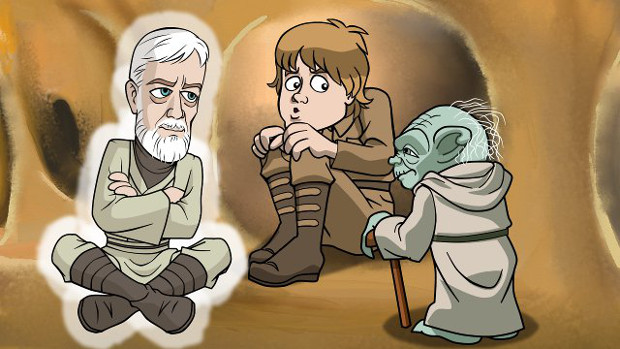
This image is from Empire Uncut, part of the Star Wars Uncut project and one of the five projects at the Tribeca Film Festival’s first juried exhibit of interactive video projects, which ran this week at the Bombay Sapphire House of Imagination on Varick Street. TFI has been supporting digital, transmedia, and multimedia projects for years through programs like its New Media Fund and hackathons, and now TFI’s Director of Digital Initiatives Ingrid Kopp (who was recently interviewed by Filmmaker) has found a way to bring some projects into a physical space to coincide with the film festival in lower Manhattan.
The result, dubbed Storyscapes, was one of this year’s fest’s most interesting events — and certainly one of the most forward looking. Most immediately, Kopp had to address the issue of reinventing for the gallery works which for the most part were conceived to live online. The result has some challenges — crowd noise chief among them (although you could argue that’s a nice challenge to have at a first-time event) — but overall being able to encounter these pieces in the real world works to their advantage. This is either because of a new element that enhances the online experience, as in the case of Empire Uncut‘s iPad app, which functions a little more smoothly than its html website; because their physical presence defamiliarizes them and makes you pay attention in new ways, as Bertolt Brecht or the old Russian literary formalists might have said; or, perhaps most importantly, because the gallery invokes the old cinematic norm of seeing things with an audience. Having the pieces in a shared space forces viewers to walk around together, and though everyone’s experience is individual there’s a definite extent to which it’s communal as well — which is a nice change for the often insular, or at least mediated, world of transmedia. With certain projects — and here I’m thinking particularly of the crowdsourced documentary Sandy Storyline — seeing it with a group can have a profound effect on your experience.
In any case, it’s important when going through Storyscapes to remember you’re not really in a fine art gallery but at a film festival, and what Kopp and her team have managed to create is an excellent window into how these five projects would work online or in other outlets. The physical exhibit closed Sunday, but interested viewers can still check out each piece online or in other venues:
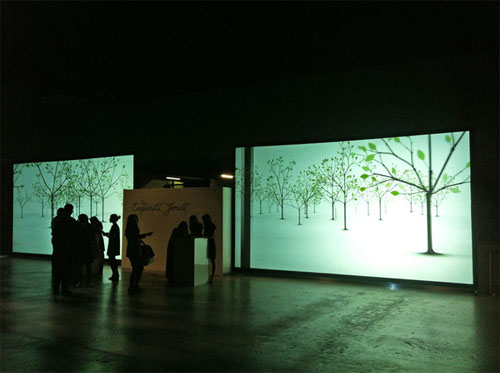 This Exquisite Forest takes the old literary concept of the exquisite corpse, a story in which each word or portion is added by a new author without seeing what the previous author had written, into the realm of the Internet and animation. The concept is that each viewer/artist can create a discrete six-second animation (or several of those), building off of a source animation or another viewer’s work. The image of the forest comes from the fact that single bits of animation can inspire different branches in later viewers, thus allowing you to follow strands of action down different paths. This trailer shows the concept in detail. And the resulting animation can be quite remarkable: generally its amateur source is discernible — some look like the cartoons my daughter makes on her Nintendo DS — but not only can these be quite fun, but the enforced brevity of the animations steers them toward the abstract and avant-garde as amateurs unwittingly imitate Len Lye, Norman McLaren, or the old pre-Disney East Coast style of morphing forms (think the Fleischer brothers and the Van Beuren Studio).
This is entertaining enough, but the piece isn’t entirely crowdsourced. Contributions were also made by artists like Olafur Eliasson, Miroslaw Balka, Raqib Shaw, Julian Opie, Mark Titchner, Dryden Goodwin, and Bill Woodrow.
At a panel discussion on Saturday co-creator Chris Milk indicated that he’s aware of the limitations of the live exhibit format and, particularly, how it does or doesn’t contribute to the project’s interactivity. Through its initial months online the team has learned that there is a small group of people who get really involved, creating animations, following all the branches, and delving as deeply as the project allows. Those users of course are receiving the maximum possible experience — and getting that deep into it generally requires spending a significant amount of time. Those who encounter it in a gallery context, whether at Storyscapes or its longer-lasting display at the Tate Modern, may create an animation or two and will generally watch for several minutes, but they’re not going to tap into the depth of the project to anywhere near the same degree. But how else are everyday art lovers going to get their work in the Tate Modern alongside not just Eliasson and Balka but Rothko, Degas, Kadinsky, and all the other artists at the most popular modern art museum in the world?
This Exquisite Forest is still growing online. Check out www.exquisiteforest.com to view and contribute. It was produced by Aaron Koblin and Chris Milk.
 Sandy Storyline This is also an ongoing project that draws its material from a mix of professionals and crowdsourcing, but that’s where the similarities to This Exquisite Forest end. After Hurricane Sandy struck New Jersey and New York last fall there was no way for any one documentarian to take in the storm’s entire aftermath. So instead, the team of Rachel Falcone, Laura Gottesdiener, and Michael Premo decided to leverage the ubiquity of video recording devices and take on a more curatorial role than most filmmakers do. The goal was to gather as much footage and as many personal narratives relating to the storm as possible. Full-motion video was used, but so were still photographs and audio recordings with no visual — anything that chronicled the storm was wanted. To make this possible they set up both a website at SandyStoryline.com (where the material would also be displayed) and a texting service where people who couldn’t access the Internet could still submit their material. The filmmakers continued to shoot their own material, of course, and they also began training the community to shoot higher quality material; Gottesdiener told me, for instance, that while Brooklyn schools were closed from the floodwaters educators asked them to involve idle high-school students in their work; the result was that the project received material shot from the distinct perspective of south Brooklyn teens, while those teens learned about documentary production and became more connected to their community and the recovery efforts.
And that’s where the exhibit was so impressive. Sandy Storyline is still online and is still collecting stories, photos, and footage, but they had to also design a space to exhibit some of their material at Storyscapes. The resulting room simulated the wreckage of the storm, with two off-kilter back-to-back flatscreen monitors showing the same footage and a functional phone-charging station to replicate those set up around New York’s blacked out neighborhoods. The footage is elegiac — shots of interviewees, long static shots of street scenes as though Ozu had wandered into a war zone, and mesmeric images of water pumping back into the ocean that seemed lifted straight out of something by Bill Viola. Even with those strengths, the audio is of course where the project’s true strength lies. Here the precedent lies in the realm of Housing Problems, as the storm’s victims one by one tell of their trials and deprivations — but then also, without fail, talk about the strength of their community and the human spirit that buoyed them all up. Speaker after speaker talks about not just how they were helped but how they left their dark apartments and went out to help others. The result is a community portrait that testifies of man’s resilience in the face of disaster. Though visitors to the website may be able to devote more time to extended viewing, seeing it with other New Yorkers in a space that was blacked out after the storm made it that much more meaningful.
Star Wars Uncut As mentioned, the version shown here was from filmmaker Casey Pugh’s current project remixing The Empire Strikes Back; hopefully a Return of the Jedi project will follow. The original New Hope piece was completed a few years ago, won an Emmy, and has been exhibited at venues such as Lincoln Center. The concept is simple enough: Pugh divided the original film into equal-length divisions (for Empire that’s 480 scenes of 15 seconds each), put it all up on the web, and asked fans to remake it. The conglomeration of styles was staggering; every submission was housed and categorized online, while Pugh and his collaborators selected their favorites to lay in with the original John Williams score to create a “director’s cut,” if that’s even the appropriate term in a case like this, and that is the version that has shown in traditional cinemas. (Watch the Empire trailer.)
Organizing this many clips online was a little unwieldy, and hence search terms were introduced so that viewers could narrow things down to just clips that take place on Tatooine or that feature Princess Leia. With Empire this allows a quick survey of versions of Yoda or Lando, and as mentioned the smooth control of the iPad moves much quicker than the online site, even if selecting individual clips remains a little imprecise. This and the big screen were the primary benefits of the gallery, though fans will really want to sit down and explore the site online. The biggest incentive, of course, is that filmmakers can still claim Empire scenes until May 1; they’ll have 30 days from then to complete and upload them.
I asked about the legal ramifications of this entire process, and it’s all on the up-and-up with Lucasfilm. With recent changes under Disney like the cancellation of the upcoming Robot Chicken spoof Star Wars: Detours and dissolution of game developer LucasArts one could wonder if Star Wars Uncut will remain in Disney’s good graces, and current indications are that it is and will continue to stay there.
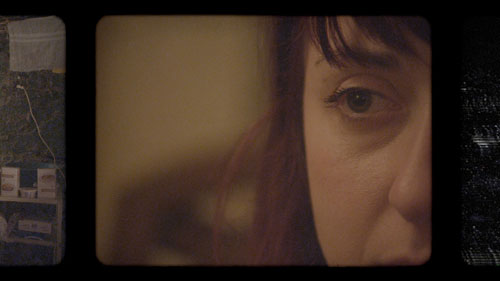 A Journal of Insomnia The newest transmedia project from the NFB, A Journal of Insomnia came to director Bruno Choiniere in the middle of the night. Insomnia is incredibly common but little discussed; it’s experienced in isolation although it happens en masse. Choiniere decided to use the Internet to remedy that, and with his team Philippe Lambert, Guillaume Braun, and Thibaut Duverneix he took the concept through an IDFA DocLab to its premiere last Thursday at insomnia.nfb.ca. One of the best features of the project is that it has to be experienced in the dead of night, tying the media in with the real world. Users set up a middle-of-the-night appointment with an electronic female voice (slightly more exotic than Siri) and they receive a phone call at that time telling them to log in. Once online — in the Storyscapes exhibit appointments weren’t necessary and nighttime was simulated by a large black chamber that visitors entered one at a time — users are asked a series of questions about insomnia and sleep; they can type their responses or draw, for instance, “Why can’t you sleep?” or “What scares you?” The responses are stored in a database that is then available for others to access, presumably also in the dead of night. Thus Insomnia bridges the spaces between sleepless souls and allows them to finally commune a little bit; the drawings are a nice element of this as they add something a little more personal than just analytic answers.
With hardly any advertising Insomnia has already gathered hundreds of entries in just a few days. It’s an unlikely subject, but one well worth investigating and including at Tribeca this year. As NFB Chairperson Tom Perlmutter told me, interactive media gives us the chance to write a completely new language for a new medium. He sees current transmedia artists as the Griffiths and Eisensteins of the 21st century, and his audible enthusiasm reemerged a few days later when the NFB discussed its impressive array of projects just released or in the pipeline. Through its Interactive unit under Loc Dao the NFB is poised to experience another renaissance like it did with Unit B and artists like Norman McLaren.
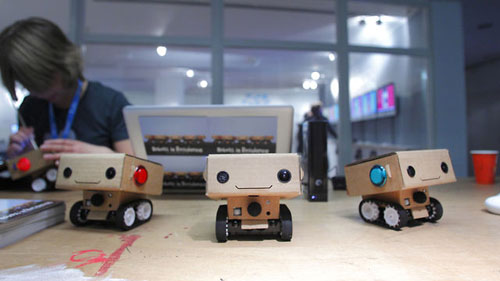 Robots in Residence These iconic little cardboard robots became the face of Tribeca’s interactive efforts this year. And how could they not — they’re definitely the cutest robots I’ve ever seen. Conceived by robot designer Alexander Reben and filmmaker and “25 New Faces” alum Brent Hoff, the robots are the means they’ve devised to investigate authorship and authority in documentary film. There’s always a voice, we’re often told; there’s no such thing as objective filmmaking. In this case the robots are completely unobjective, asking and filming the same questions to everyone they encounter, but the subjectivity comes in the way their interviewees choose to handle them and respond (as well, of course, in the editing).
You can watch the robots at work here, courtesy of Submarine Channel (makers of great short video profiles of creative and technological innovators). The process is simply that people borrow a robot for a few minutes (ID and a release form are required, of course) and begin an interview. One eye is a camera, one a microphone, and two small speakers sit atop its head. From the moment you go it is recording you, gathering footage, and then at the touch of a button it begins asking incredibly personal questions (“Tell me something you’ve never told a stranger before,” “If you died tomorrow, what would you most regret?”) with an incredibly disarmingly cute baby voice. The result is something of a hybrid between Chronicle of a Summer, Errol Morris’s Interrotron, and the Smurfs (or, I suppose, Teddy Ruxpin). You feel completely ridiculous holding and talking to this cardboard doll, but at the same time you’re having to evaluate your life in ways we generally don’t in daily living.
Hoff then takes the footage and edits it into a feature documentary. With Tribeca, he had basically 24 hours to do this before a Sunday-night premiere. But this was a remake, if that’s the right word, of an earlier Dutch version created, again, at IDFA DocLab. This film was showing in the Storyscapes space and seemed like an incredibly engaging piece.
But Reben and Hoff aren’t content to leave it at just two films created by seven robots; last week they launched a Kickstarter campaign to allow them to create a whole lot more of these mechanical Dziga Vertovs, which are actually called BlabDroids. There are lots of incentives, of course, but for $75 you could own a little documentarian of your own.
****
The diversity of the projects at Storyscapes illustrates Tribeca’s commitment to interactivity. With the success of this exhibit, last Saturday’s Interactive Day, and TFI’s other transmedia initiatives, there are lots of reasons for everyone interested in interactivity to keep tabs on what Ingrid Kopp and TFI are up to.