Back to selection
Overdraft Protection: Chloë Sevigny Talks to Amalia Ulman About her Feature Debut, El Planeta
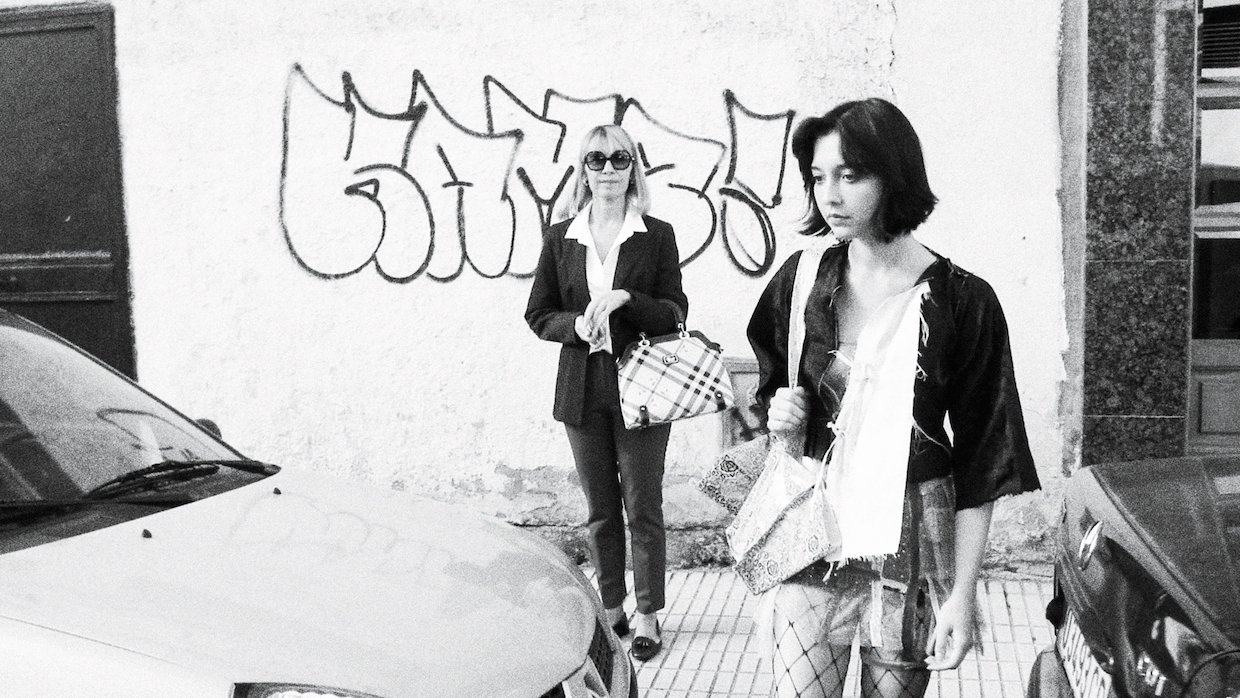 Ale Ulman and Amalia Ulman in El Planeta (Photo by Rob Kulisek)
 Starting in 2012, the saga of mother/daughter scammers Justina and Ana Belén was low-key Spanish news fodder. Their scheme followed a buy-first, pay-never model, using a variety of excuses to dodge their bills. They came to legal attention when they attempted to dodge a hotel bill in Gijón, Spain, by threatening to accuse the proprietor of sexual harassment; a year later, in 2013, they were again arrested in the same city for racking up thousands of euros in unpaid dinners.
In 2017, Argentinian-born artist Amalia Ulman received a photo of the Beléns from her mother, Ale, who still lives in Gijón, where Ulman was raised. Her fascination with their story resulted in her first feature, El Planeta, which she began developing in earnest as an artist in residence at the IASPIS Residency Programme in Göteborg, Sweden, in 2018. Acting opposite her mother, Ulman merges the Beléns’ story with her own background, including a spell of homelessness growing up. In this rendering, daughter Leonor (Amalia) and mother María (Ale) are broke and facing homelessness. Their low-key scams require pretending to be very rich, all while Leonor is trying to earn a living (rather than merely accruing unpaid “exposure”) in the fashion world, setting up photo shoot interviews from siphoned-wifi in an apartment that isn’t hers. Her attempts to shore up financial security include a failed attempt at picking up sex work via a would-be client (Nacho Vigalondo), but the money isn’t good enough. Leonor’s personal life outside her close but frustrating relationship with her mother isn’t helped by her romantic woes. An extended date with Amadeus (Chen Zhou), ending in a revelation of bad faith on his part, is an instant classic sequence in the lineage of Modern Romance, filtered through mutually fumbled navigations of English as a first language and alternately tension-diffusing and -exacerbating alcohol intake.
Shooting in black-and-white on the Blackmagic Pocket Cinema Camera while making judicious use of Gijón’s streetscapes to add background production value, Ulman trains an economically critical eye on the city in which she was raised. Comparisons to the flawlessly naturalistic performances in the work of Hong Sang-soo (which Ulman cites as an influence) are one accurate point of reference for Ulman’s first feature. But with her art—painting, sculpture, performance and video works exhibited in galleries but also across Instagram—essaying female identity, class, mother/daughter relations and their representations in mass media, it was only natural that she’d extend her exploration of these topics to the feature film. To interview Ulman we are honored to have another multi-hyphenate, Oscar-nominated actress, director and designer Chloë Sevigny, who graciously took time from shooting The Girl from Plainville, the forthcoming Hulu series about the Michelle Carter texting-suicide case, to speak with Ulman via Zoom.—Vadim Rizov
Sevigny: I watched your film last night. Sadly, I had to watch it on an iPad, but I did use my Bose noise-canceling headphones to try and get as close to a cinematic experience as I could, and I loved it. I always want to see more movies with mother/daughter relationships, so thank you especially for that. And as I was watching it, selfishly, I kept thinking of my relationship to my son, and how I wanted a daughter, and will I be able to have that same sort of intimacy with someone of the other sex? I mean, who knows what he’ll be. Everybody always asks, “Is he a boy or a girl?” And I always say, “He’s a boy for now,” which is a very trendy way of answering. But also very true, I feel.
Ulman: My mom always wanted a boy.
Sevigny: Really?
Ulman: Yeah, so she always treated me like one. Maybe you can treat him like a girl and hope for the best.
Sevigny: Right. Your real mother plays the mother in the film. I was wondering about your relationship with her and her understanding of your ideas and what you want to make. She’d never done any prior acting?
Ulman: No, but she’s that kind of person, you know? She’s very photogenic, always camera ready and funny. She grew up poor in Argentina and basically was a trophy wife all her life, so she’s very aware of what she looks like and how she presents herself. She’s an indigenous and blonde mix, which makes her very striking and beautiful. She was ready for the film. Also, she’s a big independent cinema movie buff, so she was very easy to work with because she knows so much about films. She had all the references.
Sevigny: Do you think she’s going to pursue acting more?
Ulman: I hope so. I mean, she’s good. It’s a pity she doesn’t speak English, but more independent Spanish filmmakers should use her.
Sevigny: To the genesis of the film: I know you’re celebrated as a fine artist, but I’m curious about, like, the chicken or the egg. Obviously, you work in lots of multimedia and performance in your art career. But I know the story is semi-autobiographical and sort of based on a true story. Were you interested in making a film and then you found the story? Or did you hear the story and then decide, “I’m going to make a film?”
Ulman: I’ve always been more into films and literature growing up. But because of my background, I never thought of myself being able to become a film director because I just didn’t have the access. I was a pretty lonely teenager. I had a few friends, and seeing the credits of any movie, I would be like, “I have no idea how you get to that point to where you know so many people.” So, I started performing for the camera on my own, went to art school and snowballed in that direction. I’ve always been weird within fine arts because I use very narrative forms. My practice grew bigger and bigger, and at the end I was collaborating with a lot of people, not only assistants but people that work in different fields. It was only in China meeting other artists/film directors [that I started thinking about making the film], because they don’t get money from the government. [They] are very free, in a sense that independent filmmaking is truly independent: They just grab a camera, use their friends and make films.
Sevigny: In China?
Ulman: Yes. Chen Zhou, who’s in the film as Amadeus, he’s a filmmaker himself. He was one of the people that encouraged me to finally make a movie. He was like, “Of course you can make a film. You’ve been doing all these other works,” which, for me, was important to hear because being from Europe, you have to go through a lot of institutional processes to make a film. There’s a lot of paperwork.
Sevigny: To get government funding or just to make one?
Ulman: Everything, because technically what I did is illegal in a way—to shoot a film on your own and just pay your friends cash or whatever. So, it was very refreshing to hear from other people: Go ahead, make a movie.
Sevigny: So, you had the confidence to make a film, and then how did you figure out the story?
Ulman: It happened at the same time. My mother had sent me information about this mother/daughter duo as a funny thing: “I just saw them in the street.” Then, I looked at the press and was like, “Oh, this story is fascinating”—not only because of them but how it represents the city because [Gijón] is a very small town. They just went around saying they were rich—they don’t even look that fancy, so it was interesting for me: how did they get away with this? A lot of it has to do with Spain. I’m an immigrant, so I’ve always seen it from the outside, and what they did is something that my mother and I would have never been able to do because we don’t get a pass. It was interesting to transform my mother into that sort of very traditionally Spanish conservative character, with a fur coat. So, I had that idea, then got encouraged to make a film.
Sevigny: It depends on your practice, obviously, but as you become a bigger artist and more successful, you are encountering people at institutions and galleries that you have to then—I don’t want to say “sell,” but tell a story about the work to. To frame it in a way. I think that helps the transition to being a filmmaker and getting financing because you can really articulate your ideas. People are constantly asking you to do that in an exhaustive way.
Ulman: That’s why I was able to make the film, because I produce all of my work. I’ve been writing, producing, doing the costumes, the photography, all of it. So, it was not that hard because it’s not like I’m a painter and suddenly I’m transitioning to dealing with actors, you know? It was more connected. In that sense, it didn’t surprise me or the people that did know my work because the way I work is very similar to filmmaking. A lot of people were like, “Oh, you’re an artist. You’re going to make a film.” I know there’s a lot of bad films made about artists, and I don’t judge them for thinking that way. But even now, people from the art world ask, “Is it a ’film,’ or is it a ’film, film?’” It’s a film, film.
Sevigny: Assholes. Were you a film lover? Do you think film has a different reach than fine art? Were you frustrated by the reach of your art projectsor do you just think of it as something separate? Are you interested in telling more conventional narrative?
Ulman: I’ve always loved film. That was my escape as a teen. Gijón has a very good film festival I was lucky enough to go to every year, and there was a very amazing film store. This guy had the best collection of DVDs—it was an illegal place because he didn’t have a license, he used his own DVDs. But he knew so much, and I was 13 or something. So, that was my escape, to watch all these movies. But I never thought about it—I thought it was normal to watch so many movies. I thought everyone did because my mom also was watching a lot of movies. So, I never thought about it much. Then, of course, I really love art, but I also have physical disabilities, and I’ve been in situations where I cannot attend certain things and feel bad when people not from big cities are not able to go to see things, either. So, for me, I feel like cinema does have this reach where you can be in the middle of nowhere and still watch a great film. I like it.
Sevigny: How important is access? You had this video store, I had Kim’s Video, and I feel like fine art has this bubble around it and it’s harder for people to access. Of course, we want people to see things in theaters. You’re saying you can’t attend things as a viewer or as an artist?
Ulman: As a viewer, sometimes I haven’t been able to. When I go with my friends to a lot of galleries downtown, all of them have crazy stairs to go down. I mean, I can do it, but it’s tough. Sometimes, I can’t do it, and it’s fine. I’m not expecting them to change it for me.
Sevigny: Well, everybody else is.
Ulman: Yeah. But that’s what for me makes cinema so beautiful. There’s a certain kind of magic to distribution and how it gets to different places. Suddenly, you’re in the middle of nowhere and can watch an amazing film in a small theater and it matches your life. I mean, I had many life-changing experiences with films in my own hometown.
Sevigny: You know Hal Hartley—was he always one of your favorites? How did you access him or meet him?
Ulman: I met him through Scott [Macaulay], and Hal and I became friends. He happened to have these old TVs out, and I was like, “Actually, I also need to shoot that as well.” He got a credit for allowing me to use his old ’90s TV, and he gave me a lot of great advice. I really respect him because he was able to remain very independent. I think his last movies are amazing, and I find it fascinating that he was able to maintain his aura, even though he was shooting in a very contemporary way.
Sevigny: It seems like this was a pretty tight budget.
Ulman: A really tight budget.
Sevigny: How many days did you shoot for?
Ulman: 17.
Sevigny: Wow. Quick.
Ulman: I was praying every day that nothing happened and everything went according to plan because we didn’t have extra days.
Sevigny: There’s a history of filmmakers that, like Hal, keep in that milieu and are happy and comfortable there. Do you think that for your next film you’ll be like, “Yeah, give me more money?” Or do you like those confines and constructs?
Ulman: I want everyone to be paid properly. The actors, the crew, everyone got paid in my film, and I followed Spanish scale for cinema. The crew was small, five people only, but they all had their meals. No, I wouldn’t want to go with a budget bigger than what my ideas require. I don’t think it’s necessary, and I’d rather keep my freedom as a filmmaker and be able to take risks. The less investment you have, the more you’re able to take those risks and be crazier with the film.
Sevigny: I’m glad you take care of the crew with the meals because that’s very important. It’s a very big deal right now in America with the unions and people being overworked and having to drive home. Did you have a stand-in? How were you blocking the scenes? Were you watching playback?
Ulman: I was watching playback and had an amazing director’s assistant, Carmen Roca Igual. It wouldn’t have been possible without her. She also helped with production and everything. We were multitasking. But she’s a very, very intelligent person that I trust 100 percent. If she says it’s good, it’s good.
Sevigny: The framing is also very contained. You’re in that little kitchen space, and the camera is locked off a lot.
Ulman: There was a lot of choreographing the space beforehand. Those Spanish interiors are tiny, so that was a problem the cameraman had to deal with because he was like, “I have no space to shoot. I don’t know where to shoot from.” There was a lot of re-watching, but because I’m often in front of the camera, I’m very used to running back and forth.
Sevigny: Were you rehearsing with your mom? There’s conflicting information on the internet [laughs]—big surprise, that part of it was improvised, or was it all scripted?
Ulman: All scripted. I had a very clear idea in my mind of the film from beginning to end. Watching dailies, maybe two scenes were added to respond to how everything was looking. But 90 percent of it was totally scripted. There were some rehearsals, but I feel like working with nonprofessional actors, sometimes it’s better to not let them memorize too much of anything. So, I was playing with both things: having the script, but also, depending on the skills of everyone, if a scene [gets] too stuck in the rhythm of how they were repeating the lines and everything, I will try to shake it off and be like, “You know what? Forget about all the lines, and just tell the story in your own way.” Ideally, I would like to work like Hong Sang-soo, preparing the scenes just beforehand and not having a script because I’m a very visual person, not literary. I’m happy to have a bit of improvisation and let the magic of the moment happen there. But for budget reasons, everyone wants a fully developed script for everything.
Sevigny: I saw you worked with Fiona [Duncan] on the costumes, who I know from New York. I recognized a lot of things, like the Lou Dallas capitalism trousers. It seemed like there were a lot of New York-based designers, like Women’s History Museum. I bumped up against it being a New Yorker, being like, “[Your character] went to Saint Martins. She should be wearing all London designers.”
Ulman: I mean, she was based in New York and more familiar with what was happening in New York than in London. I actually don’t even know what’s going on in London right now. The reason I went for someone in the fashion industry [to do the costumes] is because I went to fine arts at Saint Martins, so I was surrounded by fashion people, and a lot of my friends are. I wanted to do something that was not a caricature, something realistic, and that I felt confident sharing without it being a mockery. The clothing was based on what a lot of girls were wearing at the time in New York, with the Cafe Forgot people and Lou Dallas, Martina Cox, Gauntlett Cheng and all these things. Fiona helped a lot putting that together. That was fun to do.
Sevigny: A lot of the movie draws from autobiographical things, right?
Ulman: Some things.
Sevigny: Do you want to touch on those things? I was curious about your legs. You just mentioned earlier that you had had an accident and have trouble with them. I was like, “Oh, that’s such an interesting character choice. I wonder why she came up with that?”
Ulman: As you just said, that’s exactly why I added that to the character because I don’t see that enough. I feel like having disabilities that are not obvious, like being in a wheelchair, is not really shown in media or films. Or how your mood can be altered if you’re in pain. This was a chance to include that and make the character more multilayered. Also, I’ve never talked about disability in my work. None of my characters before have ever had a disability, so I think it was interesting to add that as a modulator for moods—to understand that she’s in pain and how when she’s happy with Amadeus she’s not in pain. When he tells her everything, she’s like, “Fuck it, I’m in pain now. I was in pain all along, but because I was happy, I was just being cool about it.”
The other thing that was important for the film was the fact that my mother and I did lose our home. It gave me the chance to be comedic about it, instead of doing it from a place of guilt, which I see in a lot of films right now about class.
Sevigny: I think there’s also poverty porn—people trying to access, maybe not sympathy, but using it to their advantage, in a way. Whereas your film was addressing it, but it’s still charming. You and your mom are so pleasant. It was an interesting take.
Ulman: I always like charming antiheroes. They’re not perfect, they can make mistakes. One thing to take from the film is that things are not black and white. You can be going through something and not be perfect about it. We missed the deadline for the help from the government for housing. You know, things happen. People have mental illnesses or can make mistakes.
Sevigny: I’m always obsessed with extras and how hard it is to get background. Were people in the background set up, or was that all just vérité?
Ulman: It’s just the street.
Sevigny: And everybody’s old there? Or did you make the conscious decision to only have—
Ulman: Everyone is old there. Everyone is so old.
Sevigny: The only young people you see are Amadeus and then the girls at the doctor’s office.
Ulman: It’s funny because a lot of people are like, “Why did she put in old people?” It’s like, no, I just placed the camera in the street, and that’s what happens. At one point, the city was the oldest in the world after [a city in] Iceland.
Sevigny: Just because there’s nothing there bringing young people? Everybody just leaves?
Ulman: Everyone just leaves. Some people don’t have kids. People stay with their parents into their 30s. There is no money to have kids, and people are young until their late 40s, you know? There’s not this culture of having kids. Spain and a lot of Europe is reliant on immigrants right now for people to have babies. The movie’s done from the vantage point of two people who are struggling. All you see around is closed doors and really old people, and there’s no way out.
Sevigny: Well, I had a baby at 45, so maybe I should move over there.
Ulman: That’s what my mother told me because she went to Argentina recently, and she was like, “In Argentina, I’m old, but in Spain, I still go to indie rock concerts and buy comics and have cool friends.”
Sevigny: In the beginning, you have this funny scene, flirting with sex work. I’ve had many girlfriends who do that work, and others that have flirted with the idea of it. But to see a beautiful woman like you who you think has many opportunities turn to that, I think people will be surprised.
Ulman: I wanted to show it because I mean, personally, I have nothing to hide. I know it’s so common, and I think it’s bad—not that sex work is bad, it’s just bad that it’s so common. That it’s the only resource you have, but it can’t be talked about because it’s taboo. I had so many friends that did it or tried to, at least, to see if they could pull it off. I did it briefly in London—actually, that scene was sort of based on a true thing that happened to me. But the price range in Spain is so low that you can’t even do anything with it. I think that sets the tone for the film: Even if you want to hustle, you can’t. You get 20 euros. What do you do with 20 euros? You can’t even buy a book.
Sevigny: I was interested in the edit choices. I made a few short films and often have had trouble with transitions, and I feel like the ones in your film, like the fades and cuts to black, were very helpful. Was that something you had incorporated from the beginning, or were you in the edit and were having trouble making transitions?
Ulman: No, I always wanted to do that. Conceptually, the film is very similar to a lot of my practice as an artist, but this is the only thing that comes directly from my video works. I use that stuff all the time. I’ve done a lot of video essays using PowerPoint. Using the transitions that no one uses in Premiere, the editing software, was my style choice from the very beginning. I didn’t have to fight for much in the end, but one of those things was like, “I’ll fight for this. I won’t let anyone from film school tell me not to use these transitions.” But it was great to work with [editors] Anthony [Valdez] and Katie [McQuerrey], and they were very cool with it.
Sevigny: I wonder about what else is more autobiographical throughout?
Ulman: The character of Amadeus is based on a real person I met in Saint Martins. He’s more of a fine artist now, but he went to fashion school. He grew up in a Chinese store in north Portugal, in a province very close to my province in Spain. That story was important, too, because the way Chinese immigrants are still portrayed in Spanish films is, first of all, racist but also based on a lot of clichés. And I thought it was great to show someone that is actually doing really well studying abroad, knows what he’s doing, is hands on, which is very different from what Spanish people think is going on behind closed doors.
Sevigny: Probably, sadly, a lot of Americans as well. I thought it was a very refreshing cast. I hate to say that and sound so cliché, but it was. He’s so handsome and charismatic—I mean, everybody in the film was, but there’s something special about your relationship with him and what he is pursuing.
Ulman: Yeah, he’s great to work with, and he’s collaborating with a lot of female filmmakers, which is very much appreciated. He takes direction very well and he’s very fun. The other story is also real, a guy who jerks off at this language camp and instead of getting fired, just gets transferred.
Sevigny: There’s plenty of fine artists who get into filmmaking. What about the poor actress [laughs] that wants to transition to fine art and really gets raked over the coals?
Ulman: Yeah, it happens. I was thinking, “I’m getting the same treatment as James Franco was getting,” because I remember a lot of my friends were making fun of him: “He thinks he can come and do art.” And I felt the same. I was like, “Oh, now I’m getting the same treatment from the other side.” But it’s common. They’re two very closed-off worlds with different hierarchies.