Back to selection
Microbudget Case Study: “Free Time”
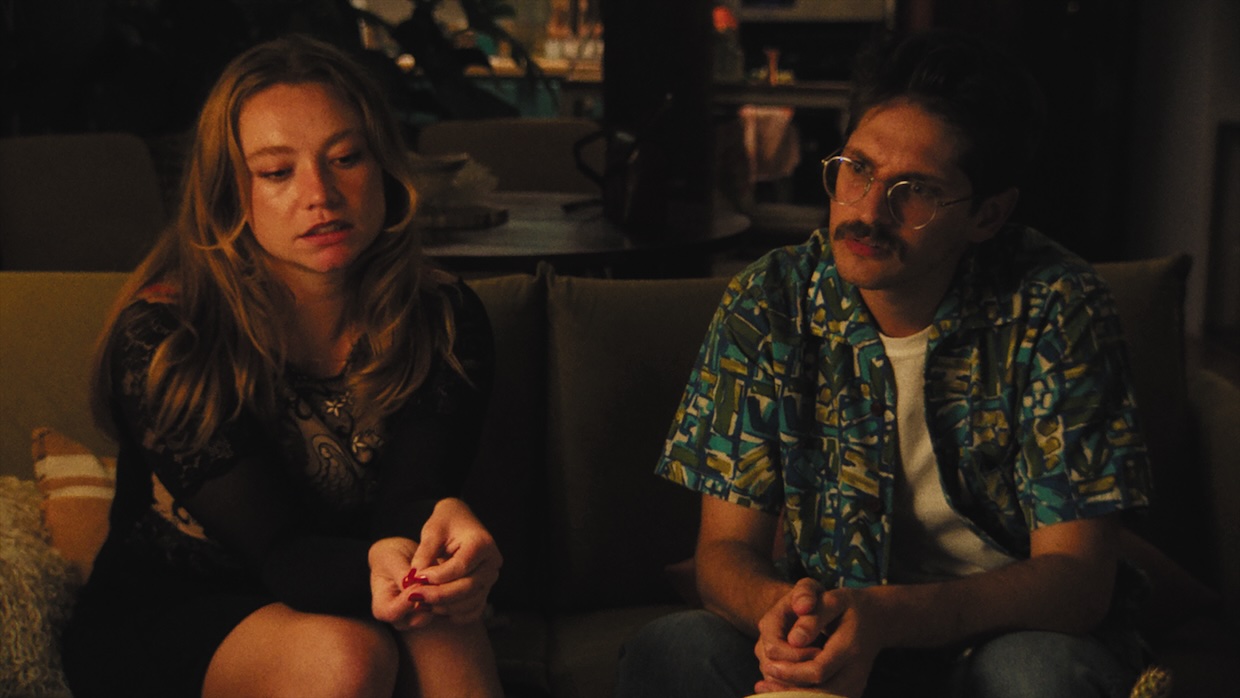 Free Time
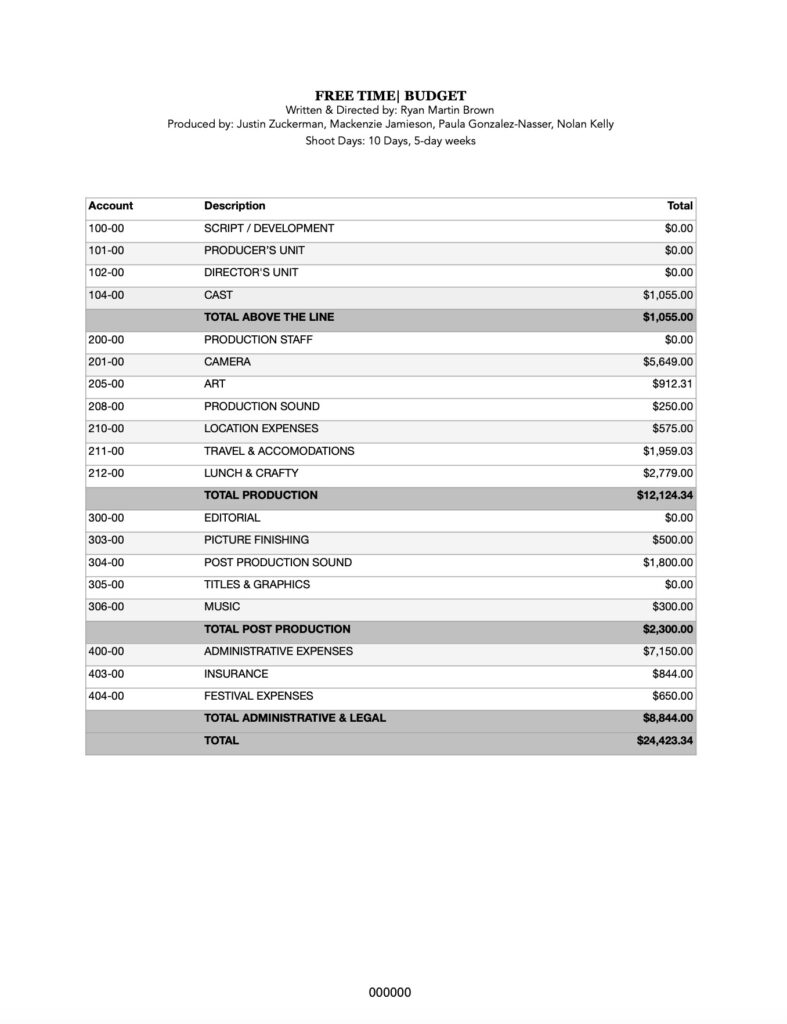
 Filmmaker’s coverage of the microbudget film movement was a large part of putting us on the map in the early 1990s. In a series of articles, Peter Broderick broke down the budgets of films such as Clerks; El Mariachi; Clean, Shaven and others, delivering on our mission of demystifying the process of independent film production. (Several years later, I contributed one of these pieces when I broke down the budget of Pi.) With microbudget filmmaking making a resurgence lately, I asked Ryan Martin Brown from this year’s 25 New Faces list if he’d give us the budget of his extremely clever microbudget hit Free Time—a Slacker for today—and he graciously replied with the accompanying top sheet and breakdown. — Scott Macaulay
I have had some reservations about sharing the budget for Free Time, the movie we made in 2021, because I have a slightly queasy feeling about legitimizing in print a process that was essentially anything but legitimate. Filmmaker asked for a top sheet for the budget—we didn’t even have one! We had a Word document where we kind of charted out costs as they came in-—or tried to. I’ve made one here, to the best of my ability, that reflects the costs in retrospect, but its reliability must be considered a little suspect—who knows what’s been forgotten or fallen between the cracks.
A little context: in 2021, after several years in New York and a year-and-a-half of COVID lockdown, my friends and I—mostly a cohort of fellow Floridians that I knew from attending Florida State University from 2012 to 2015-—had essentially accepted that the odds of us making feature films in a professional capacity were slim to none. But we had always enjoyed making things together and always had the goal of doing something long-form, so we decided to honor it in our own way.
My friend and former roommate Justin Zuckerman made a $3,000 feature on miniDV called Yelling Fire In An Empty Theater right before the pandemic, and because we had a blast making it, in the absent empty space of lockdown I had started dreaming up a way of doing it again without the miniDV of it all. I had the good fortune of working through much of the lockdown, was riding high off the stimulus checks and a fairly affordable living situation and decided I could put $10,000 toward making a movie, which was just under two-thirds of the money I had by the time COVID cases were down to a negligible amount in NYC. My plan was to make the movie and then see if I couldn’t get any friend who had gone on to a “real career” to become an EP in retrospect, passing me back $5,000 and straightening my financial situation out a bit. (This did not end up happening.) We figured we’d try festivals but didn’t have any real hopes for a splashy festival premiere (this proved true) and instead assumed we’d be showing it around town at DIY venues, like the recently opened Life World in Gowanus, where we also planned to shoot a scene or two.
What instead happened was that the film managed to scrounge up a small life for itself, slowly, over time, and that $10,000 cascaded forward to something resembling the approximately $25,000 presented here, and with it a proper theatrical release!
SCRIPT/PRODUCERS/DIRECTORS/PRODUCTION STAFF
Attempting to make a feature film for $10,000 begets one obvious truth: no one is getting paid to work on the film. This didn’t seem so crazy at the time—none of us had any clue where someone would manage to dig up the $30,000 to $40,000 required to pay a full-time crew, nor did we have any idea how or why anyone would ever see that money back again, and crowdsourcing that money from friends and family somehow felt morally objectionable. We had gotten in the habit, in the years since school, of working on each other’s short films for free, with the understanding that the time required would be relatively short and everyone would be well taken care of, and that the favor would come back around. So, we talked about doing it that way: the same as the shorts, but a bit longer.
We’d make the movie in 10 days. The crew would be small. We had four producers running the ship, plus me, with the idea that people could step away from the process if life came up or a job arose. A production designer (Ale Añez), a DP (Victor Ingles) and Colin Burgess, our lead—that was the extent of the full-time crew.
We didn’t hire a sound mixer proper but borrowed some equipment from a friend and had two friends take shifts during production for one week each. The same went for a grip/gaffer swing: one week each, with the idea that if someone needed to disappear for work, we’d replace them. That was everyone. Specific scenes were deemed more difficult or concerning, and we’d ask a few more friends to come out and help with art or camera just for those instances.
We were very fortunate to be shooting at a time when life was still slowed down by the pandemic, and people were very eager to get back together and do something with other people. I don’t think it would be able to work out like this today. And it should be said, if we had any idea we were creating some sort of movie that would actually be seen in a traditional context, maybe we wouldn’t have gone about it in exactly this way. (We haven’t since.)
CAST
Because the film was being shot for less than $20,000, we were eligible for the SAG microbudget agreement. That means that any SAG performer can work on the film for whatever amount they agree to do it for (in this case, nothing!), as long as the film is never shown for profit. Most of our cast was non-union, but this did allow us to have a few friends who were SAG members in the movie. We had no hope or sense that the film would ever get any sort of actual distribution, but when it did some three years later, we had to alert SAG and backpay these actors what they would have made on the day. This process was not so difficult.
CAMERA & GEAR
Our original plan was to shoot the film on a Canon C300, maybe one we could borrow for cheap. But again, we ended up benefiting from shooting in a world still waking up from the pandemic. Things were slow, and a friend of Victor’s in Los Angeles suggested we rent his Alexa Mini for the low cost of $2,000 for the full shoot. It was too good a deal to turn down.
We used a Canon 11-165mm zoom lens for the entirety of the shoot; we were able to get that and the microforce to operate it for $500 for the two weeks. We had boxed in Victor pretty severely when it came to gear by only renting one SUV for the production. Whatever he wanted to bring to set each day would need to be able to fit in the minivan, which also sometimes needed to transport people.
So, our rental package was small, just shy of $3,000, which we kept stored in producer Justin Zuckerman’s three-story walk-up. We’d bring down what we needed each day and bring it back up at the end of the day—not fun, and a mistake worth not repeating.
ART
Ale’s background had mostly been in non-narrative work. We talked about doing the movie almost as a documentary—we’d be careful about the locations we picked and then leave them mostly as is, with time to bring in set dressing and adjust things only at the locations we had access to ahead of the shoot. She did an incredible job sourcing props and set dressings, as well as coordinating with actors on what to wear—everything from their own closets. Colin Burgess helped keep track of his own continuity when it came to what to wear when, and most other actors were only on set for one day. We borrowed a lot of stuff—books, tents, art, instruments—and returned them at the end of the shoot.
PRODUCTION SOUND
The incredibly generous filmmaker Max Allman lent us a simple mixer and boom that we used across production. We rented lavs from ShareGrid and bought a lot of 9V batteries.
LOCATIONS
Most were lent and borrowed, and we tried to be as time efficient as possible with these asks. We shot in our own apartments or those of generous friends. Friends who ran a coffee shop in our neighborhood would let us in for two hours after close. A few bars in Crown Heights agreed to let us in if we could be in and out within short windows, and our office location allowed us in for free if we could have their students shadow the production for the day. The location we ended up having to pay the most for was actually the exterior “office” door off Canal Street, which in reality was that of a new co-working space—they charged us $500 to have access to the door for a few hours but did let us have lunch in their courtyard.
TRAVEL
We rented a minivan to transport gear around for about $900 for the two-and-a-half weeks we’d need it. We also paid for Holmes’s and Victor’s flights to and from Los Angeles—absurdly cheap at the time because people still weren’t flying much. But we did end up paying an additional $1,000 or so in Ubers and Lyfts to help get people and items to and from set with relative ease. I often rented Citi Bikes to get to set because we’d run out of room in the van when fitting gear in.
LUNCH & CRAFTY
We were a small team, so thankfully it didn’t cost too much to feed everyone every day. We’d order and pick up lunch from somewhere nearby set, usually at something resembling about $150/day. Most of our crafty was from Trader Joe’s, and we’d pick up breakfast sandwiches or bagels in the morning and get coffee for those interested.
INSURANCE
We got production insurance through Film Emporium, and it was pretty affordable and easy.
EDITORIAL/FINISHING
I worked on cutting the film alongside editor Byron Leon on weekends over the course of about a year and change. Sometimes, it was a stop-and-start process. I went back to working and tried to save up some more money to handle finishing—we ended up with about $2,000 to spend, which mostly went to the sound mix. We were happy with the LUT Victor had put together ahead of the film and mostly kept that look, with Victor making adjustments to his liking once we were picture-locked. We didn’t hire an external colorist, though I’m sure Victor would’ve liked to. Colin Burgess volunteered to do the titles and cooked them up during the year edit, basing the look on those from Hi, Mom!
MUSIC
My friend Mason Margut is a wonderful pianist and recorded a number of demos ahead of the shoot based on the script and our inspo track: Bonnie Raitt’s cover of “Women Be Wise.” He recorded these in his apartment on his iPhone, and those recordings are mostly what are in the film. We did book a studio space through a friend for about three hours to try to properly re-record his demos (harder than you would think to match!) and get the end credits song right.
ADMINISTRATIVE EXPENSES
In 2023, while the film was on a modest festival run that kicked off at Filmfort in Boise, Idaho, distribution whiz Jasper Basch reached out about his new company, Cartilage Films, and his interest in releasing the film theatrically. There were then a great many costs associated with the distribution deliverables we needed to cover, as these were not initially worked into our production budget: most notably, E&O insurance, which in and of itself requires a script clearance and title report, as well as some other assorted paperwork and media materials. We also needed to go back to our sound mixer and produce a new 5.1 mix, which we had neglected to do. Luckily, around this time, we won a cash prize from the Nashville Film Festival, and this helped to offset some of the costs required. Cartilage handled the costs of releasing the film, PR and marketing.
FESTIVAL EXPENSES
We spent roughly $650 submitting to festivals around the globe. Some festivals I received waivers from as an alum. This cost just reflects the cost of submitting; travel, lodging and so forth was paid for out of pocket in most instances. I’d say the film was accepted at about a quarter of the fests we submitted to.
We ended up spending a few thousand dollars more during production than I anticipated, and later a good deal more on those assorted distribution costs. The total cost of the movie was then spread out across three years, which made it easier to manage costs as they arose.
Again, it should be said, even if it’s obvious: I don’t think this in any way a suitable model for attempting to make a film that will be released in a traditional method, nor should it be. But for those looking to make something simple, by themselves and likely for themselves, it’s perhaps helpful to know what this process looked like for us.