Back to selection
Learning From Amos Poe
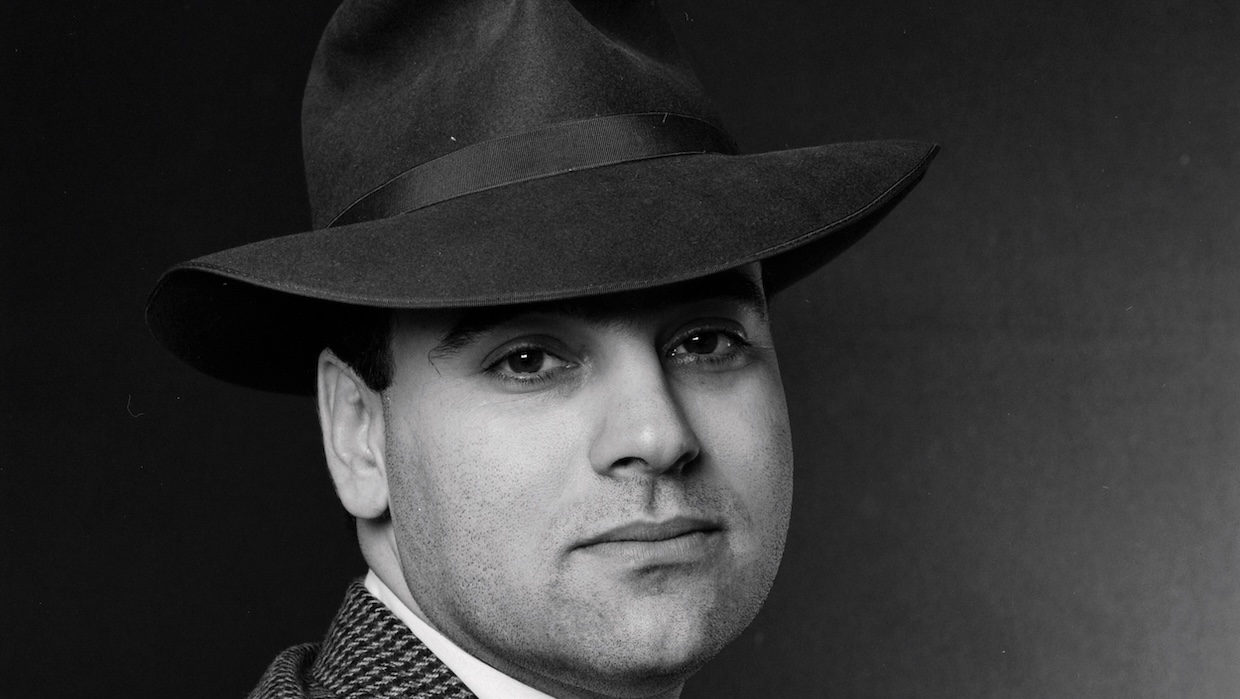 Amos Poe (Photo: Pieter van der Meer)
 The following essay about Amos Poe appears in Filmmaker’s Winter, 2026 print edition in a section, Reflections, that looks back on 33 years of American independent film and Filmmaker Magazine. Upon the sad news of Amos’s passing on Christmas Day, 2025, we are posting it and sending condolences to Amos’s family and friends. — Editor
Back when I was editing Filmmaker’s precursor, The Off-Hollywood Report, I’d attend the IFP’s Independent Feature Film Market. Filmmakers—some wearing sandwich boards or costumes—were hawking acquisition titles outside New York’s Angelika theater that were screening past the escalators inside, and the event always had an odd, nervous energy as they desperately scanned the seats for the handful of buyers. Nonetheless, I saw some remarkable films for the first time there, like Gaspar Noé’s Carne and Amos Poe’s Triple Bogey on a Par Five Hole. In its positive review, Time Out described the latter, set on a yacht circling Manhattan and featuring doc footage of Amos’s own children, as “a rare thing these days—a film that dares to go nowhere.”
But I had already greatly admired the work of Amos, having seen his seminal early No Wave titles, like The Foreigner and Blank Generation, in college—the latter a punk concert film willfully oblivious to the virtues of sync sound. Later, reading scripts for New Line Cinema, I extolled to any exec who would listen the virtues of the road movie neo-noir he wrote with Joel Rose, the unproduced La Pacifica. Over the years, I’d see Amos around New York, where he’d always have a new project and an optimistic, idealistic filmmaking attitude to emulate. So, when I learned that former student and now friend and collaborator Jaime Levinas has been working with Amos, who is currently in hospice, I asked him to write the below appreciation of the man and his work. — Scott Macaulay
Everything is black. The final scene of Amos Poe’s 1976 feature Unmade Beds just finished playing to a sold-out house at New York’s Metrograph. The credits roll, but before the audience is able to clap, the last few scenes of the film start playing again. The audience becomes quiet as they try to figure out what’s different about this ending—whether it’s part of the film or a projectionist’s strange mistake.
The version of Unmade Beds we screened that night was a fresh digitization I made from a DigiBeta master tape Amos kept tucked away in his apartment after an unsuccessful attempt to find his personal print in a Jersey City storage unit. Mysteriously, the master tape contained the ending twice, which I discovered during a tech check earlier that day at the theater. Knowing Amos, it wasn’t hard to believe he might have intentionally given the film two endings, so I texted him to ask. His response: “A second ending? Hmm… keep it going!” And so, we did.
The film ends again, and everyone finally starts clapping, not realizing that they had just witnessed what could be the last directorial decision Amos made about one of his films.
Sadly, Amos couldn’t attend the screening that night; the day before, he had begun a new round of chemotherapy that left him drained. Instead came his friend and collaborator Eric Mitchell, who occupies his own essential place in both Amos’s films and in the No Wave Cinema movement.
For those not yet initiated into Amosville (a phrase coined by Jim Jarmusch), Amos Poe stands as one of the true pioneers of No Wave Cinema, a movement that borrowed the restless spirit of the French New Wave and fused it with the raw, chaotic electricity of New York’s 1970s and ’80s downtown art and music scene. Throughout these years, Poe directed influential works such as The Foreigner (1978) and Subway Riders (1981), moving in parallel with fellow No Wave filmmakers like Vivienne Dick, James Nares, Michael Oblowitz and Beth and Scott B. What continues to captivate me and still resonates with so many of my fellow filmmakers today about No Wave is its punk, no-budget conviction that cinema doesn’t need permission or gatekeepers to exist. Years before digital video and various microcinema movements, No Wave taught that anyone with enough stubbornness and a camera could make a film.
A newfound appreciation of No Wave can be found among the current Letterboxd generation. In their comments and reviews, they react to these films as if invited into a kind of aesthetic dare: “The best plotless, abrasive, unintelligible slog I’ve seen all week,” one writes about Subway Riders. Another calls the picture “a mess, but an absolutely fascinating mess.” The comments go on like that: half critique, half admiration, always acknowledging the wandering, ragged form of the films, yet somehow uplifted by their existence. It’s as though the comments are as much about the corporate filmmaking of today—filtered, “correct,” soulless—as about these earlier underground pictures themselves. And it is exactly in Amos’s films where I find a cinema that fails forward, one that stumbles toward beauty and emotion.
I first met Amos in 2017 when I moved to New York to study film at Feirstein Graduate School of Cinema. He taught a directing course, which was as unconventional as you can imagine. As he recalled recently to me, “At first, I wasn’t even aware how scared I was of teaching. I didn’t know how to teach. I never went to film school, so I didn’t have that situation to learn from. What I realized was: let’s just make a movie. So, that’s what we do. We just come up with a story and/or a feeling, and we make a movie.” And indeed, “making a movie” was really the only structure of the class.
During the week we’d build the set, and on Friday we’d shoot. Between takes, Amos would come up with wild unfiltered ideas: “Why don’t you make one character really tall and the other one a midget?” “What if he had an eye patch and talked through one of those throat speakers?” He’d throw them out casually, as if talking about the weather. They were little triggers intended to make us think differently. Then, when the shoots would start, he would step back and let us proceed as he took a nap in a 19th-century lounge chair down in the prop room.
Over time, some of Amos’s lines became a kind of shared language among our group of filmmakers—Amos-ian axioms. When colors in the production design weren’t working: “Try making it black and white.” When the only usable take was clearly out of focus or the DP wasn’t satisfied: “Focus is for pussies. Move on!” I particularly remembered that one, and when I asked Amos where it came from, he said, “Of course, I want something in focus, but what do I want to see? I like images that don’t have everything in focus. What’s more interesting is what’s not in focus. You have a hundred places that aren’t. Which part do you want the audience to look at? The dance they do when their eyes move through the frame.”
After taking his class, Amos and I kept in contact, and our relationship moved from him being a teacher to a friend and mentor of sorts. He was the first person to show a film of mine in a theater (New York’s Roxy Cinema) and later had a small cameo in my 2020 short Midnight Coffee, where he played a character in a corner stirring endlessly a cup of coffee.
In 2022, Amos was diagnosed with cancer, which marked the beginning of his fight against the illness but also a new kind of urgency in his creative process. Amos started working on a book, multiple scripts and a stronger-than-ever Instagram presence. Full of artistic juxtapositions, his feed reads like a slow-unfolding archive: black-and-white portraits by Fernando Natalici, stills from his films, scraps of the downtown world that has long since been paved over. The captions move between confession, film history and poetry. Albert Camus, Lucy Sante, Max Porter. It’s clearly the voice of someone who doesn’t believe in the separation between cinema and literature, between a life lived and a life documented.
One day, I received an Instagram message from Amos:
“I had a dream the other night where we had written a Robbe-Grillet–like script that was a reimagining of Last Year at Marienbad… Set in southern Argentina… In the neo-western genre… embodying the tropes of action and inaction… of colonialism and animal breathing… it was called Best Western…and the dream was very beautiful…”
And before I knew it, we started writing that film, and it was for me a moment to learn from him and truly bond on a creative level. What surprised me was the craftsmanship of his writing, much different than the scrappy underground style of his early films, which is what he’s most known for, and much closer to the post-No Wave part of his work.
After films like Subway Riders, Amos wrote about 30 features over a span of 15 years. Most works-for-hire, two were actually produced: The Guitar (2008) and Frogs for Snakes (1998), which he also got to direct. But among those unmade pictures are scripts that have accumulated a mythical stature, such as La Pacifica, a project co-written with the novelist Joel Rose. A big-budget cross-country neo-noir with a femme fatale for the ages and increasingly violent set pieces, it’s one of the best scripts ever written, attests its group of fans. Warner Brothers was in the process of producing the film, casting Bruce Willis, but the project fell through when the studio executives changed. One of the executives, however, liked the project so much he helped get it to a new branch of DC Comics named Paradox Press, which published the story as a graphic novel.
In the past months, as Amos went from fighting cancer to the hospice phase, the projects we were working on together went on standby. Instead, I would just visit him to hear stories about the past—an attempt through memory to preserve what soon could be lost.
“Dying is a series of giving up things, things that you used to do that you are not going to do anymore,” said Amos on one of these visits. “Now I can look back and go, ‘Holy shit.’ I may never be able to run on a beach again, or drive a car again, or go to a movie theater and sit through a two-hour movie.”
“Isn’t life always a bit of that?” I remember asking him. “There is always the last time you went to the playground or the last time you had a pajama party. How is this different?”
“It is different,” he replied. “I know what going to the beach is going to be like—it’s going to be difficult, and I’m going to be in pain. And because I’m going to be dealing with pain, I’m going to be self-conscious. So, you have to let go of your [previous] experience and be like, ‘OK, I’ve already done that, and now let me accept this new reality and see it for what it is, without having the crutch of an ego and wanting to do something else.’ That’s the hardest part.”
I thought to ask, “What was the last film you saw?”
“Ikiru,” Amos said. “Seeing Ikiru on New Year’s at Metrograph, I had such a feeling for it.”
As we move toward the inevitable, I can’t help thinking about the projects that remain unmade, the stories still hovering in the margins. What comforts me now is knowing I will always have the fragments we worked on together, traces of his voice and way of seeing. They will keep me company in the future during the solitary hours of writing as a quiet reminder that, while his films continue to be rediscovered by new generations, part of him will still be here for me, still teaching and collaborating.
As a celebration of his artistry and influence, Metrograph is dedicating a program to Amos Poe and No Wave Cinema running from January 3 to January 19, 2026.