Back to selection
Tension and Releases: Editor Ronald Bronstein on “Marty Supreme”
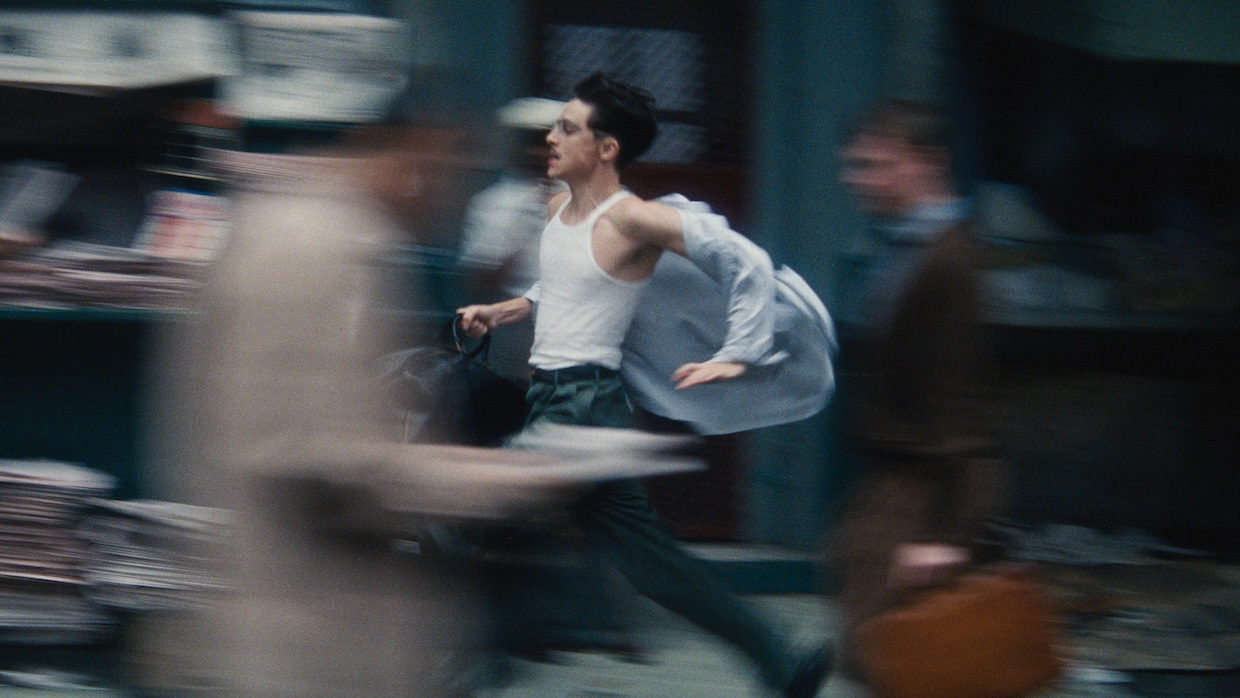 Timothée Chalamet in Marty Supreme
 Ronald Bronstein premiered his feature Frownland at South by Southwest the same year as Josh Safdie’s short We’re Going to the Zoo played, and he felt a pang of insecurity when he saw it. “I was like, ‘Oh, my God, there’s somebody also vying for the same kind of immediacy,” said the veteran writer-editor. “It was like my feet were made of lead; this guy was like a helium balloon.”
Back in New York City, Josh introduced himself to Bronstein and convinced him to play a character based on his own father. Bronstein helped write and edit the project, which became Daddy Longlegs, then went on to collaborate with the Safdie brothers on three subsequent features. On each, Bronstein primarily would write with Josh and edit with Benny, often alone in various projection booths while working as a freelance projectionist. Bronstein says, “When DCP first showed up, anybody with a functioning set of eyes and aesthetic standards knew that you were being sold a bill of goods. The quality loss was so apparent that it was impossible not to be infuriated by it. But as soon as I realized that I didn’t have to do changeovers—that I could hit ‘Start’ and have the next two hours to sink into my own work—all of those standards went out the window. Just goes to show how self-optimizing we all are at heart.”
Bronstein and Benny tended to divide up sequences and cut them separately; they only had the luxury to start editing side by side while working on Uncut Gems. Bronstein continued this practice on Marty Supreme, Josh’s first return to solo directing after an amicable creative split with his brother. Timothée Chalamet stars as Marty Mauser, a cocky ping pong player who embarks on a picaresque journey to become a world champion. “Josh and I have been trying to write a 90-minute movie for the entire duration of our relationship, and we just always have too much to say—and we’re maximalist in our approach,” Bronstein reflects. “In person, we tend to speak too much and figure out what we’re trying to say while we’re in the midst of saying it. You meet certain people and ask them a question, and you can just see little fasteners on their jaw pop one at a time; then, their mouths open up, and they articulate themselves with absolute precision. Josh and I aren’t like that.”
Bronstein explains, “Gems was the first time we had a work that was received on a larger scale, so when we sat down to start devising this one, it took a little bit of time and mental fortitude to not lean into expectations in order to meet them or deliberately shy away from them in attempt to showcase range, which is not something that Josh and I respect at all.” Episodic and digressive, Marty Supreme feels like a cinematic high-wire act centered upon a determined, albeit self-destructive man who can’t seem to get from point A to point B without multiple detours, and Bronstein acknowledges the structure is “bananas.” Of the film’s 150-minute runtime, the first 45 minutes follows the eponymous character “living in the future,” acting as though he’s made of Teflon, until repercussions begin to rear their ugly head. “He has no sense of consequences and comes back to New York, and all of a sudden, for the first time, something that you’ve seen him do earlier in the movie returns. It throws the entire narrative off course.” Much like earlier Safdie brothers films, Bronstein and Josh let the whims of a protagonist guide the film instead of the narrative, which forces them to focus on micro human choices at the expense of a predetermined framework. (“If you start a project with a character rather than a plot line, then the character is constantly going to thwart you.”) Hence, Marty Supreme is a coming-of-age story that feels like an epic mostly because of its controlled unpredictability.
Though Bronstein says that he and Josh “organize the material and tether it to a theme,” it’s still a mystery how they devised a structure as complicated as Marty Supreme’s in the editing room. Some of it manifests during the writing process, but it becomes more apparent as they’re building it in sequence, in which they see how “the pacing of the movie can fold in and out like an accordion. People assume that we cut fast, that there’s a lot of cuts, [but] I’m not a very cutty editor. I think that’s the easiest way for people to assume that’s generating the tension. It isn’t; it’s something else. It might have something to do with this attempt to make the viewer feel like they’re riding on the very tip of the crest of the wave of the movie, so that you can’t see one second ahead of you.”
Bronstein works very slowly, doesn’t assemble rough cuts and only shows Josh his material when it’s ready. Moreover, the two never have, and never will, make an assembly cut, preferring to start with the first scene without using the script as a reference. “Movies on this scale, by necessity, are shot out of sequence, which means when assemblies are built during production, the scenes are being constructed out of sequence. That causes me so much anxiety and also deprives me of having an understanding of how the pacing functions [and] how the emotionality of the work is developing.” For Bronstein, editing is “liberating” precisely because even though the script was the genesis of the material, there’s no obligation to adhere to the original conception of any scene. “When you have an assistant making an assembly for you,” he explains, “their only North Star will be the script. They don’t have the agency or authority to disrespect the writer, whereas Josh and I have the agency to disrespect ourselves as much as we want.”
Josh gravitates toward editing action-oriented scenes, while Bronstein prefers the “big, meaty dialogue exchanges,” which he treats like “little existential medieval duels, where you have two people with opposing viewpoints, usually with one of them humiliating the other.” It’s crucial the audience see every perspective without any of them canceling each other out. “Things are not shot like a documentary. There’s no attempt at objectivity—everybody gets their own shot, reverse shot and subjective eyeline, so there’s a lot of material. You’re rooted in Marty’s subjective viewpoint. He’s the clothesline that every idea in the movie is sort of hanging on. But [in] each exchange [he has], you’re looking to access the viewpoint of the person he’s interacting with and make sure that that viewpoint is felt equally. It’s almost like a weird Cubism.”
Bronstein stresses that editing for him is a private affair, “the great reward for all the hassles one has to contend with through collaboration.” At one point, he compares the process to “those obnoxious Magic Eye images from the ’90s,” where relaxing the focus of your eyes determined whether the image would turn from 2D to 3D. “But you never were quite sure how you managed to get into the 3D space, and it was a very fragile thing where you could get knocked out of it at any time. I look at editing in that way. It takes a certain amount of force to bring yourself to load up the hard drive, just because you feel like the stakes are going to be so huge. But once you get into that zone, if you can stay in it, it’s the deepest way that you can commune with the material, to the point that it always shocks me that any filmmaker would deprive themselves of the opportunity. Because even when you’re writing, you’re not free. You’re writing for production; you’re writing to execute, whereas [in] editing, it’s almost like looking at a stockpile of found footage, and now you can impose intentionality onto it. The goal is to try to figure out what your own psychic fingerprints are, what makes you separate from any other individual on the planet, then try to capture that in the work and not get in your own way.”