Back to selection
“We Will Be Passing Out Little NOT AI Buttons to Our Audiences”: Valerie Veatch on Her Sundance-premiering Ghost in the Machine
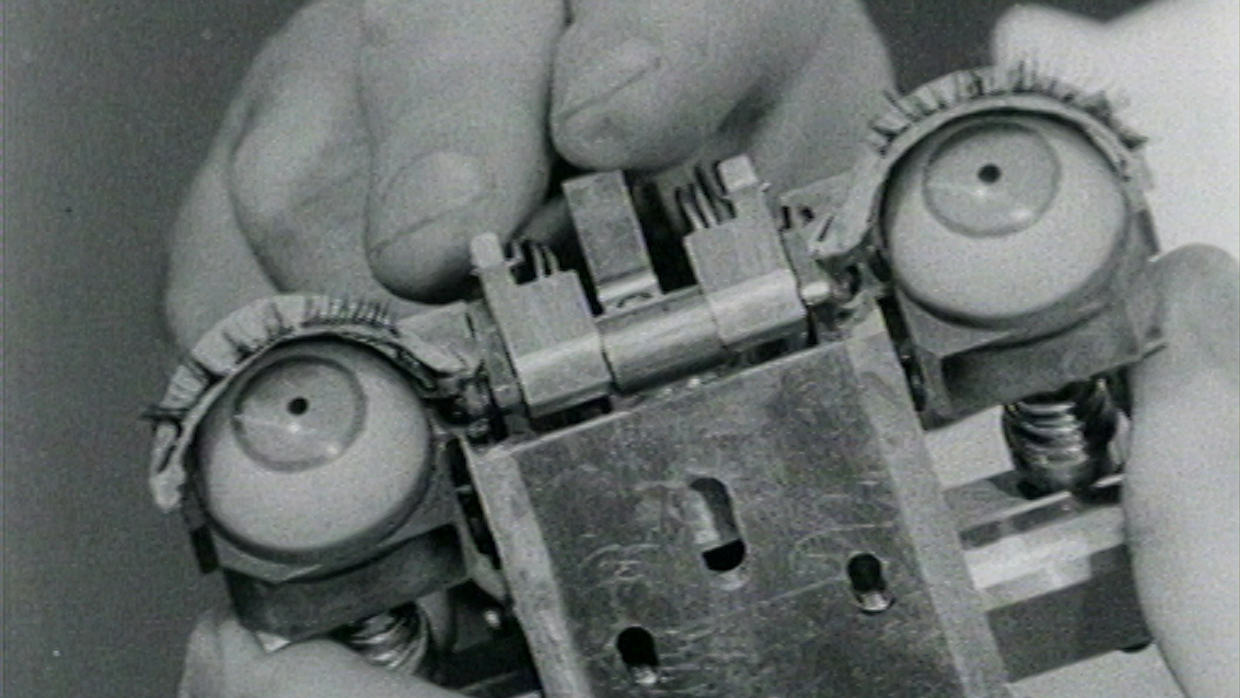 Ghost in the Machine, courtesy of Sundance Institute
 Until now, the Silicon Valley hype cycle has defined the terms of the artificial-intelligence debate, with advocates predicting universal affluence and the end of all diseases while critics worry that computers will steal not only our jobs but our creative pursuits too. Valerie Veatch’s Ghost in the Machine proposes a different possibility altogether: that “AI,” if you can even call it that, is just the latest in a long line of grift-y attempts by powerful, exclusionary white guys to remake the whole world in their own image. Connecting the dots between AI’s origins and such lamentable historical low points as the discredited racist eugenics movement of a century ago, and shining a light on the all-too-human work force grinding out content-moderation for dismal pay at the bottom of the AI stack, Ghost in the Machine argues that the only proper response to this would-be revolution is radical resistance.
Divided into eight hard-hitting chapters with provocative titles (“Chapter 8: Slopoganda”), set to a stirringly dystopian soundtrack, and filled with rapidly moving images that are helpfully labeled “AI” and “NOT AI” (one can’t help wishing some of it was in fact hallucinated), Ghost in the Machine enlists a wide array of speakers—from philosophers to linguists to critical thinkers—to take the air out of the AI hype machine, and sound the alarm about its creators’ objectives.
Just prior to the film’s Sundance debut in the NEXT section, Filmmaker interviewed Veatch, the film’s director, writer, producer, and EP, whose HBO docs Me at the Zoo (2012), co-directed with Chris Moukarbel, and Love Child (2014) likewise probed crucial friction points between society and technology.
Filmmaker: I know you’ve spent your career focused on the intersection of tech and society, but how exactly did this film originate? How much did you know about the darker aspects of AI history before starting production?
Veatch: Yes, my previous two Sundance documentaries examined what were new technologies at the time as they were becoming normalized. This subject is a useful way to explore what forces are shaping society, of locating power. With Ghost in the Machine the threads I pull at in my earlier work come together.
It was actually experimenting with AI generative tools in the creative process that provoked this film. I was kind of quietly living my life when my friend signed me up to be part of a volunteer “artist group” testing the technology for a large AI company; it was so fun to be a part of a Slack channel where other people were enthusiastically exploring their art. But then the darkness set in. Images and scenes generated by this technology (WIRED did wonderful coverage on this) were just awful: distressing and obvious racial biases, highly sexualized images of women out of context, unprompted. This creepy technology was being put forward as a “tool” for creatives, but nothing could be further from the truth. Generative AI is not cinema—the intentional production of images—but rather, as we learn in the film, the result of a technology built on extraction, exploitation, and control.
So it was this vast canyon between the rhetoric around so-called “AI” and the reality of “slop” that made me curious: who built this technology, and why? I learned so much making this film. And the more I followed the story the more I realized we must reframe our understanding of what big tech is up to, urgently.
Filmmaker: You interviewed dozens of academics specializing in a variety of disciplines, and of many nationalities, races and genders. So how did you find all these folks and choose who to ultimately include (and cut)? It seems the editing process might have been daunting.
Veatch: The most joyful and exciting part of this process for me has been uncovering this story with all the folks we see in the film – the passion for their work fueled my own. It felt so important to tell this story and connect these dots.
The journey, in retrospect, makes sense thematically, and it all unfolded organically. In my quest to understand how generative AI “creative tools” perpetuated such obvious and harmful biases I started reading white papers, looking at the footnotes, finding email addresses and cold calling people. I wasn’t sure if it would work to build a film out of web video interviews (I love how the style lends authenticity to the piece) and the efforts felt very much like painting a mural, and also investigative journalism. I’m so thankful to everyone in the film—it ended up being over 36 people—for taking the time to have thoughtful conversations over the internet at odd hours.
I didn’t have anyone sign a release before our interviews. I hadn’t made an “essay doc” before, and I was sensitive to the fact I was contextualizing other people’s ideas and research in the piece. I wanted them to be able to watch the finished film, see how their ideas are being used in the broader narrative, and then participate with full agency. I did this because there is a lot of nuance in the AI dialogue and I didn’t want to misrepresent anyone. I looked forward to any feedback.
Since I edit my own work I have immense flexibility and immediacy when sculpting a film. At the beginning of August I was staring down a timeline of nearly eight hours worth of really compelling selects. There is so much to this story when we look past the tech bro hype. I love the editing process, which is all-consuming, and I personally love watching the film.
Filmmaker: Could you talk a bit about the doc’s structure? Why the chapter format, and the captioning of “AI” and “NOT AI” on the images throughout? Were these decisions made early on?
Veatch: Over the last year the film hung over me like a feeling. I didn’t have a distinct idea of what narrative devices I would be using at the outset. For example, I narrate the film, albeit sparsely. Normally, putting any of myself in my documentaries about a subject matter like this is something I wouldn’t do. But using my voice in places allowed me to just move freely in an essay format.
The “three act structure” is a useful guide to structuring a story and feels kind of intuitive. I knew we would follow the journey of conflict and resolution. The eight chapters kind of drape around this abstracted three-act structure. It went from three sections, to five chapters, to eight chapters. They sort of formalized as the film’s edit was drawing to a close.
One of my favorite parts of the project is the NOT AI label. This was quite organic. Because the film was born out of my well-intentioned exploration into a new “creative technology” of generative AI, I wanted to use AI slop as a punch line in the film (yes, the film has a sense of humor). Like when people are talking about Superintelligence, cutting away to AI generated slop is funny. However, it wasn’t obvious to my family and friends watching the piece what was AI, so I thought, well, we shall label it. And nearly all of the film is NOT AI. I love as the storyline becomes more surreal, and the dystopic fantasies of the tech bros get more untethered, and the political realities feel more absurdist every day, the NOT AI reassures us that yes, this dystopia is real.
At Sundance and beyond we will be passing out little NOT AI buttons to our audiences. I love that this is kind of taking on its own meaning, that one could project whatever one might want onto this motif. For me personally as a filmmaker and artist, NOT AI is the rejection of the tech bro narrative of “technological optimism,” and a rejection of these generative AI systems as “creative tools.”
Filmmaker: I’m also curious to hear how the Silicon Valley contingent might respond to or refute this counter narrative to the AI origin story. Have you reached out to or heard from them?
Veatch: This film began because I was brushing up against what you call the Silicon Valley contingent through this volunteer artist group for one of the big AI companies. With pure intention I started asking questions around why outputs were so obviously socially problematic and how would we fix this. I was told engineers don’t prioritize social issues. When I pushed, I was met with total stonewalling and referred to a “third party DEI specialist who dealt with equity initiatives in tech.” As a filmmaker, I found this deeply insulting and was shocked to hear them characterize failures in their product as an “equity initiative in tech.”
The tech bro narrative and power structure, as we see in Ghost in the Machine, is ubiquitous. Their perspectives fill every page of our newspapers, our politicians breathlessly capitulate to them. If you look at Sundance this year, for example, almost every event is sponsored by a big tech company. There are so many panels celebrating how to integrate generative AI “tools” into our workflows. The sanctimonious exceptionalism of the tech industry—we should not regulate AI, we should not question the nonconsensual integration of AI into every piece of software—perpetuates their consolidation of power and I wouldn’t trust a story that featured their voices. If you look at the films around AI that feature the tech bros, their conclusions are “let the boys keep building their toys.” Our story cuts to the heart of this.
Filmmaker: In the end, the film struck me as both terrifying and hopeful—as many of the participants consider AI to be a whole lot of hype (down to the coining of the term). If we’re nowhere near an existential crisis, there’s still time to change the trajectory. What are your thoughts and perhaps prescriptions moving forward?
Veatch: Yes, you are totally right. This existential crisis is manufactured. What we see in Ghost in the Machine is that the dichotomy of “AI doomers vs. AI boomers” are two sides of the same coin that accept—laughably—that there is such a thing as Superintelligence or there is an inevitability to AI systems replacing humans. When we unpack this concept, it immediately disintegrates into a history of pseudoscience and fantasy.
The story we uncover in Ghost in the Machine is about power, and the way technological systems erode agency and also our ability to connect with each other and create solidarity. The antidote to this dystopia is to center communities on care. As basic as this sounds, if we can reframe our daily life, our communities, our politics—bringing care and community into the center of the frame—the rest falls into place. It’s not easy. It’s not glamorous. It’s the daily grind of being present and anchored in lived experience, of building connections and overcoming the lies perpetuated by big tech that have torn us apart.
As Jonathan Flowers says in our film: “The most radical thing you can do in the age of AI is say, ‘Why does this need AI?’ If you can’t answer the question, then it doesn’t need it. And you can refuse to use it when it is offered to you. Again and again. You can say, ‘This has no value here.’”