Back to selection
Talk Is Cheap: Radu Jude on Kontinental ’25
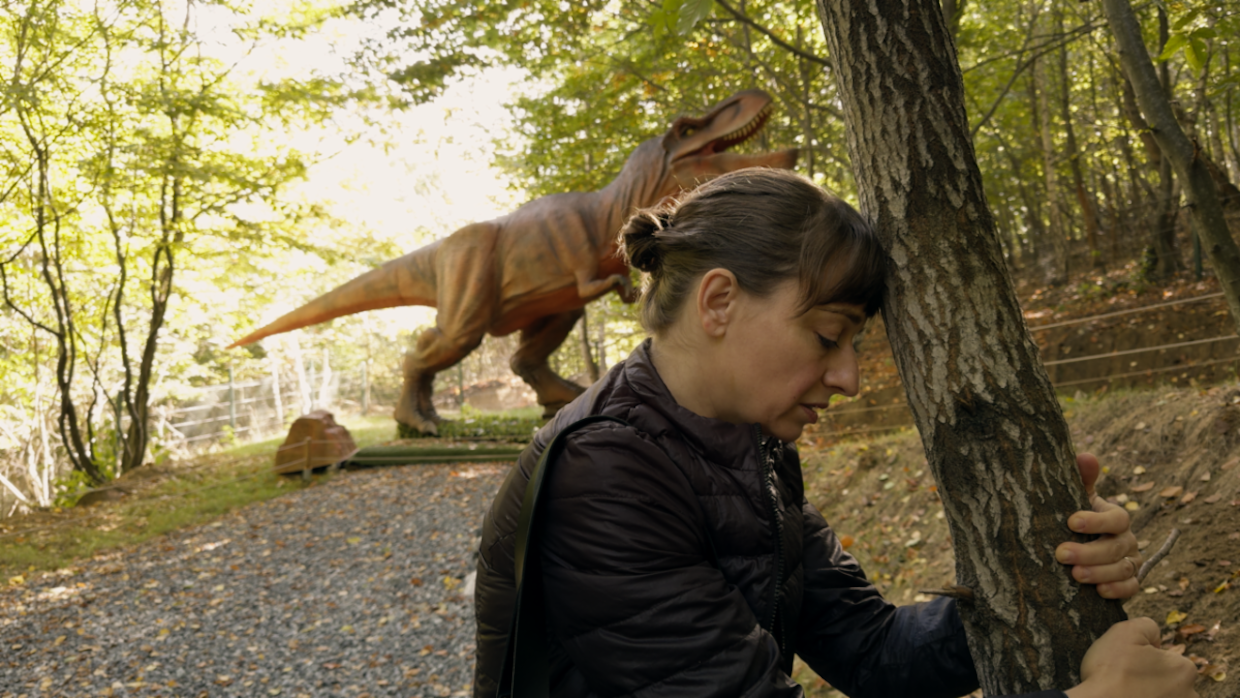 Kontinental '25
 From Pearl White’s Perils of Pauline to Antonioni’s aimless, quasi-somnambulant heroines, the wandering woman has a venerable history in cinema. The figure has given filmmakers a vehicle for formal experimentation and narrative risk and stories organized less around destination than duration, encounter, and drift.
With Kontinental ’25, Radu Jude continues his exploration of wandering women, this time through Orsolya (Eszter Tompa), a bailiff reeling after the suicide of her most recent evictee—a former athlete turned squatter living in abandoned buildings in the Romanian city of Cluj-Napoca. Guilt or shame? Humiliation or distress? Jude doesn’t delineate Orsolya’s feelings so much as show them exploding into a space oversaturated with competing claims to historical memory, language, and real estate. Orsolya recounts the eviction and death again and again, to friends, strangers, and authority figures alike, questioning what she should or shouldn’t have done. Yet, she seems less concerned with truth-telling than with history-telling—hoping, perhaps, that truth might slip through the cracks.
Kontinental ’25, it should be noted, is Jude’s tenth narrative feature. His filmography spans twenty years, including a mix of fiction and documentary (sometimes both at the same time), and he’s probably best known for 2021’s Bad Luck Banging or Loony Porn, for which he received the Golden Bear at the Berlin International Film Festival. It’s a body of work that bungles whatever notions Anglo-American cinephiles might have about Romanian cinema: unlike his forebears in the so-called Romanian New Wave of the 2000s and 2010s, Jude’s Romania is less a historical or psychic dilemma with complicated, maddening recursions than it is a living, breathing body that’s been badly mistaken for a corpse, splayed out on an operating table and cut open for further study.
Jude spoke with me about these questions with his characteristic blend of formal intelligence and playful insouciance, and about the strange economy of contemporary filmmaking, where words are cheap, images are overproduced, and reception often arrives faster than reflection. He remains, I think, one of our most gifted chroniclers of the hyperkinetic junkspace of twenty-first century experience: a filmmaker whose work feels at once unsettling, destabilizing, and unmistakably alive.
Ricky D’Ambrose (RD): I’m curious about the origins of Kontinental ’25—and whether you see affinities with Do Not Expect Too Much from the End of the World. I heard you on Nic Rapold’s podcast discussing how you approached the Dracula source material, and it made me wonder [whether] Kontinental ’25 bridges those two films. It even feels like a vampire film in some conceptual way—not literally, but in its atmosphere.
Radu Jude: That’s an interesting way to see it. I hadn’t thought of it like that.
To answer part of your question: the connection between the films was mostly pragmatic. I made them back-to-back, with the same actors and largely the same crew, in the same period. There wasn’t a conscious intention to create thematic continuity or conceptual bridges between them—or with my earlier films.
Of course, connections inevitably appear, but they weren’t planned. I lived for several months outside Romania—seven months in Berlin, on a grant. I liked it there a lot, but I didn’t really understand Germany. What I did understand, through distance, was Romania.
Romania is still largely unknown—especially to Americans. It’s a small Eastern European country with a very specific history: fascist dictatorships, then a brutal communist regime, followed by a rapid transition into neoliberal capitalism without much social protection. All of this creates a very particular mix—political, economic, historical—that produces strong stories.
In a strange way, when I look at the United States today, despite the difference in scale, I sometimes feel something similar. Watching what the Trump era has produced—it’s terrible for everyday life, I imagine—but also strangely compelling to analyze, to interrogate. I don’t know if that resonates for you.
RD: It does. Watching your films as an American can feel like receiving dispatches from the near future. We don’t have the same historical layering of regimes, but lately, there’s been an intensifying dissonance—hyperactive nationalism, incompatible ideas forced together, things that once felt mutually exclusive.
In Kontinental ’25, we follow a woman—she’s Hungarian, living in Romania—
Radu Jude: Yes, she’s ethnically Hungarian but a Romanian citizen.
RD: —who’s dealing with intense guilt over the death of a homeless man she was trying to help in her job as a bureaucrat.
Watching her move through the film reminded me of Cléo from 5 to 7. But instead of waiting for medical results, she goes from person to person—friends, a priest, strangers—and each offers her a different explanation, a different moral diagnosis. None of them provide real comfort. It all feels like attempts at pacification.
Could you talk about this structure—the movement through encounters, stories, explanations that never quite satisfy?
Radu Jude: I think that’s a very accurate reading—and I like the Cléo comparison a lot. I’ll borrow that.
The film is built around two relatively simple ideas. One is that it’s a film about language—about words. Language doesn’t just describe the world; it offers comfort. It gives us frameworks, excuses, moral explanations.
When we face a problem—especially a moral one—we talk. We talk to others, to ourselves, to therapists, priests, friends, lovers. Romania has only recently embraced therapy as a cultural practice, but the impulse is universal.
Cinema is usually thought of as a medium of images, and words are often treated as secondary or even undesirable. I wanted to make a film where words were the main material—where language itself became the subject. That idea was influenced, indirectly, by Victor Klemperer’s book Language of the Third Reich. Do you know it?
RD: I know Klemperer—his diaries—but not that book specifically.
Radu Jude: He was a Jewish German philologist who survived the Nazi period because he had [scare quotes] an Aryan wife. He paid obsessive attention to how language shifts under ideology—how words acquire new meanings. I always say this book should be required reading for screenwriters.
There’s a story about Nazi propaganda putting quotation marks around “foreign” things—foreign politicians, even foreign cats. Only German cats were real cats. That idea stayed with me. In the film, the protagonist tells the same story repeatedly, but slightly differently each time. The wording changes, the emphasis shifts. Synonyms are never truly identical. Each retelling subtly alters meaning.
And there was also a practical reason: words are free. You can use one word or a million—they cost nothing. So, I decided to treat language as the film’s special effect.
RD: Words as special effects.
Radu Jude: Exactly.
RD: Was Klemperer something you were reading while writing the film, or did it surface afterward?
Radu Jude: It was more of a coincidence. The idea for the film goes back more than 10 years. It started with a short news item. I once developed it as a one-page proposal for HBO Romania, but the project never happened.
Every few years, I’d return to it, then abandon it again. Eventually, it felt like the right moment—because real estate, gentrification, corporate power, and local political corruption had intensified dramatically. These forces now shape cities everywhere.
That’s when I also became more aware of Cluj, where the film is set. It’s Romania’s second city—often called the Romanian Silicon Valley—wealthy, rapidly developing, extremely expensive, with poorly planned expansion into the suburbs. I teach there periodically, at a small film school, and over time I came to understand the city’s contradictions. All of that pushed me to finally make the film.
RD: Your work has evolved considerably over the years—from more classical narrative structures to something more experimental and essayistic. How do you think about that evolution? What’s driven the changes in your approach?
Radu Jude: I’m constantly thinking about what I’ve made, what I’m doing, what I want to do, and also the more uncomfortable questions: why, for whom, and what’s the use?
The changes in my work are tied to personal circumstances but also to my relationship with what I hesitate to call an “industry” in Romania—just the environment, the conditions around filmmaking.
For example, I wasn’t accepted into film school many times. So, I started out working as an assistant director—often on big American and European productions that came to Romania, and also commercials. At first, I wanted to become a “professional filmmaker” in the classical sense: to know everything—to light a shot, use equipment, run a set with 200 extras, all of that.
But gradually—through making my own films, and through being exposed to more information—my perspective shifted. Romania, after the revolution, was still very isolated, and to some extent it still is. There aren’t major exhibitions. There are translations, but not enough. Public libraries aren’t well stocked. Culturally, it’s an isolated place.
Without the internet, I don’t think we’d even be having this conversation—not just technologically, but in terms of access to the same films and books. The internet changed everything.
So, discovering the avant-gardes, independent cinema, and younger filmmakers—your work, Ted Fendt, others—was crucial. I remember being shocked when I saw your first feature. I think I read an interview where you said you made it in under a month, and I thought, how is that possible?
RD: A couple of weeks.
Radu Jude: A couple of weeks. And I thought, an American makes a film like that, while in Romania we still want big budgets. But it takes time to absorb all of this. It doesn’t change you overnight. It’s a long process—personal, professional, and informational.
RD: This conversation will run in Filmmaker magazine, which has a readership of filmmakers. I’m asking partly because I’ve experienced this tension myself—the way recognition can create its own paralysis—but I’m curious how you arrived at the stance of being “protected by the work.” It feels especially important in a medium where response can be so totalizing.
Radu Jude: It’s a crucial question. In all the arts, but especially in cinema—because filmmaking is organized in such a stupid way—the reception is rarely useful. Films are received in these extreme, black-and-white terms that don’t allow a person to grow.
I’m always amazed by how cinema works: someone makes one film, and the next morning they’re called a master, a genius. That doesn’t happen in painting or poetry or theater. But in cinema, it happens every week: a new genius appears, and then a year or two later, after the second film, people say “we were wrong.”
It’s childish and neurotic. I understood this very early—at least intuitively. Not having success is a problem; having success is another problem. They’re linked. Of course, without recognition it can be psychologically—and economically—very hard to keep working. And if you have a lot of success, other dangers appear. I’ve seen people damaged by both extremes.
I learned this when I was young, working as an assistant director. I encountered many directors—Romanian and foreign, famous and not famous. I watched what these pressures did to people and promised myself: I have to be as stoic as possible. Not fooled by success, not crushed by failure. That’s easy to say, but very hard psychologically.
Years ago, something happened that helped. I was shooting I Do Not Care If We Go Down in History as Barbarians—in 2018, around when we first met—and during that shoot an earlier essay film, The Dead Nation, was premiering at Locarno. I stopped filming for three days, went to the festival, came back, and then for a month I didn’t even read the reviews.
By the time I started hearing reactions, I was already editing the next film. And suddenly, the pressure felt smaller. My psychological reaction was less intense. I thought, if I can premiere a film while I’m already shooting or preparing another, that would protect me.
And it happened again. Recently, I was shooting a film between France and Romania—produced by Saïd Ben Saïd—while Dracula was being released in the [United States] and Romania. The reception was mixed, to say the least—especially in Romania, where it was more negative. But I was away shooting the next film, and in that sense, I didn’t care as much.
Part of this also comes from my models. I discovered the avant-gardes late, but once I did—John Cage, Jonas Mekas, Andy Warhol—they became like gods to me. And you learn from them not only aesthetically, but in attitude. Cage says something like, if nobody hates what I’m doing, something is wrong. You acquire that taste over time. It’s tricky, of course. But as long as I can work, I feel protected by the work itself.
RD: You mentioned Warhol earlier, and watching Kontinental ’25 I kept thinking about him in a way I never have with your other films. I’m trying to figure out why.
Maybe, it’s the fixed frame—that’s the obvious connection. But there’s also a pop art–ease in the film: pop culture simply exists inside it. The McDonald’s “I’m lovin’ it” ad on the TV. The signage—Luxor Real Estate. The detritus of the economy intruding everywhere.
It’s so cold and alien next to this woman’s inner crisis that it becomes funny. The film has a lot of humor because of that.
Radu Jude: I agree. And there’s something else—less visible—but related to what we were talking about earlier: method, speed, and the acceptance of error.
RD: Is that something you’ve carried into Kontinental ’25 specifically? Accepting what might have felt like errors or limitations?
Radu Jude: One of Warhol’s great lessons—beyond his films—is that if something went wrong, he often didn’t reshoot. He didn’t repaint. He didn’t correct. He left it as it was. That takes a lot of guts.
Thom Andersen has an essay—I’m paraphrasing, not quoting exactly—about how nobody can resist the urge to improve, to refine. Warhol resisted it. He could leave something dumb or fragile in its first form. Not even I can do it like Warhol—I didn’t make a Warhol film. But there’s something in his acceptance of errors and failures that feeds you.
RD: Warhol and Cage both come to prominence in the 1960s—happenings, chance operations. There’s a sensibility running through your work that feels connected to that period: the idea that a movie could be, in part, a chance operation. You can script it, cast actors, make decisions—but still allow chance.
It’s also interesting that today we have more tools than ever to make inexpensive movies, and yet people seem more committed than ever to polish—Instagram, influencer culture. The tools are cheap, but everyone wants the result to look bigger than it is.
Radu Jude: Yes. You have more tools and more outlets, but because it’s so easy now, and there’s so much content, I think the ambition shifts.
I see this with students where I teach. For my generation, the crucial question was, will I be able to make a film at all? Can I find funding, equipment, actors—can I make even a short? We didn’t even dream of features.
For students now, that question barely exists. They can make a film. So, their question becomes, will this film get into Cannes, Berlin, Venice? Otherwise, why do it? For us—and maybe for you, too—the [answer] was simply, make something and then see if anyone responds.
Now, people think, I can make a film anytime. So why make one unless it’s going somewhere?
RD: You can write a poem anytime, but you don’t need money to write a poem.
Radu Jude: True. But you can make a one-minute film on your phone.
RD: Sure. But a feature still involves labor—people should be paid.
Radu Jude: Of course. I’m not saying it’s easy. But I was so moved by Notes on an Appearance—the intelligence of the spaces, the subway map, the newspaper layouts. I thought, if you really want to do something, you find a way.
RD: You find a way.
Radu Jude: And that way can be more interesting. Instead of filming in the subway, you show a map. I’ve never been to the [United States], but I feel like I know the New York subway by heart—and it was much more interesting to see it that way.
RD: Since you brought up Notes on an Appearance: when I was trying to get it made, a producer read the script and immediately budgeted it as though every transition required an apparatus—car rigs, permits, the whole thing. The film ended up costing about $20,000 precisely because we kept asking, “what’s the simplest way to convey this?” A subway map and the sound of a train can do the job.
Radu Jude: Yes—but maybe he was smarter than you. If he gets half a million, the money comes back. People are impressed by budgets.
RD: They are. The next film should just be a budget. Film a budget.
Radu Jude: Why not?