Back to selection
Facing the Music: David Lowery and Chloé Zhao Dig Into Mother Mary
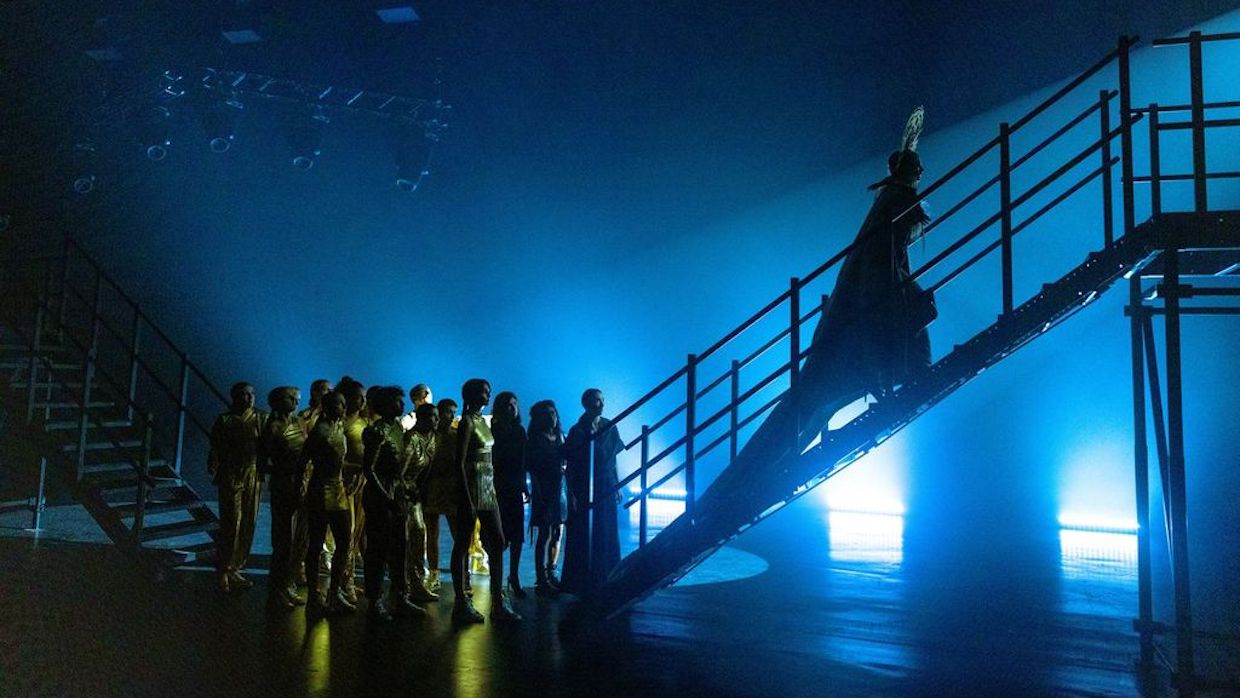 Mother Mary, photo by Eric Zachanowich
 David Lowery and Chloé Zhao have been friends and collaborators since January 2012, when they met as fellows in the annual Sundance Screenwriters Lab. In the years since, both directors have found artistic and commercial success. Much as Zhao has alternated between Nomadland and Hamnet on one hand and The Eternals on the other, Lowery has given us deeply personal films like The Green Knight as well as mainstream fare like Peter Pan & Wendy. In fact, it’s the delta between those two approaches to filmmaking, and the identity questions that arose while switching between them, that inspired his latest film. In Mother Mary, Anne Hathaway plays the title role, a pop star trying to reconnect with her own artistic identity and with an old friend and collaborator she has betrayed. That would be Sam, portrayed by Michaela Coel, a costume designer who has retreated to her spacious estate in London to mourn her expulsion from Mother Mary’s world. As the film proceeds from naturalistic drama to supernatural intrigue, an apparition known in the script as the Red Woman comes to light, representing the “spooky action at a distance” that characterizes Mary and Sam’s fraught but inexorably entwined relationship.
Zhao and Lowery spoke on the phone a few days before the Oscars, where Hamnet’s Jessie Buckley took home best actress and Lowery and Zhao’s Sundance Labs classmate Ryan Coogler won the Oscar for best original screenplay.
Zhao: Congratulations! I’m really happy the world is getting to see this film. I saw it alone in the dark in London, and I had quite a profound, almost transcendental experience. When I met you after, and we had to go out into the streets of Soho, it was almost as if I’d just come through a ceremony, and I wanted to talk about everything at once. I’m glad we had time at the vegan restaurant afterward to process it all. Some time has passed now, and we’ve had more conversations. How are you sitting with it?
Lowery: I’m excited for the world to see it. That conversation we had after that screening was one of the first times I actually spoke with anyone about the finished film in a context that wasn’t about “how can we make the pace quicker?” or “how can we make it more commercial?” It had been such an intense experience making the movie that I hadn’t taken a moment to step back and think about where it had come from, how it had changed, how it changed me. Now that the film is done and about to enter the world and become detached from me, these are all things I’m trying to wrap my head and heart around in a way I haven’t had much of a chance to do until now.
Zhao: You’re in that integration period now. The ceremony has ended. I think filmmakers should be given a great deal of grace when asked to speak about a film at this point in its existence because we’re still learning what it is we’ve made—right alongside the audience.
Lowery: Absolutely. There are things I can talk about, things I know I was trying to do. And yet, there’s so much I’m going to discover in the weeks and months and years ahead. I know this now from experience. You learn so much about a movie from both the audience who sees it and from the time that passes and the distance that grows.
Zhao: I think that’s especially true when an artist makes a film about an artist, which you and I both did. There’s a good chance it’s because we’re questioning something within ourselves. You told me at a Halloween party, when I first saw some footage long before I saw the finished film, that the initial idea was a two-hander in a room—a kind of conversation between two versions of yourself. Can you talk about the origin story? Because it clearly came out of questions you were asking internally.
Lowery: It’s not uncommon for anyone in any line of work to question whether they’ve made the right choices in their life. But when we as filmmakers are committing these big chunks of time to self-expression, and then you look at what you’ve expressed, you wonder if you’re using the right language, if you’re communicating as lucidly as you’d like. In my case, I can pinpoint it to almost the exact date. It was 2019, nearly seven years ago. I was making The Green Knight, which was a very specific type of movie that felt very true to me, but it was also a very difficult production. I was coming home from set worn out and exhausted one day and had to jump on a call about the film I was supposed to make next: Peter Pan & Wendy for Disney.
The cognitive dissonance of moving from the world of The Green Knight into the world of Peter Pan was really making me question my choices as a filmmaker. I felt this need to figure out a way to embrace both aspects of my personality, that they could make such different pictures. Looking back now, they don’t feel that different. But in that moment, I just thought: I don’t know which part of me is really me. I don’t know who David Lowery is anymore. So, I started writing a dialogue between the part of me that could make Disney movies and the part of me that could make The Green Knight. It sounds reductive to say it that way because of course I can make both. I love all forms of cinema. But in that moment, I was confused, and that confusion—my search for clarity—became the early pages of the screenplay.
Zhao: I understand that on a very personal level. For me, it was Eternals alongside Nomadland. They seemed to contradict each other, and there’s so much polarizing energy between them. But they both exist within us, and that tension is very uncomfortable. So, of course, we make a film about an artist to explore it. What I find is that, because it comes from such a raw and truthful place, from a place where you have no choice but to make it, the characters feel both archetypal and deeply nuanced. Your two main characters, Mother Mary and Sam, feel like two archetypes within your own psyche. At what point did you start thinking about actors?
Lowery: I wasn’t thinking about actors while I was writing. I was thinking about archetypes that exist in the world the movie takes place in: the pop star, the designer. There are large, emblematic personalities in both those fields I could look to for inspiration. But it was genuinely challenging to even consider casting, because these characters needed to exist as both archetypes and fully developed human beings who were separate from myself.
One of the great things about casting is the metatextual quality of the process: when you cast an actor, you’re casting them to play a part, but you also have access to their entire body of work, and you can choose to lean into that or turn away from it. With Mother Mary in particular, I felt we needed to lean into that metatextual aspect—to find a performer who could bring with her that degree of celebrity, that degree of pop cultural presence, and let it do much of the heavy lifting. Of course, she also had to be able to sing, to dance, to hold her own in what is essentially a two-hander over two hours in one very restrictive location. All of those things factored in, but leaning into that meta quality really focused the search.
Zhao: What about Sam?
Lowery: Sam was in some ways much easier to cast because she is more directly me, much more representative of my current disposition. When I was writing her, you know how you’re in a conversation with someone and you think of exactly the right thing to say five minutes after you’ve parted ways? I was giving myself the freedom with Sam to say exactly what I always wish I could say in the moment. I met Michaela in October of 2022, and I was already a huge fan. I was starstruck, honestly, because I was such an admirer of I May Destroy You. Her writing is some of the great writing of our generation. So, to know she had read my script and saw something of value in it was humbling. But when we met, the rapport was instantaneous. I could just hear her saying these words. The language I’d written for myself seemed like it would come naturally to her. Interestingly, when we first met, we didn’t talk about which part she would play. I’d sent the script before we’d cast Annie [Hathaway], and that in-between stage just allowed us to talk about the script and both characters. But something about the language made it very clear. She speaks in a very writerly fashion, uses exactly the right words at exactly the right time. She knows how to deploy language as a weapon and as a suit of armor in equal measure. And she knows how to make written language sound like it’s coming off the cuff.
Zhao: The chemistry between the two of them is extraordinary. How did you work with them, especially given you went in without a chemistry read?
Lowery: I’ve never actually had the opportunity to do a chemistry read, so you’re plunging in blind. But I felt that no matter what their chemistry was, it would work for this film. It’s an unpredictable pairing in so many ways, and yet I felt that added a layer of history to their relationship that could go unspoken but be incredibly profound. The parts were written in such a way that it gave me the luxury of trust. I didn’t need to know what the chemistry would be. I knew that it would exist in some shape or form. What I can say now is that it was a day-by-day process. We learned who these characters were, how we saw each other. I’m including myself in that. Even though it was just the two of them on screen together, it very much was a process amongst all three of us to learn who we all were.
Zhao: It’s almost painful how present you have to be for that process. You can’t control it. You have to stay present to whatever comes and hold it on a daily basis. And that’s why it translates onto the screen. It feels so alive. You’ve talked about directing as a physical act.
Lowery: I have to hold all of those emotions and be open to them. The best way for me to do that is to be physically present in the scene with the actors, just off camera, so I feel as if I’m a participant engaging with them every step of the way. That usually manifests as me contorting myself into weird positions on the floor next to the camera, feeling everything that’s happening. My entire body is tense in the strangest ways. After a day of shooting I am physically exhausted, even though I haven’t actually done that much.
Zhao: I believe firmly that a director should work not just from their logical mind but from their subconscious. Their body is giving them answers because they’re feeling what the audience will hopefully feel in the moment. That’s why your films always feel ceremonial to me when I watch them. A ceremony requires the shaman to be co-creating, fully participating. Which leads me to something I’ve been wanting to ask about. Talk to me about quantum entanglement as a framework for this film.
Lowery: Quantum entanglement is one of the most incredible aspects of our universe and also one of the best metaphors for relationships. It’s remarkable how many potent metaphors exist in the quantum realm—how we can take these truly mind-bending, paradoxical facets of existence and use them to understand aspects of ourselves and the way we engage with others. Sometimes, when you have a relationship that could be described as symbiotic or codependent or star-crossed—all of those things are spooky, in the scientific sense of the word. As someone who was raised very Catholic and whose faith began to lapse, I found that all the wonder and awe that had existed in the ceremony and rituals of my religious upbringing got supplanted by awe of the natural world—all of its mysteries and paradoxes, which are just as extraordinary and sometimes more so. Quantum physics gave me that.
I’m getting softer as I get older. I used to be a militant atheist. I still wouldn’t prescribe any one belief to myself, but I’ve grown gentler about how the mysteries of the world might work. I trust the scientific inquiry, and I love the way scientific inquiry can mirror emotional inquiry. So, when I was writing this script and using it as a repository for everything I was interested in, quantum physics fell into it very quickly. There was originally quite a bit more of it, entire acts of the movie that eventually fell away. Even in what we shot, there was far more about quantum mechanics that we filmed and ultimately cut. One of the best notes I received late in the process was from my wife, Augustine. We’d filmed the movie in two chunks, and in the first leg we shot all this material about spooky action and quantum entanglement. The characters talk about it at great length. When Augustine saw the cut all together, she said, “I don’t think you need to explain quantum mechanics and spooky action quite so much because the movie is demonstrating it.” That allowed me to let go of some dialogue I genuinely loved but realized was redundant in the face of what the film was actually doing.
Zhao: She’s right. When I walked away from that screening and we got to the restaurant, I was talking about the collective unconscious. By taking out the explicit references, you give it a wink. But more important, you allow people to apply their own container to it. Science is the new mysticism, in a way. Science is somehow proving to us that the mystery exists. When I watch your films, particularly this one, there are moments where I feel something that’s hard to explain. It’s something I recognize, something very old that’s in my own psyche. It evokes a moment of enchantment that I might have lost in my more logical way of thinking about relationships. How do you balance the logical and the mysterious? Is it in the writing, the edit, or something you discover along the way?
Lowery: It’s something I tried not to think too much about because I felt that, if I did, I would lose access to whatever depth I was trying to plumb. There’s a point in this movie where the objective reality of the words begins to fall away and can no longer suffice. Sometimes, I was aware of that turning point in the screenplay. There came a moment in the script where I realized the characters could no longer talk about what they were talking about, that words could no longer express what needed to be expressed.
When we were actually on set it was harder to find. The first fifteen or twenty days of the shoot were entirely in sequence, and it was very easy to fall into the rhythms of the dialogue and accept that that was enough. We had a path and a map, and we knew what we were doing. The second we started shooting out of sequence, jumping ahead on that path, getting lost without the map, we had to tap into something deeper. We often didn’t know what we were doing, and we were frequently lost. It was scary and confusing. But out of that confusion, something—a strange truth—began to emerge. I didn’t necessarily know it at the time, but in the edit I could see it. I could see the way in which that uncertainty gave way to honesty, both in the performances and in the filmmaking itself. It also gave me permission to walk out of a very literal room and enter something more subjective. That was built into the movie from the beginning, but I had almost forgotten about it.
Zhao: I feel so much of what you’re saying. For anyone who’s been through some kind of guided ceremony, the first 15 or 20 minutes, you’re holding on for dear life because you’re clinging to your logical way of being. And then, as it starts to unravel you, the things you didn’t know were there start to come up. I was feeling that as your film progressed, both in myself and on screen. The film itself started to have a conversation with the mystery, and your actors, the design, the camera—everything started to help the audience transition the way your characters do. And then it builds to a moment of catharsis. But first, you have to kind of die.
Lowery: It’s funny. I hadn’t thought about it in those terms, but that’s literally what happened, both in the making of the movie and in the experience of watching it. So much of what the film was meant to do, we had to live through ourselves. We couldn’t just represent the journey. We had to take it.
Zhao: Which gets us to the music. “The sacred and the profane”—that phrase in the press notes jumped out at me. Talk about the playlist, and how music functions in this film.
Lowery: The combination of the sacred and the profane has been part of pop music for as long as I can remember. I grew up in the ’80s when Madonna was my parents’ worst nightmare. She was taking all this iconography my family took very seriously and, from their perspective, perverting it. But I think what she was actually doing was recontextualizing it. There are so many parallels between pop iconography and religious iconography that go beyond just appropriating a name or an image. When you go to church and when you go to a concert, they are, at their best, very similar experiences. When a song manages to pierce the somewhat critical membrane I sometimes surround myself with and makes me want to move—that’s a profound experience.
So when I was conceiving of this film, part of it was that I genuinely love pop music, and I love the idea of combining this very serious and esoteric artistic inquiry with the most open and directly accessible form of expression. There was also a very specific moment. While we were making The Green Knight in Ireland, we were staying at the same hotel in Wicklow where Ariana Grande was staying during her Dublin shows. That hotel was haunted. None of us could sleep, it had such a strange energy. And I just started thinking: what is it like to be up all night in a haunted hotel and then have to go on stage in front of a hundred thousand people the next day? That funny little detail was also an influence.
When it came to the actual music, there was what I listened to while writing, which existed in the tonal register of the film, and then there was what I wanted Mother Mary to perform, which had to be different. She couldn’t be singing songs that sounded like the movie, or she would negate the purpose of the film. So, Annie [Hathaway] and I talked a lot about finding musical common ground: let’s find the artists who speak to both of us and build a library of reference that we can turn to as we figure out who Mother Mary is. We brought in Jack Antonoff and Charli XCX, two of the greatest minds in pop music. FKA Twigs came in and helped us as well, who is more representative of the tone of the movie. Creating a pop star from scratch is not for the faint of heart. We took every bit of extra time and put it all toward deepening our understanding of who Mother Mary is and what type of songs she sings. By the end of it, Annie and I were writing lyrics ourselves because we knew there were specific things we needed in there.
One thing I love about pop music is that it can take the worst day of your life, the worst feeling you’ve ever had, the most heartbreak you’ve ever experienced and turn it into something beautiful, cathartic, joyous, and communal. I wanted this movie to represent that. I wanted it to be about taking something terrible and turning it into something beautiful.
Zhao: That makes me emotional because for an artist to do that—to get to that point—it’s almost like a sacrifice is required. And you really see that in both of the characters. Their friendship, the loss of it, that yearning they have for each other—that emptiness became the sacrifice the alchemical process needed for the transformation. Wouldn’t you say?
Lowery: I think so. And there’s always the question, at the end of the day: was it worth it? Absolutely. But it’s interesting: do the hurt feelings come first or the art that emerges from them? And then the art that helps heal those hurt feelings? It’s a cyclical process. I’m still figuring out at what point I slipped into this particular cycle.
Zhao: Before we run out of time, let’s talk about the Red Woman: the design, the technical choices. And I loved what you told me after the screening about Jung’s Red Book.
Lowery: The design of the Red Woman is something I could talk about all day. After you first saw the film and you told me about Jung’s Red Book, which I was vaguely aware of but had never actually looked at, I bought it and found a passage that described almost exactly what I was trying to evoke with that spirit. I was trying to tap into something elemental. I didn’t want a familiar version of a ghost or an apparition. In the script, she’s simply described as the Red Woman because she is part of both Sam and Mother Mary. She was meant to evoke both of them visually. But once I started to think seriously about what that would mean in front of a camera, I realized we needed to break down our assumptions of what a phantom even needs to be.
We did some early concept art that told me we were going down the wrong path. To get back on the right one, I started looking at art. I got a bunch of modeling clay and started making sculptures. I worked with Bina [Daigeler], our costume designer, who came up with incredible costumes and puppets and strange combinations of the two. And Annell Brodeur, who built the ghost for A Ghost Story, was also building puppets based on my clay sculptures. When the Red Woman first appears in Sam’s room as a mess of fabric on the floor, that’s a rod puppet Annell built. But I knew it needed to become something more. Like the songs, it needed to take something painful and unpleasant and transmogrify it into something beautiful.
In pursuit of that beauty, I discovered an artist named Daniel Zel, who works in Brooklyn. His medium is wind and fabric. Because Sam works with fabric, it instantly felt right. This is what a spirit born from her would look like, taking the form of the medium she uses to express herself. We brought him on board and created a ghost made of various types of red fabric choreographed with wind. He has a very proprietary system, very simple, involving the passage of air through fabric. We spent four days filming this fabric moving through the breeze, working from storyboards but also just experimenting, as if it were a chemical process, seeing what forms of expression emerged when we introduced wind to this very specific type of red fabric. And out of that, the character was born. She’s never one thing. She’s always changing form. She’s like liquid, constantly going through permutations. I felt that was the perfect way to represent a ghost that doesn’t yet know how to find its true form. In a way, she represents the entire process of making the movie. The entire film could be summed up in what we were trying to do with that ghost.
Zhao: It’s the intangible—what we’re even trying to do in this conversation. And of course, it’s red. There’s so much you can attach to that color: the prima materia, the color of blood, the color of love. The way it interacts with the characters, the way it functions within the ceremony of your film. Each character, each audience member interprets it as their own truth. That’s what goes through the ceremony.
Lowery: Completely. And thank you for helping me continue to learn what it is I was after. I’m still figuring it out. But conversations like this are how I get there.