Back to selection
Point of No Return: Digital Nostalgia in Backrooms
 Backrooms (2026)
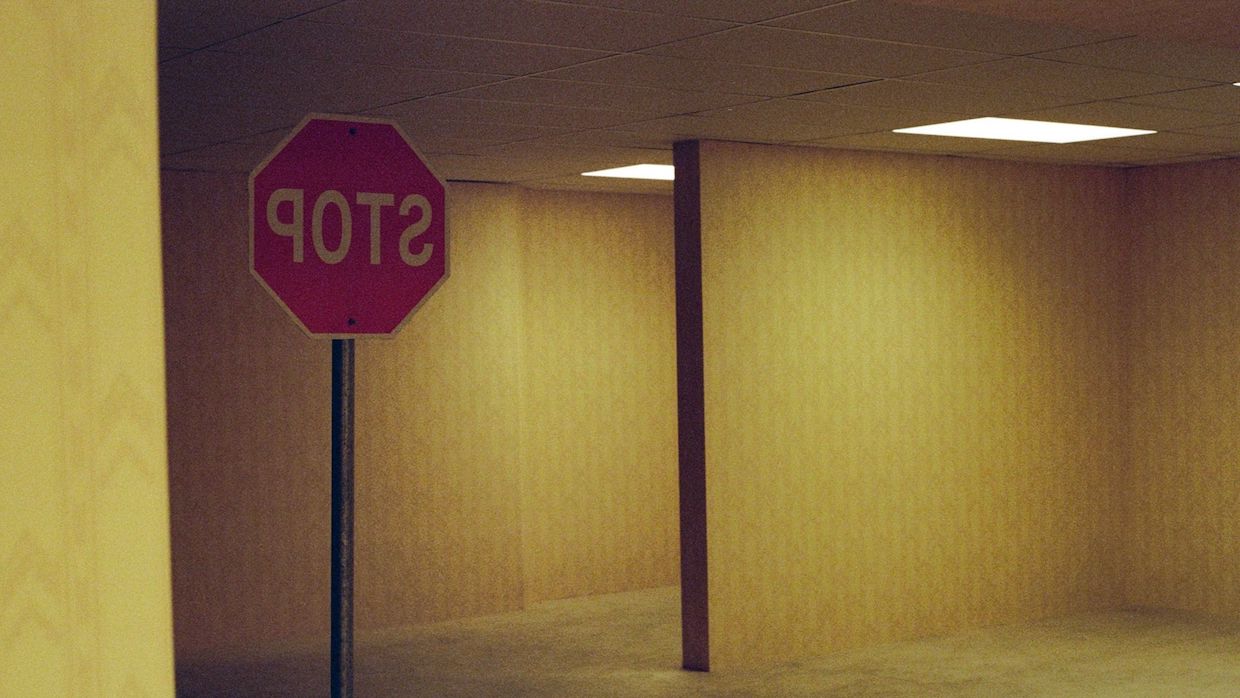
 Like the internet lore for which it is named, Backrooms (2026) encapsulates a paradox of embodiment and time. Kane Parsons’s feature film—an adaptation of his cult YouTube series of the same title—has its origins in a photograph of a former furniture store undergoing renovations in Oshkosh, Wisconsin, taken in 2003 and uploaded to 4chan in 2019. This unlikely source became the starting point for a diffuse, Lovecraftian latticework of anonymous mythmaking and creepypasta, whose locus eventually migrated to Reddit, where it split into separate communities of originalists and revisionists. Their prolific output is a striking example of hypermodern digital creativity predicated on the surreal anachronism of physical spaces that predate the advent of Web 2.0, tinged by curdled nostalgia for a less mediated past. Think drop ceilings, stained or unfinished walls, sodium-vapor fluorescents, cheap linoleum tile, and other trappings of early-aughts retail and domestic architecture. The most important thing is that they appear ominously empty, an Escheresque maze to be explored at one’s own risk. In this setting, Parsons charts the transformation of 20th-century analog agoraphobia into 21st-century cyber-dissociation, its endless nooks and crannies uneasily hosting the ghosts of technologies past alongside the latest versions of our own technodystopian anxiety. Backrooms operates like an episode of The Twilight Zone set in the uncanny valley of the present.
The place: an anonymous stretch of suburban sprawl in Santa Clara, California. The time: June, 1990. The sky is clear and blue, the tree-lined streets are slightly cracked and largely empty, the strip malls are vast and low-slung. Inside, past heavy curtains, cushy brocade armchairs sit atop off-white wall-to-wall carpets, surrounded by cheap blonde wood fixtures. These places will feel immediately familiar to many American millennials, but also to a younger generation that never experienced them firsthand. For them, these sites are the stuff of #nostalgiacore and #liminalcore videos on TikTok or Instagram, hashtags which have surged in popularity since the pandemic broke our collective sense of time and troubled our sense of safety in common spaces. Social-media users now reckon with the algorithmic hegemony of the present by yearning for the unplugged past, frequently through deceptive retrobait content or AI-generated imagery, often with a generous helping of conservative political overtones thrown in. Even at their most ominous, these videos are heavily sentimentalized in tone. The paradoxical mash-up of technologies and time periods on display in the creation and dissemination of these videos is essential to their aesthetic as well as to the emotional freight they carry. Young people—including Parsons, who was seventeen when he began making the web series—feel this in their bones; they are natives of these Backrooms. Nostalgia is a double-edged sword of comfort and anxiety, and media geared toward and created by Gen Z wields it recklessly and relentlessly.
As observers of digital nostalgia both academic and amateur have pointed out, the entropic solipsism of this kind of media is predicated on a deep sense of loss motivated by the modern internet itself. “I want to go there” is a common refrain in responses to these videos, but for every ostensibly positive piece of #nostalgiacore online (unsupervised kids at play outside, “grandma’s house in 2003,” etc.), many more picture “the ’90s” or “Y2K” in decay: Blockbusters overgrown with weeds, low-res shots of parking lots with shopping carts tipped over, half-dead Toys “R” Us signs, and vacant malls, novelty restaurants, and teenage bedrooms. Nostalgia can be disquieting as well as comfortingly narcoticizing. The past is a foreign country, as L. P. Hartley wrote, and digital jaunts “back” to it both highlight the impossibility of return to “simpler times” (most poignantly for those born after the now idealized moment has passed) and augment the accelerationist instability of the present. “Nostalgia is a surrender to the world as it is,” writes Colette Shade in her 2025 book, Y2K: How the 2000s Became Everything. There’s a worrisomely metastatic duality hiding inside this kind of media—nostalgia-bait as a carcinogen, mutating the present into something brittle, passive, and self-annihilating—and Backrooms, a vibe piece by design, provides a surprisingly nuanced understanding of that paradox. The past was never simpler, and the way it is pursued here is knowingly futile.
That quiet ambiance of despair born of futility runs through Parsons’s film, which presents 1990 as a technological and cultural point of no return. Clarke (Chiwetel Ejiofor) runs a furniture store, Ottoman Empire, on the verge of liquidation, his wares woefully cheap and prone to breaking under his weight. His therapist, Mary (Renate Reinsve), is haunted by the loss of the home where she spent an unhappy childhood, demolished to make way for prefab condos. When we meet her, she is peering down at years of her own youthful handprints embedded in the sidewalk outside the ruin, a memorial to twentieth-century physical memory, and she carries off a chunk as a talisman against further dislocation. Cybertechnological progress is a similarly pressing specter: The film opens on Blair Witch–style DV-cam found footage of the Backrooms’ impossible byways before settling on a shot of floppy disks and a chunky old computer monitor on a desk as our explorer screams in terror offscreen. Consciously outdated low-budget cable TV ads and self-help cassettes duel for attention on clunker TV sets while announcers selling hardware ask questions like, “Are you still using paper folders?” Those who explore the interdimensional lacunae have likewise adapted to shifting production demands: “We used to build MRI machines,” one explains. “No we do this.”
Only one thing’s for certain: No one has any idea what’s going on. Things are changing too fast, getting too big to understand, and it’s almost impossible not to get lost in this cultural dead end, a labyrinth that’s constantly remaking itself. “We all have our loops,” Mary tells her patients, referring to the patterns of anxiety we repeat. The rooms Clarke comes to believe are windows into his own mind are in fact a backdated representation of internet-enabled collective intelligence. Backrooms highlight the ways technology forces us to share those loops—to doomscroll each other’s septic mindsets—even as it makes us feel less connected. Still, the film’s sharpest intercession into this now familiar strain of technoskepticism is the ambivalence built into and around that premise—on every level, the world these characters live in, on the eve of today’s technological regime, wasn’t viable either. Under the circumstances, what recourse is there other than to go through the looking glass, become a glitch?
On its surface, the actual narrative of Parsons’s film is rather run-of-the-mill, heavy-handed horror trauma-plotting, therapeutic psychobabble and all. Its few substantial story beats are by far the least compelling things about this film, though credit is still due to writer Will Soodik (Ash vs Evil Dead, 2015–18; Westworld, 2016–22) for committing to highly calibrated ambiguity when it matters most. Though the reason why the Backrooms exist is (thankfully) never explained, that they appear at the precise moment when history is about to “end,” before new media reshapes the world, makes this film a kind of ghost story for the noncybernetic individual self. In this sense, Backrooms is a meta-hauntological tone-poem on the ambivalent nature of our engagement with nostalgia online, and on the internet itself from our current vantage point. Both AI and the Backrooms are based upon predictive models of iteration. “It’s like describing a dog to someone who’s never seen a dog and then asking them to draw it,” multiple characters say of this generative void’s distorted “memory” for people, places, and things as it mutates ad infinitum. Ejiofor’s Clarke, fundamentally devoid of human connection, financial stability, or a viable future as the country transforms around him, succumbs to the false comfort of his own personal form of AI hallucination, becoming just another creepypasta on a Reddit subthread, made briefly tangible on film before returning to the liminal space of internet discourse once more.